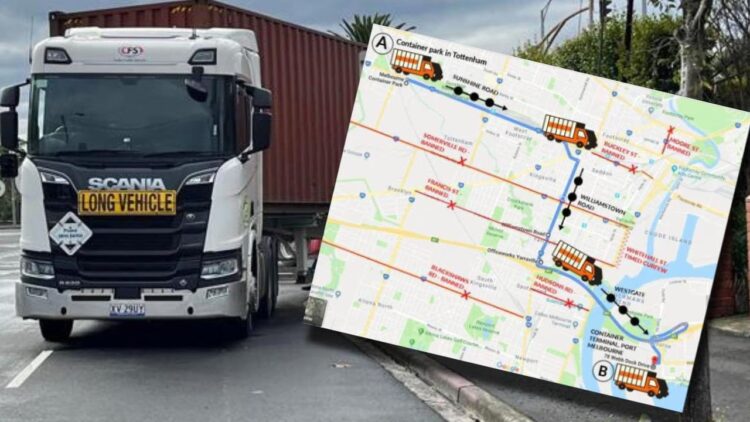
Dive into New Melbourne Truck Bans to Williamstown Road Curfew

The Melbourne truck bans represent a major shift in inner-west freight management, enabled by the West Gate Tunnel’s opening. The new rules have sparked a debate on balancing community needs with economic efficiency.

The Victorian Government will enforce a night-time and weekend “No-Truck Zone” on Williamstown Road. It recently confirmed the policy will take effect once the West Gate Tunnel opens in December 2025.

Moreover, the decision is part of a broader strategy that includes truck bans on several other residential streets.

Some residents and community advocates praise the move for improving liveability. However, container transport groups criticize it, arguing it highlights a lack of freight planning and could increase congestion and costs on other routes.

New Melbourne Truck Bans Led the New Williamstown Road Curfew

The new regulations designate a section of Williamstown Road as a ‘No-Truck Zone’ during specific hours. The restricted area runs between Geelong Street in Seddon and the West Gate Freeway in Yarraville.

The curfew is in effect during the following times:

  • Weekdays: From 8:00 pm to 6:00 am
  • Weekends: From 8:00 pm Friday to 6:00 am Monday

It is important to note that exemptions will apply for essential deliveries, such as groceries and parcels, to ensure services to residents and businesses continue uninterrupted.

Melbourne Truck Bans, Williamstown Road Curfew
Williamstown Road truck curfew starts next month, banning most trucks on weeknights and weekends. | Image Source: Save Willy Rd

Compliance will not be left to chance; the government will monitor heavy vehicles using smart roadside cameras. These automated systems detect vehicle types and exemptions, fining violators automatically.

New Melbourne Truck Bans Aims to Improve Safety and Liveability

The Victorian government positions these truck bans as a key benefit of the West Gate Tunnel project.

This initiative aims to improve safety and liveability in Melbourne’s inner western suburbs. Its core strategy is to reduce truck traffic on local residential streets.

Roads and Road Safety Minister, Melissa Horne stated, “We are removing a significant number of trucks from local roads across western Melbourne, a key step in improving community safety and liveability.“

Melbourne Truck Bans, Williamstown Road Curfew
Melissa Horne previews tunnel’s “major freight impacts” in address to industry. | Image Source: VTA

According to the government, the West Gate Tunnel offers a more direct route for heavy vehicles accessing the Port of Melbourne. They state this new pathway renders local streets like Williamstown Road obsolete for through traffic.

This move designates Williamstown Road as a No-Truck Zone. It now joins other residential streets like Francis Street and Somerville Road with this same status.

Industry Split: A Win for Residents or a Loss for Logistics?

The announcement has revealed a clear split within the transport industry. It showcases two very different perspectives on the impact of these new rules.

1. A Welcome Change for Community Amenity

The Victorian Transport Association (VTA) has endorsed the curfews. VTA CEO, Peter Anderson described them as a “win-win for residents and freight operators alike”.

Moreover, Anderson argues that the West Gate Tunnel provides a seamless alternative for port access. He states this allows for reduced truck traffic on residential streets while maintaining the capacity to keep Victoria’s economy moving.

Melbourne Truck Bans, Williamstown Road Curfew
VTA CEO Peter Anderson endorses Melbourne truck bans, calling the West Gate Tunnel a “win-win” for residents and freight efficiency. | Image Source: Prime Creative Media

The VTA views the tunnel as vital infrastructure for meeting the future freight task, which is expected to double by 2050. The association also sees the curfews as a way to strike a balance between community amenity and economic prosperity.

2. A Squeeze on an Essential Industry

In stark contrast, the Container Transport Alliance Australia (CTAA) has expressed strong disappointment. CTAA Director Neil Chambers said container transport operators feel “very let down, victimised and demonised even”.

The alliance supported past east-west bans on the condition that north-south routes like Williamstown Road would remain open. They were also promised these routes would be upgraded for increased freight from Brooklyn, Tottenham, and Sunshine.

Chambers contends that the government has failed to act on recommendations from a 2021 corridor study. That study called for upgrades to Millers Road and Williamstown Road to cater for projected 2031 traffic volumes.

What are The Ripple Effects of New Melbourne Truck Bans?

The CTAA warns that the new bans will have significant negative consequences that could extend beyond the transport industry.

The new night and weekend truck bans on Williamstown Road are expected to push heavy vehicles onto the Millers Road corridor.

Moreover, the CTAA describes this corridor as having “dilapidated road infrastructure and traffic-light sequencing” that will not cope with the increased volume.

Melbourne Truck Bans, Williamstown Road Curfew
Williamstown Road curfew will push thousands of trucks onto other strained corridors, operators warn, raising costs and congestion. | Image Source: Doublelee/stock.adobe.com

Furthermore, these restrictions compound the financial pressure from new heavy vehicle tolls on the West Gate Freeway. The CTAA has modelled that these tolls could increase container freight costs by 13% to over 30%, depending on the task.

The additional delays and inefficiencies from the Williamstown Road curfew are expected to add to these transport costs.

The industry group cautions that these increased logistics costs risk filtering through to higher prices for food and household goods. This would contribute to the broader cost-of-living pressures facing Victorians.

Here’s How Manage Vehicle Can Help Transport Operators Amid Williamstown Road Curfew

For transport operators and truck drivers, adapting to the new Melbourne truck bans requires more than just rerouting; it demands robust compliance management.

The implementation of automated camera enforcement means that accidentally entering a No-Truck Zone can result in swift fines. This is where a comprehensive fleet compliance management system becomes indispensable.

Manage Vehicle can be a critical tool for navigating these regulatory changes. Its features allow operators to proactively manage their fleet’s compliance with the new rules.

The geofencing capability can be configured to create virtual boundaries around the Williamstown Road No-Truck Zone. This system will then automatically alert drivers when they approach the restricted area during curfew hours.

This real-time fleet compliance system helps prevent costly violations and ensures drivers adhere to the mandated routes. Furthermore, the platform’s route planning and optimization tools can integrate the new bans directly into logistics planning.

Dispatchers can generate routes that automatically avoid Williamstown Road during restricted hours, balancing compliance with operational efficiency.

Manage Vehicle centralizes compliance data and vehicle tracking. This gives operators the clarity and control needed to adapt to changes, minimize disruptions, and protect their bottom line.

See how Manage Vehicle can ensure your fleet’s compliance. Book a demo today.
Rampant Illegal Practices Crippling Australia’s Transport Industry

Rampant illegal practices are systematically undermining Australia’s road transport industry. This creates an unfair playing field that rewards lawbreakers and punishes compliant operators.

The shadow economy of sham contracting has reached a crisis point. Industry leaders are urgently calling for government intervention to stop the collapse of legitimate businesses.

In a stark warning to federal government representatives, National Road Transport Association (NatRoad) CEO, Warren Clark stated,

“The normalization of sham contracting is now evident, with transport companies brazenly advertising for “employee drivers with ABNs” on mainstream job platforms, signaling a blatant disregard for the law.”

This brazen approach demonstrates that enforcement has become “essentially non-existent.” Illegal operators now manipulate systems with impunity, compromising both industry viability and road safety for all Australians.

Sham Contracting is Illegally Crippling Legitimate Operators

Sham contracting occurs when businesses misrepresent employees as independent contractors, illegally stripping workers of basic protections while evading employer obligations.

Under Australia’s Fair Work Act, it is illegal to misrepresent an employee as an independent contractor. This applies if the business has no reasonable belief for the claim or knowingly makes false statements to misclassify the employee.

Rampant Illegal Practices, Sham Contracting Undermining Australian Road Freight Industry
Sham contracting creates an unfair 30% cost advantage for lawbreakers, forcing ethical trucking companies out of business. | Image Source: Linkedin, Humanised Group

In these arrangements, workers are required to obtain ABNs and perform work identical to employees. However, they do so without any of the legal protections and entitlements.

This systematic manipulation creates an artificial cost advantage of 20-30% for non-compliant operators over legitimate businesses. Shady operators use sham contracting to dodge taxes, super, insurance, and award wages.

Gary Mahon, CEO of the Queensland Trucking Association, recently warned that,

“Perpetual rise of ABN-based employment” not only erodes workers’ rights but “destabilises the entire supply chain, creating a two-tier system that favours cost-cutting over safety and fairness”.

Evolving Illegal Schemes: How Operators Disguise Employment

Illegal operators have developed increasingly sophisticated structures to disguise employment relationships. This makes detection even more difficult for already stretched regulators.

Labour hire facades represent a concerning evolution in this space. These “agencies” fraudulently classify 100 plus workers as contractors, despite them operating like employees.

Urgent Call to Address Rampant Illegal Practices
From labour hire facades to ABN sharing rings, discover the sophisticated methods used to illegally misclassify employees and undercut honest competition. | Image Source: Australian Trucking Alliance

This model systematically misrepresents employment relationships on an industrial scale. Similarly, ABN sharing rings have emerged where individual drivers set up as sole traders.

These structures allow participants to employ themselves or share an ABN with others. This lets them avoid GST registration, skip tax returns, and evade superannuation obligations.

As one CEO starkly observed, “These schemes are designed for fleeting operation, enabling perpetrators to make a quick profit while evading all employer responsibilities, including taxes, superannuation, and workers’ compensation.”

So, these schemes exploit regulatory gaps and verification weaknesses that authorities have failed to address.

Why Tolerating Illegal Practices Harms Everyone?

1. Competitive Distortion

The rampant illegal practices fundamentally distort market competition, creating what Mahon describes as a “two-tier system that favours cost-cutting over safety and fairness”.

Legitimate operators cannot compete against businesses operating with 20-30% lower cost bases achieved through illegal schemes.

Urgent Call to End Illegal Road Transport Practices
By tolerating sham contracting, Australia is creating a two-tier industry where law-breakers prosper and compliant operators are unfairly driven out of business.

As Clark notes, this creates a perverse reality where “breaking the law is more profitable than following it,” forcing ethical businesses to either compromise their standards or lose contracts to unscrupulous competitors.

2. Safety and Exploitation Risks

The cost-cutting pressure inevitably forces drivers into dangerous situations.

“This race to the bottom forces drivers into exploitative contracts and pressures legitimate businesses to slash prices, often leaving non-compliance as their only path to profitability,” Clark explained.

This erosion of safety standards comes as Australia faces a significant driver shortage. At the same time, road incidents have increased over the past two years, creating a perfect storm of risk for all road users.

3. Economic and Revenue Impacts

The widespread non-compliance represents billions in stolen public revenue through evaded taxes, superannuation, and other obligations.

Gary Mahon of QTA stated, “The erosion of the statutory framework would undermine industry stability, lead to revenue losses, and hamper the capacity to fund essential public services”.

With the road transport industry employing 640,000 Australians and contributing 8.6% to GDP, its destabilization threatens broader economic consequences.

The Gaps in Our Road Transportation Safety Laws

Despite the known issues, multiple enforcement failures have enabled these illegal practices to flourish.

According to NatRoad, critical systemic gaps are undermining enforcement. Audits are rare, penalties are weak, and agencies are under-resourced.

Making matters worse, legitimate transport businesses often face more scrutiny than the fraudulent operators they are competing against.

Rampant Illegal Practices Due to Weak Enforcement and Minimal Penalties
Weak enforcement and minimal penalties have created massive gaps in road transport safety laws, allowing sham contracting and unsafe practices to flourish unchecked. | Image Source: Fueltek

Clark draws a powerful analogy, “This is the equivalent of establishing a strict anti-doping rulebook for the Olympics but conducting no actual testing.

The moment a few athletes realize there are no consequences, the integrity of the entire competition collapses as cheating becomes the norm.”

Industry leaders have called the reliance on TPAR to capture ABN labour abuses a “misguided hope.” They are now urging the ATO to adopt more effective solutions.

Meanwhile, the Closing the Loopholes Amendments contain critical weaknesses that require urgent addressing.

A key flaw is a “barn door size” loophole in the reasonable belief defence within the Fair Work Act 2009, which undermines enforcement capabilities.

How to Ensure Compliance and Protect Your Business from Rampant Illegal Practices?

1. Government Intervention

Government Intervention to Address Rampant Illegal Practices
NatRoad demands five key government actions, from director liability to major audits, to crack down on illegal operators and protect compliant businesses. | Image Source: ABC News

NatRoad has presented federal government with a clear five-point demand plan:

  • Launch targeted, large-scale audits specifically against known high-risk and non-compliant operators.
  • Hold company directors personally liable with significant penalties for those who knowingly facilitate or ignore sham contracting.
  • Bar persistently non-compliant companies from bidding on all government transport contracts.
  • Establish a mandatory and timely investigative process for all whistleblower reports.
  • Re-mandate and properly fund the Shadow Economy Taskforce to make the road transport industry its primary enforcement priority.

“The government’s failure to address this systemic crisis continues to disadvantage compliant businesses, exploit vulnerable workers, and cost the public treasury billions in lost revenue to deliberate fraud,” Clark warned.

2. Industry Protection Measures

Legitimate fleets can take proactive steps to protect themselves while awaiting stronger government action.

Mahon advises that “To combat sham contracting, fleets must proactively vet their subcontractors and demand transparent proof of how workers are legally engaged.”

Businesses should also recognize the illegality of supplying trucks and equipment while using contractors for labour only, a clear indicator of sham arrangements.

How to Strengthen Your Operational Defenses?

While regulatory action is crucial, legitimate operators can immediately strengthen their compliance position through a modern fleet compliance software, Manage Vehicle.

Manage Vehicle provide the digital infrastructure needed to maintain rigorous standards and demonstrate compliance during audits.

Rampant Illegal Practices Crippling Australia's Road Transport Industry
In an unfair market, strengthening your defenses is key. Discover how digital tools for compliance and documentation can shield your business from risk. | Image Source: Uffizio

MV offers a logbook similar to an electronic work diary (EWD) to monitor driver licenses, and work permits for roadside vehicle inspection. The system sends proactive alerts before deadlines are missed, eliminating manual monitoring gaps.

Manage Vehicle also provides a centralized compliance dashboard that give real-time visibility into fleet-wide compliance status. Also, MV automatically records truck drivers’ work and rest hours in compliance with regulatory requirements.

The crisis of rampant illegal practices in Australia’s road transport industry demands immediate and decisive action from both government and ethical operators.

As Clark starkly summarizes, “The message right now is clear: breaking the law is more profitable than following it. That has to change.”

With legitimate businesses failing, workers being exploited, and road safety being compromised, continued inaction is simply not an option. The time for empty rhetoric has passed.

Only comprehensive audits, meaningful penalties, director accountability, and modern compliance systems like Manage Vehicle can restore integrity to this vital industry.

To learn how modern fleet compliance software can help protect your legitimate transport business through automated monitoring, document tracking, and audit-ready reporting, contact our compliance specialists today for a demonstration.

Aussie Truck Driver Quiz: 10 Riddles to Test Your Road Knowledge

The life of a truck driver is a demanding journey, testing patience and skill while navigating from city grids to the isolated outback.

A truck driver must master everything from dense city traffic to the long, lonely outback highways. It is a job that is never simple.

It pays to keep the rule book fresh in your mind. Let’s dive into 10 random questions that every professional truck driver in Australia should be able to answer confidently.

1. A Fire Truck Approaches Behind You with its Flashing Lights and Siren On. What Should You Do?

When you see those flashing lights and hear that siren in your mirrors, your primary duty is to get out of the way safely and predictably. Panic is your worst enemy.

The key is to signal your intentions clearly and move to the left as much as you can to create a clear path for the emergency vehicle.

First, check your mirrors and assess your surroundings. If you’re on a multi-lane road, indicate left and move into the left-most lane, or even onto the road shoulder if it’s safe and wide enough for your rig.

Driving Tips, Fleet Safety, Compliance
Panic is the real danger. The key is to be predictable: signal your intentions and move left where safe. Never break the law to get out of the way! | Image Source: Dreamstime

If you’re on a single-lane road, slow down and pull over to the left as far as possible, even coming to a complete stop if necessary.

Never break the law to get out of the way, like running a red light, but do everything within the legal road rules to facilitate their passage.

Remember, every second counts for that emergency vehicle. Your calm and decisive action ensures they can get to where they’re needed without delay, potentially saving lives and property.

2. If it’s Getting Dark or it Starts Raining, Which Lights Should You Use?

The golden rule for using lights in deteriorating conditions is simple: see and be seen. As soon as visibility drops, whether from fading light, rain, or even smoke, you must switch on your headlights.

In these situations, you should not be using your parking lights alone, as they are insufficient for both your vision and for making your large vehicle visible to others. For rain, fog, or dust, you must dip your headlights to low-beam.

Fleet Management, Driver Safety, Aussie Truckie Quiz
Don’t be the driver creating a dangerous glare. In rain, fog, or at dusk, your low-beam headlights are your best tool for maximum visibility without blinding others. | Image Source: Adobe Stock

Using high-beam in these conditions is not only illegal but dangerously counterproductive.

The bright light reflects off water droplets or particles. This creates a blinding glare that drastically reduces your own vision and dazzles oncoming truck drivers.

Using your low-beam lights with your tail lights makes your truck highly visible from all angles. This combination provides the best overall illumination and significantly reduces collision risk.

3. Do You Have to Give Way to Pedestrians Crossing the Road You’re Turning Into?

Yes, absolutely. This is a fundamental and non-negotiable rule across Australia.

Whenever you are turning left or right at an intersection, and pedestrians are crossing the road you are entering, you must give way to them. This applies even if there are no marked pedestrian crossings.

Road Safety, Driver Responsibility, Road Rules
It’s not just a courtesy; it’s the law. Failure to give way at intersections carries heavy penalties for a reason. Ensure you’re always in the right. | Image Source: YouTube Channel, Conquer Driving

As a professional truckie, you have a greater responsibility due to the size and potential for harm your vehicle carries. Always approach intersections with extra caution, scanning the footpaths and road edges for pedestrians about to cross.

A moment of patience ensures everyone’s safety. Remember, the person on foot always has the right of way in this scenario, and failing to give way can result in severe penalties and, tragically, even worse outcomes.

4. The Weather is Foggy and There is a Car 100 meters in front of you. Which Lights can You Use?

In dense fog, your goal is to maximise your vehicle’s visibility without impairing your own or others’ vision. The correct lights to use are your low-beam headlights and your fog lights, if your truck is equipped with them.

Your low-beams are angled to light up the road directly in front of you without causing excessive glare in the fog.

Road Safety, Driving Tips, Fleet Safety
Fog creates a blinding wall of light if you use the wrong setting. The correct choice? Your low-beam headlights are essential for seeing the road, not just the fog. | Image Source: Les Schwab

Crucially, you must avoid using your high-beam headlights. High-beams illuminate the fog itself, creating a solid, blinding wall of white light. This wall reflects back at you, making it impossible to see the car 100 metres ahead.

Your fog lights are specifically designed with a wide, low-cut beam to light up the road edges and improve side visibility without causing glare.

And don’t forget your tail lights, they are essential for allowing the vehicle behind you to see you from a safe distance.

5. The Vehicle Ahead is Travelling at 85 Kilometer Per Hour Speed. Can You Legally Overtake This Vehicle?

This question hinges on one critical piece of information: what’s the signed speed limit?

You can legally attempt to overtake if the speed limit is 100 or 110 km/h. However, you must also ensure it is safe and that there is a clear, designated overtaking lane. You must complete the manoeuvre without exceeding the posted speed limit.

Road Rules, Overtaking, Driver Safety
Don’t just check your speedometer, check the signs. The legality of your overtake hinges on the speed limit and heavy vehicle regulations. Know the rule before you make the move. | Image Source: YouTube Channel, mylicensesa

However, you must also consider the specific road rules for heavy vehicles, which may have lower speed limits than cars on certain roads. Furthermore, the practicality of overtaking is vital.

Overtaking in a heavily laden truck at a closing speed of only 15km/h will take a long time. As a result, you will need a significant stretch of clear road.

Always assess the situation thoroughly, is it worth the risk and fuel for a minimal gain in speed? Often, it’s safer and more efficient to maintain a safe following distance.

6. Who is Allowed to Use a T3 Lane Without Restriction?

A T3 lane (Transit Lane) is reserved for vehicles carrying a minimum of three occupants including buses, motorcycles, and bicycles. The purpose of these lanes is to encourage carpooling and ease traffic congestion.

The only vehicles that can always use a T3 lane without restriction are buses, motorcycles, bicycles, and taxis. However, taxi rules can vary slightly by state, even though they are generally permitted.

T3 Lane Driving Test, Fleet Safety, Road Rules
Not everyone can use that lane! T3 lanes have strict rules. As a truck driver, you can only enter if you meet the passenger requirement, unlike buses, motorcycles, and bikes. | Image Source: News.com.au

As a truck driver, you are only allowed to enter and use a T3 lane if you and your vehicle meet the minimum occupancy requirement of three people. Driving in a T3 lane as a single-occupant truck is a traffic offence and can result in a fine.

7. Both You and Another Vehicle Want to Turn right, But the Road You are On is Ending. Who Gives Way?

The road rules clearly define this common right-of-way scenario. At a T-intersection where two oncoming vehicles are both turning right, neither truck driver has priority. This is the straightforward rule for this specific situation.

In this situation, both vehicles must turn right, passing in front of each other. The correct and safest procedure is for both drivers to turn behind the other vehicle.

Driving Tips, Roads Safety, Truck Driver Life
Who goes first? This classic intersection scenario tests your knowledge of right-of-way procedures. The correct, safest path is for both drivers to turn behind each other. | Image Source: Shutterstock

This means you should steer to the right and pass behind the oncoming vehicle as you complete your turn. It is crucial to make eye contact (if possible), signal clearly, and proceed with caution, ensuring you do not cut in front of the other driver’s path.

8. You are Pulled Over by Police. Can You Legally Refuse a Roadside Breath Test?

The law mandates that drivers must submit to a roadside breath test upon request. Under Australian law, driving is a privilege that comes with responsibilities, and one of those is agreeing to breath testing when lawfully requested by a police officer.

A roadside breath test is a standard procedure used to enforce drink-driving laws and keep the roads safe.

Truck Driver Responsibility, Fleet Safety, Road Rules
No refusal, no excuses. Compliance is mandatory. A roadside test is a standard procedure, and refusing it will cost you your licence. | Image Source: Australia Breathalysers

Refusing to undergo a breath test when directed by a police officer is a serious offence. The penalties for refusal are typically just as severe, if not more severe, than those for driving over the legal alcohol limit.

You will likely face heavy fines, immediate licence disqualification, and potentially a criminal record. Compliance is not just a legal requirement but a professional obligation for every truck driver, especially those operating heavy vehicles.

9. How Does Using a Phone While Driving Cause Inattentional Blindness?

This statement is completely true. Inattentional blindness is a specific psychological phenomenon: you fail to see something in plain sight because your attention is focused elsewhere.

Your brain becomes primarily engaged in the conversation or task when you use a mobile phone while driving, even for a few seconds. This means it is not focused on the complex and dynamic environment of the road.

Truck Driver, Distracted Driving, Fleet Safety
Your phone makes you blind to danger. Inattentional blindness is the real reason a simple text can lead to a major accident. For your safety and everyone else’s, keep your full attention on the road. | Image Source: Shutterstock

For a truck driver, the consequences are magnified. Your vehicle requires a much longer stopping distance and has significant blind spots.

When you look at a phone, you take your eyes and mind off the road. This means you might completely miss a car changing lanes, a pedestrian stepping out, or traffic signals changing.

This Cognitive Distraction is why hands-free is not risk-free, and why physically handling a phone is so explicitly and heavily outlawed.

10. Is it Legal to Drive Through a Red Light to Make Way for a Police Vehicle?

No, it is not legal. You must never break the law to make way for an emergency vehicle.

While the law requires you to move out of their path as safely as possible, this does not extend to committing a traffic offence like running a red light or speeding.

Truck Driver, Fleet Safety, Driving Test
This is a common misconception. You must not drive through a red light for any emergency vehicle. They are trained to find a way around you; you are responsible for your own legal actions. | Image Source: CarsGuide

The correct action is to slow down, indicate, and move as far left as you can without proceeding through the red signal. If you are stopped at a red light and cannot move left any further, you must remain stationary.

Instructors train emergency vehicle drivers to anticipate these situations, and they will find a way around you. Their maneuvers may include mounting a kerb or using the wrong side of the road.

If you illegally enter an intersection to get out of their way, you risk causing a serious crash, and you will face liability for any offence you commit.

Manage Vehicle: Your Partner on the Road to Compliance and Safety

Tired of the stress that comes with road inspections and the constant battle against driver fatigue? Let Manage Vehicle be the co-driver you can always count on.

Our cloud-integrated app, Manage Vehicle is built for you, the Australian truckie. It seamlessly tracks your compliance logs, manages fatigue, and keeps your vehicle in check. This helps you avoid heavy penalties and stay safe on those long hauls.

Manage Vehicle, All-in-One Fleet Compliance Management Software Built for Australian Truck Drivers
Compliance, made simple. Safety, made certain. That’s the Manage Vehicle promise. Your essential partner on the road. | Image Source: Cartrack

Stop worrying and start driving with confidence. Sign up for our 30-Day Free Trial on Manage Vehicle app and experience the peace of mind that comes with having a true partner in your journey.

Telematics for Real Time Data Insights: Taming the Australian Road

Remember when running a fleet was about logbooks, gut feelings, and a prayer that everyone made it back safe? Those days are vanishing in the rearview mirror, replaced by telematics for real-time data insights.

Recently, the National Heavy Vehicle Regulator (NHVR) has been aggressively promoting its next-generation telematics and Intelligent Access Program (IAP), encouraging more operators to adopt certified systems for improved safety and mass management compliance.

This NHVR push actively shapes the future of Australian transport, connecting fleets, powering decisions with data, and making operations transparent.

Beyond the Black Box: Here’s How Telematics is Saving Lives

For too long, telematics was seen as just a “spy in the cab.” But for the modern transport business, it’s the most powerful safety tool ever invented. It’s not about monitoring your drivers, it’s about protecting them.

Real-time data analytics transforms raw information into actionable insights that prevent accidents before they happen.

Benefits of Telematics, Useful for Fleet Management
Telematics in fleet management plays an essential role in driver safety, and vehicle efficiency.

Imagine getting an instant alert when a driver exhibits harsh braking patterns on a notoriously dangerous stretch of the Pacific Highway. This isn’t just a notification; it’s an opportunity.

An opportunity to call that driver, check in on fatigue, discuss road conditions, and reinforce safe practices.

This proactive approach fosters a culture of safety, reduces insurance premiums, and, most importantly, ensures your team gets home to their families every night. It turns reactive hindsight into life-saving foresight.

The Profitability Puzzle: Turning Telematics Data into Profits

In an industry where margins are tighter than a drum, wasted fuel and inefficient routes are a direct hit to your bottom line.

Real-time data analytics is the key to unlocking hidden profits across your entire operation. It provides a crystal clear view of where every single dollar is being spent or wasted.

Think about idling time. An engine idling for just an hour a day can burn over $4,000 in fuel annually, per truck!

Telematics for Smarter Trucks, Safer Trailers
Australian truckies and operators must know that using telematics is for smooth road operations with cloud-integrated devices connected to the fleet for real-time data insights.

Telematics identifies this waste instantly. Furthermore, advanced analytics can optimise routes in real-time, accounting for traffic, weather, and road closures, slashing drive times and fuel consumption.

It empowers you to move from scheduled maintenance, which can lead to unnecessary downtime to predictive maintenance. Get alerts on vehicle health issues before they become a catastrophic, roadside breakdown, saving you thousands in emergency repairs and lost revenue.

Your All-in-One Command Centre: Compliance, Management, and Peace of Mind

Juggling logbooks, maintenance schedules, NHVR regulations, and driver credentials is a massive administrative burden. One paperwork error can lead to hefty fines and compliance breaches.

You need a system that does the heavy lifting for you, integrating every aspect of your operation into one seamless, cloud-based platform. This is where Manage Vehicle enters the picture. We’re more than just a telematics provider, we are your partners in performance.

Why Choose Manage Vehicle as Your Fleet Partner?

Run your entire business from a single dashboard with our all-in-one, secure cloud platform for fleet and compliance management.

Manage Vehicle automatically captures electronic work diaries (EWDs) to ensure strict NHVL compliance. It also streamlines vehicle registrations, insurance, and service histories to eliminate paperwork chaos.

Telematics for your Transport and Logistics Business
Sign up for a demo session with Manage Vehicle and get a fantastic deal for your fleet business.

Access your secure cloud-based fleet data from anywhere, your Sydney office or Broome roadside, and take complete control with unparalleled peace of mind. It’s the command centre your fleet has been waiting for.

Ready to stop driving blind and start leading the pack? Don’t let your competitors leverage data first. Schedule a free, no-obligation demo of Manage Vehicle today and discover how we can help you boost safety, maximise profitability, and simplify compliance for your Australian transport business.

The Future of Australia’s Transport Industry is Green!

Australia’s transport and logistics sector is at a crossroads!

As the nation strives toward net zero emissions by 2050, the trucking industry, responsible for nearly 18% of Australia’s greenhouse gas emissions, must embrace innovative solutions to reduce its environmental footprint.

From electrifying fleets to leveraging AI-driven logistics, sustainability is no longer a choice but a necessity.

Let’s explore how green fleet initiatives are transforming Australia’s transport industry and offers practical insights for operators ready to join the revolution.

1. The Urgency of Sustainable Transport Sector in Australia

Australia’s transport sector is on track to become the nation’s largest source of emissions by 2030. With freight demand projected to triple by 2050, the industry faces immense pressure to decarbonize without compromising efficiency.

The Australian government’s transport and infrastructure, Net Zero Consultation Roadmap outlines a clear mandate is to reduce emissions through transformative investments in green technology, renewable energy, and proactive policy changes.

For transport operators, this shift isn’t just about regulatory compliance, it’s a competitive advantage.

Sustainable Transport Sector in Australia
Australia’s transport industry is moving into a sustainable future with Net Zero Consultation Roadmap.

60% of Australian consumers prefer carbon-neutral delivery options, and businesses that adopt sustainable practices often see improved brand reputation and long-term cost savings.

From reducing fuel consumption to minimizing waste, sustainability aligns operational efficiency with environmental responsibility.

2. Key Green Fleet Initiatives Transforming Australia’s Transport Industry

  • Electric Vehicles (EVs) and Alternative Fuels

Electric vehicles are at the forefront of Australia’s green fleet transition. By 2030, 30% of last-mile delivery vehicles are expected to be electric, significantly reducing transport-related emissions.

EVs, along with hydrogen-powered trucks and renewable diesel alternatives, offer a viable path to decarbonizing heavy vehicles, a segment historically deemed “hard-to-abate”.

  • AI and Route Optimisation

Artificial Intelligence is revolutionizing logistics planning. AI-powered algorithms analyze real-time data, traffic patterns, weather conditions, and vehicle performance, to optimize routes, reduce idle time, and minimize fuel consumption.

This not only cuts emissions but also lowers operational costs. For example, Manage Vehicle’s transport management system uses GPS tracking and route optimization to reduce fuel use and emissions while ensuring timely deliveries.

  • Circular Economy and Waste Reduction

Sustainable logistics extends beyond vehicles to include packaging and waste management. Companies are adopting circular supply chain models, using biodegradable materials and refurbishing returned goods to minimize landfill waste.

Veolia’s waste management initiatives, for instance, help logistics firms implement recycling programs and reduce environmental impact across their operations.

3. The Role of Policy and Collaboration in Australia’s Transport Industry

Government policies and industry collaboration are critical to accelerating the green transition. The federal government’s New Vehicle Efficiency Standard aims to incentivize EV adoption.

Meanwhile, state level initiatives like, Queensland’s reduced public transport fares, encourage a shift toward sustainable mobility.

Australia's Transport Industry Goes Green
The role of policy and collaboration is important to build a sustainable and green fleet initiatives for Australia’s transport industry.

For SMEs, balancing business objectives with sustainability remains challenging. Holistic planning and systemic approaches, such as land use policies and modal shift strategies, are essential to ensure equitable access to green technologies.

Governments must also prioritize investments in charging infrastructure, especially for heavy vehicles, to address range anxiety and support nationwide adoption.

4. Leveraging Technology: The Manage Vehicle Fleet Solution

For Australian transport operators and truck owners, achieving sustainability requires more than just electric vehicles, it demands integrated, data-driven management tools.

This is where Manage Vehicle comes in. This cloud-based fleet and compliance SaaS app is specifically designed for Australia’s transport industry, offering a comprehensive suite of features to streamline operations and reduce environmental impact.

Here’s some key features of Manage Vehicle to look upto:

  • Digital Compliance and Record-Keeping:

Replace paper-based systems with digital workflows for fatigue management, driver training, and incident reporting. This reduces administrative overhead and ensures compliance with evolving regulations.

  • Telematics and Emissions Tracking:

Integrate GPS tracking and dashcams to monitor fuel consumption, idle time, and carbon emissions in real time. The platform also provides actionable insights to optimize routes and reduce fuel waste.

  • Preventive Maintenance Alerts:

Schedule servicing and repairs to keep vehicles running efficiently, extending their lifespan and minimizing resource waste.

Why Manage Vehicle Stands Out?

Unlike generic fleet management tools, Manage Vehicle is tailored to the unique needs of Australian operators. Its user-friendly interface and modular design allow businesses to start with essential features and scale as needed.

As one happy client, Kasun Tharaka, owner of A&Jay Rentals said that, “The GPS tracking system is incredibly accurate. I can see the exact location of all our vehicles in real-time, which has drastically improved our route optimisation and reduced fuel costs. Deliveries are now more timely, and customer satisfaction has increased.”

Driving Toward a Greener Future

The path to a sustainable transport industry requires collective action, from adopting EVs and AI-driven logistics to leveraging innovative software solutions like Manage Vehicle.

By embracing these changes, Australian operators can not only meet regulatory demands but also build resilient, future-ready businesses.

Manage Vehicle Solution for Sustainable Green Fleet Initiatives
Manage Vehicle solution can be beneficial tool for your fleet business with extraordinary features that stand out in a competitive market.

Ready to transform your fleet operations? Explore Manage Vehicle’s 30 days free trial and discover how easy it is to reduce costs, ensure compliance, and contribute to a greener Australia.

The Big Switch to Electric Trucks in Freight and Logistics Industry

The big switch in the freight and logistics industry is coming in 2026, and it’s accelerating faster than many expected. For transport operators and drivers, the future is not just on the horizon, it’s rolling into the depot today.
Right now, major logistics companies and forward-thinking operators are already trailing electric trucks on urban delivery routes and regional runs.

From the streets of Melbourne to the highways of Queensland, these zero-emission vehicles are proving their mettle, moving goods without a drop of diesel. This isn’t a distant dream; it’s a real-world testing phase that’s setting the stage for a nationwide transformation.

What’s Happening in Freight and Logistics Industry?

Australian freight and logistics industry is firmly in the pilot phase. Companies are deploying electric trucks for specific, suitable tasks like last-mile deliveries in metropolitan areas and fixed short-to-medium haul routes.

These electric trials are crucial. They’re helping manufacturers understand battery performance in our unique conditions and are giving fleets real data on running costs, maintenance, and charging cycles.

what is happening in freight and logistics industry?!
Australian freight and logistics industry is taking pace into transitioning the electric vehicles with the trial run.

You’re likely to start spotting these sleek, silent machines more frequently, they’re the vanguard of a cleaner, more efficient freight industry.

The Challenge: Roadblocks on the Australian Highway

Let’s be frank, this transition isn’t without its potholes. The two biggest hurdles are cost and infrastructure.

The upfront price of an electric truck is significant, and the national network of heavy vehicle charging stations is still in its infancy, creating serious “range anxiety” for interstate hauls.

Furthermore, Australia’s patchwork of state-based regulations presents a unique headache. The weight regulations change at each state border.

High Vehicle Cost and Infrastructure in Australian Trucking Industry
The real challenge for operators and drivers is high vehicle repairing cost and infrastructure in the process of EV transition.

Electric trucks, with their heavy battery packs, often weigh more than their diesel counterparts. This can lead to complex compliance issues, forcing operators to choose between carrying less cargo or facing potential penalties when crossing borders, a logistical nightmare that eats into profitability.

The Solution: Smarter Management for a Smarter Fleet

Navigating this new landscape requires more than just a new truck; it requires a new way of thinking. This is where Manage Vehicle comes in. We understand that your operation’s efficiency is paramount, especially when adopting new technology.

Our all-in-one, cloud-based fleet and compliance management software is designed specifically for Australian operators tackling these exact challenges. How does it help?

  • Manage Vehicle (MV) Simplifies Compliance:

Get real-time insights into vehicle mass and dimensions. Plan routes with confidence, knowing our system helps you stay across varying state-based rules, reducing the risk of costly compliance breaches at weigh stations and borders.

  • MV Enhance Safety and Efficiency:

Our platform integrates seamlessly with advanced dash cameras and 4-channel fatigue and distraction detection AI cameras. It alerts drivers with seat vibrators to combat drowsiness, making every journey, especially long, unfamiliar electric routes safer.

Easy Compliance, Driver Safety and Vehicle Efficiency in Real-Time Data
Manage Vehicle is the solution to your freight and logistics with easy compliance, safety and efficiency within real-time vehicle navigation.
  • MV Gives Total Real Time Control:

Whether you’re in the office or on the road, the MV Driver and MV Operator apps give you live tracking of your vehicle’s location, battery status (integrated with telematics), and driver performance. Optimise routes, manage charging schedules, and maximise uptime.

Manage Vehicle turns the complexity of the electric fleet transition into a manageable, streamlined process, putting you firmly in control.

Manage Vehicle Software for Your Transport and Logistics Business
Manage Vehicle ensures you in this EV transition for smoother compliance, and real-time insights for your fleet.

The road to 2026 is being paved right now. Don’t get left behind in the dust of the diesel era. Embrace the future of freight with the management tools built to support it.

Ready to future-proof your fleet? Sign up for a 30-day free trial of Manage Vehicle today and experience how effortless the switch to smarter, compliant, and safer fleet management can be. Let’s navigate the electric future, together.

Benefits of Fleet Management Software for Admin Work

Fleet management software benefits go far beyond convenience — they can transform how a business runs. Managing a successful fleet can be both rewarding and challenging, especially when bogged down by time-consuming administrative tasks. Many operations still rely on paper-based processes, grappling with data accessibility and accuracy issues.

fleet management software benefits

Top 5 Ways Fleet Management Software Saves Admin Time

Remove Human Error:

Fleet management software is like a superhero against mistakes. It turns complicated tasks into simple digital processes, making sure we get the right info without any mix-ups. This means no more headaches from decisions based on wrong info, and no more wasting hours fixing mistakes. The software is like a super-smart assistant, making sure everything is accurate and saving us a ton of time that we’d otherwise spend correcting blunders. It’s not just a tool; it’s our guardian against errors.

Easy Access, No More Search Stress:

Say goodbye to the information treasure hunt! Fleet management software is like a magic organizer. It puts all the data in one easy-to-reach spot, so you don’t have to go on a wild search across different files and folders. Imagine it as a super-efficient assistant that hands you exactly what you need when you need it. This not only saves you from the frustration of hunting down info but also supercharges your productivity. No more time wasted on searching; it’s all right there at your fingertips, making your work smoother and faster.

Remove Multi-platform Stress:

Ever felt like a juggling act with multiple logins and platforms? Fleet management software steps in as the ultimate simplifier. It brings all the processes together in one neat application, playing nice with other business software. No more hopping around different platforms like a digital acrobat—just one login, one place, saving you precious time that would be better spent elsewhere.

Imagine it as your digital unifier, ensuring all your fleet management tasks are under one virtual roof. This not only takes away the stress of managing multiple logins but also turbocharges your efficiency. It’s like having a personal assistant streamline your digital workspace, making your workday a smoother ride without the unnecessary platform-hopping hassle.

Simplify Analysis:

Imagine your data being a storyteller, sharing insights without you having to wish for it. That’s the magic of fleet management software. It takes all those complicated numbers and transforms them into simple, easy-to-understand insights. Think of it as a data wizard that empowers managers with clear information.

No more drowning in complex data analysis—this software does the heavy lifting. It’s like a superhero sidekick, providing managers with instant, digestible information. With this digital ally, decision-making becomes a breeze. Quick, informed choices are just a glance away, without the need for diving deep into intricate data puzzles. It’s not just about simplifying analysis; it’s about making your data work for you.

Document Management:

Tired of the document scavenger hunt? Fleet management software steps in as your virtual file organizer. It creates a central hub for all your manuals, legal papers, and policies, saving you from the time-consuming game of tracking down and sharing documents.

Think of it as your digital document wizard—keeping everything you need in one accessible spot. No more digging through endless folders; it’s all neatly organized for quick access. This not only simplifies your document management but also frees up valuable time for more meaningful tasks. It’s like having a personal assistant for your paperwork, making your work life a tad more organized and a lot more efficient.

The Importance of Onboarding and Training:

Choosing the right fleet management system requires careful consideration of current and future digitization needs. Opt for a provider with a proven track record and a professional services team for onboarding support.

The Bottom Line:

Embrace the digital revolution with the latest fleet management software to unlock time savings and enable your business to reach its full potential. Explore the tools available and envision a digital future for your fleet management.

The Top Fleet Management Software in Australia

Fleet management software is an invaluable tool for many businesses in the freight and trucking industry, whether they run a small fleet of vehicles or manage a large, vast set of assets.

Vehicle management software is essential in ensuring these fleets’ efficient, safe, and cost-effective operation.

In this article, we examine the significance of fleet management reports and explore how they improve various aspects of fleet operations.

What does Fleet Management Software do?

Fleet management software breaks down critical data about your fleet’s performance. They pull information from telematics systems, GPS trackers, maintenance logs, and driver reports.

The software analyzes and presents this data in a clear, actionable format. Ultimately, this helps fleet managers make more educated and informed decisions, which improves overall performance.

Key Elements of Vehicle Management Software

  1. Vehicle Performance Metrics: A vehicle management software will obtain and provide detailed performance information on each vehicle. Its fuel efficiency, mileage, engine diagnostics, and maintenance history constitute such metrics.

    Monitoring these metrics will allow for fleet managers to plan their preventive maintenance schedule and fuel optimisation, saving operational costs.
  2. Driver Behavior Analysis: Many fleet software management include driver behaviour analysis, tracking speeding, harsh braking, and idling time.

    This data helps fleet managers identify avenues where driver training may be needed to improve safety as per NHVR standards. It also helps when addressing potential liability issues.
  3. Route Optimization: Advanced vehicle management software can provide suggestions into route efficiency.

    By analysing routes taken, idling time and traffic conditions, the organisation can then use the best possible route and thus consume less fuel in delivering products. The result- improved customer satisfaction because of on-time services.
  4. Compliance Checking: Fleet management software guarantee that companies in the regulated industry comply with regulatory standards.

    Such examples may include hours-of-service compliance for drivers, inspection of vehicles, etc. Furthermore, compliance deters violations and enhances overall safety.
  5. Inventory Management: Some systems connect fleet reports with inventory tracking. This confirms that goods are moved efficiently, avoiding stockouts, and preventing overstocking.

Benefits of Fleet Management Software

  1. Cost Reduction: Fleet management software help identify cost optimizations like better routing, smaller fuel usage, or reduced maintenance costs in businesses. Such savings can have significant impacts on the bottom line.
  2. Better Safety: Vehicle management software create a safer driving environment by monitoring driver behaviour and setting ground for corrective actions when needed. This reduces the risk of accidents.
  3. Improved Customer Service: Efficient route planning and on-time deliveries improve customer satisfaction and loyalty. With real-time tracking capabilities, companies can also provide customers with accurate delivery estimates.
  4. Data-Driven Decision Making: Fleet management software provide valuable data that can inform strategic decisions, such as whether to expand the vehicle, replace aging vehicles, or invest in new technology. Fleets can base these decisions on empirical data rather than guesswork.

Efficient vehicle management software is critical to staying competitive. Fleet reporting software empowers businesses with concrete performance, safety, cost savings, and compliance insights.

Companies that embrace this technology gain an edge in customer service, safety, and efficiency. As the tech evolves, fleet management software will only grow in importance—helping businesses shape a smarter, greener future.

How Does Fleet Visibility and Insight Work

Like managers, almost every business or responsible person strives to optimise fleet visibility. If you also want to manage your vehicle well, you must first understand everything about the car, its field of vision and its outcome insights.

So, before buying and trying out any vehicle management software that will give you complete fleet insights and help you achieve productivity, find out some answers to the questions below:

1. What is fleet visibility?
2. What is fleet insight?
3. How do vehicle transparency and vision work to gain productivity?

Apart from the above questions, in this article, you will also learn how to run your fleet management smoothly by increasing operational transparency and vehicle route optimisation. So, let’s start the visibility and insight journey.

What is Fleet Visibility and Insight?

Fleet visibility helps decision-makers understand and monitor vehicles from anywhere in real time.

It gives fleet managers an overview of the vehicle and helps them easily keep and retrieve every record regarding driver location, fuel usage, and maintenance records.

Why is maintaining vehicle visibility one of the essential tasks of fleet management? Because everyone wants a real-time update to make their decisions about expenses, downtime, and productivity more accurate.

They want to know precisely how their vehicle operates to make smarter fleet decisions. That is why no organisation or manager wants to get help from outdated systems like spreadsheets and paper.

Managers must use an innovative software solution to get accurate visibility and insight. Using the right platform, they can easily monitor all assets, such as health, expenditure, and maintenance.

It can also achieve fleet metrics and bridge the gap between field and office to monitor team productivity.

How does Fleet Visibility and Insight Work to Gain Productivity?

Fleet visibility will help you to get high ROI and run your truck smoothly. You will need the best fleet management software to give you complete insight and view of your caravan. Before understanding how it works, know its benefits.

Fleet Visibility Makes You a Good Decision-Maker

You can plan and optimise your vehicle’s routes by getting visibility from fleet management software. Also, real-time updates give you a clear view of who will be making deliveries, where, and when.

Visibility helps organisations and fleet managers eliminate challenges and make the right decisions.

For example, you are using fleet management software that will help you give a customer an accurate arrival time; they can have people and equipment ready for the delivery, reducing delays and saving you time and money.

Another benefit of visibility is that you can easily calculate and control the number of hours individual drivers are assigned.

Know What Actual Routes Your Vehicles Took

Knowing the route, you will get the deepest level of visibility, i.e., what happened once a driver left the DC, paired with vehicle tracking technology that uses GPS positioning to monitor exact movements.

So, not only are you able to locate the location of your trucks or fleet vehicles. However, you also get information about further delivery operations that help you flee your vehicle.

You can then add that information to your strategies so fleet visibility can continuously improve your routing.

Visibility empowers you to save many seconds, minutes, and even hours from your delivery schedule, which means fewer trucks, less fuel, and actual savings.

Fleet management software delivers the route insight promptly through the complex data. This visibility will help you to understand more accurate data than drivers’ feedback.

Therefore, you can smartly eliminate the slack that most planners need to build into their route plans to be safe.

Also Read: Current Scenario of International Driving Conversion in Australia

Increase Performance through Fleet Insight

Accurate fleet visibility will help you reduce wasted time and miles and improve your customer service. In such a situation, inaccurate information would not be a basis for any penalty in the transportation operation.

Visibility Helps Fleet Drivers Management

Going through the proper route plan will also improve your interaction with drivers. You can easily track the performance of the driver.

From each driver’s performance, you will find out which particular driver is booking overtime regularly and who is not.

More data will also show which driver is not responsible for the delay at the delivery location. And can either reschedule with the customer or, in a route plan in the future, manufacture in a reasonable amount.

The higher your visibility, the higher the productivity. You’ll get tricked less frequently for using expensive, third-party, spot-market services to meet driver or truck shortages – another saving.

The critical point is that if you are not analysing data about delivery activity, you cannot measure performance or improve it. In this case, you will need the best fleet management software.

Fleet Management Software with Fleet Visibility and Future Insights

Some other long-term benefits of optimising visibility through fleet management software include Improving the company’s daily workflow.

Fleet managers easily handle work orders, charting productivity, and automation. It will prevent and predict maintenance more efficiently, ensuring optimum vehicle conditions.

Don’t walk in competitive lines; you only have to get innovative fleet management software to monitor vehicle visibility and trim the fat by getting excellent visibility in every move.

Get your quote today, and call us. We will assist you with our fleet solution.