
Aussie Truck Driver Quiz: 10 Riddles to Test Your Road Knowledge

The life of a truck driver is a demanding journey, testing patience and skill while navigating from city grids to the isolated outback.

A truck driver must master everything from dense city traffic to the long, lonely outback highways. It is a job that is never simple.

It pays to keep the rule book fresh in your mind. Let’s dive into 10 random questions that every professional truck driver in Australia should be able to answer confidently.

1. A Fire Truck Approaches Behind You with its Flashing Lights and Siren On. What Should You Do?

When you see those flashing lights and hear that siren in your mirrors, your primary duty is to get out of the way safely and predictably. Panic is your worst enemy.

The key is to signal your intentions clearly and move to the left as much as you can to create a clear path for the emergency vehicle.

First, check your mirrors and assess your surroundings. If you’re on a multi-lane road, indicate left and move into the left-most lane, or even onto the road shoulder if it’s safe and wide enough for your rig.

Driving Tips, Fleet Safety, Compliance
Panic is the real danger. The key is to be predictable: signal your intentions and move left where safe. Never break the law to get out of the way! | Image Source: Dreamstime

If you’re on a single-lane road, slow down and pull over to the left as far as possible, even coming to a complete stop if necessary.

Never break the law to get out of the way, like running a red light, but do everything within the legal road rules to facilitate their passage.

Remember, every second counts for that emergency vehicle. Your calm and decisive action ensures they can get to where they’re needed without delay, potentially saving lives and property.

2. If it’s Getting Dark or it Starts Raining, Which Lights Should You Use?

The golden rule for using lights in deteriorating conditions is simple: see and be seen. As soon as visibility drops, whether from fading light, rain, or even smoke, you must switch on your headlights.

In these situations, you should not be using your parking lights alone, as they are insufficient for both your vision and for making your large vehicle visible to others. For rain, fog, or dust, you must dip your headlights to low-beam.

Fleet Management, Driver Safety, Aussie Truckie Quiz
Don’t be the driver creating a dangerous glare. In rain, fog, or at dusk, your low-beam headlights are your best tool for maximum visibility without blinding others. | Image Source: Adobe Stock

Using high-beam in these conditions is not only illegal but dangerously counterproductive.

The bright light reflects off water droplets or particles. This creates a blinding glare that drastically reduces your own vision and dazzles oncoming truck drivers.

Using your low-beam lights with your tail lights makes your truck highly visible from all angles. This combination provides the best overall illumination and significantly reduces collision risk.

3. Do You Have to Give Way to Pedestrians Crossing the Road You’re Turning Into?

Yes, absolutely. This is a fundamental and non-negotiable rule across Australia.

Whenever you are turning left or right at an intersection, and pedestrians are crossing the road you are entering, you must give way to them. This applies even if there are no marked pedestrian crossings.

Road Safety, Driver Responsibility, Road Rules
It’s not just a courtesy; it’s the law. Failure to give way at intersections carries heavy penalties for a reason. Ensure you’re always in the right. | Image Source: YouTube Channel, Conquer Driving

As a professional truckie, you have a greater responsibility due to the size and potential for harm your vehicle carries. Always approach intersections with extra caution, scanning the footpaths and road edges for pedestrians about to cross.

A moment of patience ensures everyone’s safety. Remember, the person on foot always has the right of way in this scenario, and failing to give way can result in severe penalties and, tragically, even worse outcomes.

4. The Weather is Foggy and There is a Car 100 meters in front of you. Which Lights can You Use?

In dense fog, your goal is to maximise your vehicle’s visibility without impairing your own or others’ vision. The correct lights to use are your low-beam headlights and your fog lights, if your truck is equipped with them.

Your low-beams are angled to light up the road directly in front of you without causing excessive glare in the fog.

Road Safety, Driving Tips, Fleet Safety
Fog creates a blinding wall of light if you use the wrong setting. The correct choice? Your low-beam headlights are essential for seeing the road, not just the fog. | Image Source: Les Schwab

Crucially, you must avoid using your high-beam headlights. High-beams illuminate the fog itself, creating a solid, blinding wall of white light. This wall reflects back at you, making it impossible to see the car 100 metres ahead.

Your fog lights are specifically designed with a wide, low-cut beam to light up the road edges and improve side visibility without causing glare.

And don’t forget your tail lights, they are essential for allowing the vehicle behind you to see you from a safe distance.

5. The Vehicle Ahead is Travelling at 85 Kilometer Per Hour Speed. Can You Legally Overtake This Vehicle?

This question hinges on one critical piece of information: what’s the signed speed limit?

You can legally attempt to overtake if the speed limit is 100 or 110 km/h. However, you must also ensure it is safe and that there is a clear, designated overtaking lane. You must complete the manoeuvre without exceeding the posted speed limit.

Road Rules, Overtaking, Driver Safety
Don’t just check your speedometer, check the signs. The legality of your overtake hinges on the speed limit and heavy vehicle regulations. Know the rule before you make the move. | Image Source: YouTube Channel, mylicensesa

However, you must also consider the specific road rules for heavy vehicles, which may have lower speed limits than cars on certain roads. Furthermore, the practicality of overtaking is vital.

Overtaking in a heavily laden truck at a closing speed of only 15km/h will take a long time. As a result, you will need a significant stretch of clear road.

Always assess the situation thoroughly, is it worth the risk and fuel for a minimal gain in speed? Often, it’s safer and more efficient to maintain a safe following distance.

6. Who is Allowed to Use a T3 Lane Without Restriction?

A T3 lane (Transit Lane) is reserved for vehicles carrying a minimum of three occupants including buses, motorcycles, and bicycles. The purpose of these lanes is to encourage carpooling and ease traffic congestion.

The only vehicles that can always use a T3 lane without restriction are buses, motorcycles, bicycles, and taxis. However, taxi rules can vary slightly by state, even though they are generally permitted.

T3 Lane Driving Test, Fleet Safety, Road Rules
Not everyone can use that lane! T3 lanes have strict rules. As a truck driver, you can only enter if you meet the passenger requirement, unlike buses, motorcycles, and bikes. | Image Source: News.com.au

As a truck driver, you are only allowed to enter and use a T3 lane if you and your vehicle meet the minimum occupancy requirement of three people. Driving in a T3 lane as a single-occupant truck is a traffic offence and can result in a fine.

7. Both You and Another Vehicle Want to Turn right, But the Road You are On is Ending. Who Gives Way?

The road rules clearly define this common right-of-way scenario. At a T-intersection where two oncoming vehicles are both turning right, neither truck driver has priority. This is the straightforward rule for this specific situation.

In this situation, both vehicles must turn right, passing in front of each other. The correct and safest procedure is for both drivers to turn behind the other vehicle.

Driving Tips, Roads Safety, Truck Driver Life
Who goes first? This classic intersection scenario tests your knowledge of right-of-way procedures. The correct, safest path is for both drivers to turn behind each other. | Image Source: Shutterstock

This means you should steer to the right and pass behind the oncoming vehicle as you complete your turn. It is crucial to make eye contact (if possible), signal clearly, and proceed with caution, ensuring you do not cut in front of the other driver’s path.

8. You are Pulled Over by Police. Can You Legally Refuse a Roadside Breath Test?

The law mandates that drivers must submit to a roadside breath test upon request. Under Australian law, driving is a privilege that comes with responsibilities, and one of those is agreeing to breath testing when lawfully requested by a police officer.

A roadside breath test is a standard procedure used to enforce drink-driving laws and keep the roads safe.

Truck Driver Responsibility, Fleet Safety, Road Rules
No refusal, no excuses. Compliance is mandatory. A roadside test is a standard procedure, and refusing it will cost you your licence. | Image Source: Australia Breathalysers

Refusing to undergo a breath test when directed by a police officer is a serious offence. The penalties for refusal are typically just as severe, if not more severe, than those for driving over the legal alcohol limit.

You will likely face heavy fines, immediate licence disqualification, and potentially a criminal record. Compliance is not just a legal requirement but a professional obligation for every truck driver, especially those operating heavy vehicles.

9. How Does Using a Phone While Driving Cause Inattentional Blindness?

This statement is completely true. Inattentional blindness is a specific psychological phenomenon: you fail to see something in plain sight because your attention is focused elsewhere.

Your brain becomes primarily engaged in the conversation or task when you use a mobile phone while driving, even for a few seconds. This means it is not focused on the complex and dynamic environment of the road.

Truck Driver, Distracted Driving, Fleet Safety
Your phone makes you blind to danger. Inattentional blindness is the real reason a simple text can lead to a major accident. For your safety and everyone else’s, keep your full attention on the road. | Image Source: Shutterstock

For a truck driver, the consequences are magnified. Your vehicle requires a much longer stopping distance and has significant blind spots.

When you look at a phone, you take your eyes and mind off the road. This means you might completely miss a car changing lanes, a pedestrian stepping out, or traffic signals changing.

This Cognitive Distraction is why hands-free is not risk-free, and why physically handling a phone is so explicitly and heavily outlawed.

10. Is it Legal to Drive Through a Red Light to Make Way for a Police Vehicle?

No, it is not legal. You must never break the law to make way for an emergency vehicle.

While the law requires you to move out of their path as safely as possible, this does not extend to committing a traffic offence like running a red light or speeding.

Truck Driver, Fleet Safety, Driving Test
This is a common misconception. You must not drive through a red light for any emergency vehicle. They are trained to find a way around you; you are responsible for your own legal actions. | Image Source: CarsGuide

The correct action is to slow down, indicate, and move as far left as you can without proceeding through the red signal. If you are stopped at a red light and cannot move left any further, you must remain stationary.

Instructors train emergency vehicle drivers to anticipate these situations, and they will find a way around you. Their maneuvers may include mounting a kerb or using the wrong side of the road.

If you illegally enter an intersection to get out of their way, you risk causing a serious crash, and you will face liability for any offence you commit.

Manage Vehicle: Your Partner on the Road to Compliance and Safety

Tired of the stress that comes with road inspections and the constant battle against driver fatigue? Let Manage Vehicle be the co-driver you can always count on.

Our cloud-integrated app, Manage Vehicle is built for you, the Australian truckie. It seamlessly tracks your compliance logs, manages fatigue, and keeps your vehicle in check. This helps you avoid heavy penalties and stay safe on those long hauls.

Manage Vehicle, All-in-One Fleet Compliance Management Software Built for Australian Truck Drivers
Compliance, made simple. Safety, made certain. That’s the Manage Vehicle promise. Your essential partner on the road. | Image Source: Cartrack

Stop worrying and start driving with confidence. Sign up for our 30-Day Free Trial on Manage Vehicle app and experience the peace of mind that comes with having a true partner in your journey.
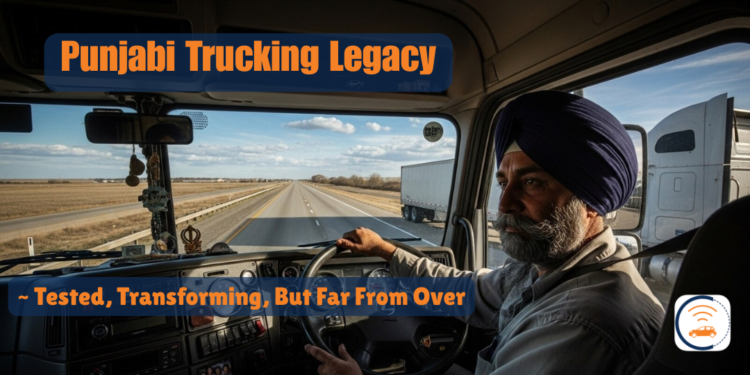
Punjabi Trucking Legacy: Collapse or Comeback?

The Punjabi trucking legacy on North America’s highways has long been more than a profession. It stands as a moving testament to resilience, faith, and the pursuit of opportunity.

Today, that legacy faces its most severe test as recent tragedies cast long shadows over an entire community.

The very industry they helped build now views them with suspicion, and the dreams woven into countless miles of asphalt suddenly feel fragile.

Yet, behind the headlines and harsh rhetoric lies a more complex story of community, contribution, and quiet perseverance that demands to be heard.

Punjabi Sikhs are a cornerstone of the trucking industry, making up roughly 20% of all U.S. truckers and a large portion in Australia. This success grew from a self-sustaining community that provided mentorship and built businesses.

The profession also uniquely accommodates their religious practices, like wearing turbans and keeping uncut hair.

Causes of the Crisis: Recent Tragedies and Their Implications on Punjabi Trucking Legacy

The Punjabi trucking community now finds itself at a crossroads following two devastating accidents that have triggered national scrutiny and heated immigration debates.

The California Case: Jashanpreet Singh, 21 Year Old Truck Driver

On Tuesday, 28th October, tragedy struck a California freeway when 21-year-old truck driver Jashanpreet Singh allegedly drove while intoxicated, resulting in a crash that killed three people.

Singh has been charged with three counts of gross vehicular manslaughter while intoxicated and one count of driving under the influence of a drug.

Punjabi Trucking Legacy, Is Its Fall Really True
Jashanpreet Singh, whose not-guilty plea sparked a national debate on trucking and immigration. | Image Source: ABC10

Despite pleading not guilty, the case has become a flashpoint in immigration debates. The Department of Homeland Security revealed Singh entered the U.S. illegally from India in 2022.

His requirement for a Punjabi interpreter during court proceedings raised questions about how he obtained a commercial driver’s license despite apparent English proficiency limitations.

The case has drawn national attention, with toxicology reports contradicting his family’s claims that he never uses drugs.

The Florida Tragedy: Truck Driver Harjinder Singh

Just months earlier, on August 12, another incident had already put the community under scrutiny.

Harjinder Singh, a 28-year-old India-born truck driver, allegedly made an illegal U-turn on a Florida Turnpike, blocking the roadway and causing a minivan collision that killed three people.

Punjabi Trucking Legacy, Collapse or Comeback
Harjinder Singh, the truck driver charged with vehicular homicide after a wrong U-turn on the Florida Turnpike. | Image Source: Times of India

The charges against him include three counts each of vehicular homicide and manslaughter.

Authorities stated that Singh entered the U.S. illegally from Mexico in 2018 and was processed for fast-track deportation. However, he was later released on a $5,000 bond after claiming a fear of returning to India.

His work authorization, denied during Trump’s first term, was granted under the Biden administration in 2021.

The case drew additional attention when Singh failed an English proficiency test after the accident. He answered only two of twelve questions and identified just one of four road signs.

AspectJashanpreet Singh (California)Harjinder Singh (Florida)
DateOctober 2025August 2025
ChargesGross vehicular manslaughter while intoxicated, DUIVehicular homicide, manslaughter
Immigration StatusEntered illegally in 2022Entered illegally in 2018
English ProficiencyRequired Punjabi interpreter in courtFailed post-accident English test
Policy ImpactTriggered MAGA backlash against immigrantsPrompted Trump administration to freeze trucker visas
Comparison of Two Recent Accident Cases. | Source: Times of India, News.com.au

Consequences: Punjabi Trucking Legacy Under Scrutiny

The aftermath of these tragedies has extended far beyond the courtroom. It has had real-world consequences for the Punjabi trucking community and sparked policy changes.

Harassment and Fear

In the wake of these incidents, Sikh truckers across the United States have reported increased harassment and discrimination.

The North American Punjabi Trucking Association has received numerous reports of Sikh drivers being targeted. In one instance, a Sikh man was ejected from an Oklahoma truck stop for trying to take a shower.

Punjabi Trucking Legacy Under Scrutiny
Increased scrutiny is now threatening thousands of Punjabi Sikh truck drivers, the very backbone of American commerce. | Image Source: LA Times

Sukhpreet Waraich, a trucker who owns an interstate freight carrier in Fontana, California, expressed the community’s anxiety:

“I’ve been talking to a lot of truck drivers, and they’ve been saying, ‘People look at us different now'”.

The situation has created such tension that some drivers are reconsidering their careers. Harsimran Singh, CEO of Gillson Trucking, reported that five of his Sikh drivers quit, telling him they no longer feel safe.

Policy Changes and Community Response

The political fallout has been swift and significant. Following the Florida crash, the Trump administration announced an immediate pause on all issuances of commercial truck driver work visas.

U.S. Secretary of Transportation Sean Duffy condemned what he called “despicable failures” in the system, vowing to “use every tool at our disposal to hold these states and bad actors accountable”.

Punjabi Trucking Legacy on Policy Changes and Community Response
U.S. Secretary of Transportation Sean Duffy, who announced a freeze on truck driver visas following the fatal accidents. | Image Source: Yahoo

In response, Sikh communities have proactively launched English language classes to address proficiency concerns.

Simultaneously, organizations like the Sikh Coalition have been reaching out to truckers to ensure they know their rights if stopped by authorities.

Beyond the Stereotypes: Success Stories and Diverse Narratives

While recent tragedies have dominated headlines, they represent only a small fraction of the Punjabi trucking experience.

Beyond the negative stereotypes lies a richer tapestry of stories that showcase the community’s resilience, diversity, and valuable contributions.

For every driver involved in an accident, there are thousands of Punjabi truckers who operate safely and professionally year after year. Sukhpreet Waraich, one of the many drivers concerned about increased scrutiny, proudly states,

“I’ve been driving since 2019. I haven’t got a single ticket”.

Many American-Punjabi truck drivers point out that they immigrated to the United States “the right way, legally.” They emphasize their commitment to safety and their respect for the country’s people and values.

As one Punjabi truckie eloquently expressed, “We’re judged not by our hearts or our work, but by the mistakes of a few. That hurts… because we’re part of the same road, the same dream”.

Sandeep Kaur: Breaking Barriers in Brisbane

In Australia, Sandeep Kaur represents the vibrant future of Punjabi trucking, shattering multiple stereotypes simultaneously as a female heavy vehicle operator.

Ms. Kaur hails from a small village, Goraya in Punjab and overcame significant personal challenges, including the early loss of her father and financial hardships. She later came to Australia as an international student from India in 2013.

Punjabi Trucking Legacy, Beyond the Stereotypes
In Australia’s male-dominated trucking industry, Sandeep Kaur stands out as one of the few women behind the wheel of a heavy vehicle. | Image Source: SBS Punjabi

Today, she navigates massive B-double trucks through interstate routes from Brisbane to Sydney, Melbourne, and Adelaide.

“This is not as difficult as I thought it to be. All you have to do is drive your load and finish the given task. You are your own boss. Your gender doesn’t matter here”. Ms. Kaur says in an interview with SBS Punjabi.

Ms. Kaur credits her mother as her inspiration and emphasizes mindset over external barriers,

“The first barrier is your own mind. Once you overcome that, everything else becomes so simple”.

Despite societal pressures that often discourage women from unconventional careers, Kaur remains focused on her goals. She aims to run her own fleet of heavy vehicles within ten years.

Satnam Singh: From Detention to Business Ownership

On Reddit, a user asked, “Why the Punjabi Sikh Community is so Active in Trucking as Compared to Other Professions?”

In response, American-Punjabi truck driver Satnam Singh offered a powerful testimony of transformation through the profession.

Punjabi Trucking Legacy
Journalist Shreen Khan joins Satnam Singh, a Punjabi Sikh trucker who crossed the U.S.-Mexico border, faced detention, and now owns a lucrative trucking company, to learn the story behind his remarkable journey. | Image Source: AJ+ on X.com

Satnam has been in the industry for 25 years. He shared his journey from crossing the U.S.-Mexico border and getting detained to now owning a successful trucking company that earns $200,000 annually.

Mr. Singh explained that trucking provides crucial opportunities for immigrants who may lack college degrees or strong English skills but possess a strong work ethic.

“Trucking is a hard job but we are willing to work hard,” Mr. Singh said.

He highlighted the freedom the profession offers, the ability to set one’s own schedule and determine one’s workload.

Satnam Singh’s story echoes the experiences of thousands who have found economic mobility through transportation.

Punjabi Trucking Legacy: Tested, Not Broken!

The Punjabi trucking legacy is not falling, it’s being tested. Like any community, it has its challenges and individuals who make tragic mistakes, but these exceptions do not define the whole.

The true Punjabi trucking legacy is built on countless safe journeys, immense economic contributions, and the religious freedom found on the open road.

It is a story of generational perseverance that has made these truckers indispensable to countries across the world.

Punjabi Trucking Legacy Tested, Not Broken
The enduring symbol of a community’s resilience: a Sikh trucker continues the long haul, upholding a legacy that persists despite its challenges. | Image Source: CTV News

The road ahead requires balance. This approach acknowledges where the community must improve while refusing to let isolated incidents erase decades of contribution.

The moral is not that the Punjabi trucking legacy is collapsing. Rather, it is evolving, facing modern challenges while maintaining its core values of hard work, faith, and family.

The trucking industry is adapting to new regulations and safety standards. The community’s resilience shows this isn’t an end, but another mile in the long journey of an extraordinary diaspora success story.

Drive Safer with Manage Vehicle Software

In light of recent tragedies, technology now offers powerful tools to prevent accidents before they happen.

Manage Vehicle’s fleet compliance management software provides drivers with essential safety features. It provides you with a digital logbook, a driver training toolbox, optimized routes, and real-time insights for proactive maintenance.

Drive Safer with Manage Vehicle Software
Navigate with confidence: Modern fleet management software provides real-time insights and tools to help ensure every journey is a safe one. | Image Source: The Bains Firm

Manage Vehicle ensure compliance with regulations, manage driver fatigue, and maintain vehicles in optimal condition. In doing so, they directly address several key factors that contribute to road incidents.

Whether you’re an owner-operator or part of a larger fleet, embracing such technology represents a positive step toward safer highways for everyone. Start Your Free Trial Today for 30 Days!

Weekend Read: Eco-Friendly Fleet Management Practices

Every mile matters, but how you manage those miles matters even more. Let’s take a glimpse into eco-friendly fleet management practices below!

The transport and logistics industry is the backbone of global commerce, but it also accounts for a significant share of carbon emissions.

Recently, a fuel spill incident in NSW highlighted how mismanagement not only leads to environmental hazards but also spikes operating costs for fleet companies.

Incidents like these remind us that eco-friendly fleet management is no longer optional, it’s essential.

The good news? With the right practices and tools, companies can reduce their carbon footprint and increase profitability.

1. Rethinking Route Optimisation

Poorly planned routes waste time, fuel, and resources. Even a small detour in daily operations can add up to thousands of unnecessary miles each year.

By integrating route optimization strategies, fleets can save fuel, lower emissions, and ensure faster deliveries.

Rethinking Route Optimisation
While you’re on the road, and you lost your way and went to the other direction, it will affect the last mile delivery with runtime.

Modern fleet management systems like Manage Vehicle offer real-time traffic updates and GPS tracking, allowing drivers to take the most efficient paths.

This not only reduces fuel consumption but also enhances customer satisfaction with on-time deliveries.

2. Preventive Maintenance for a Greener Future

Breakdowns and unexpected repairs don’t just drain resources, they also lead to inefficiency and waste. Regular vehicle inspections and preventive maintenance keep fleets running smoothly while reducing harmful emissions.

Preventive Maintenance for Eco-Friendly Fleet Management
Fleet owners or managers can save themselves from unexpected repairing costs and breakdowns during a fleet operation.

Eco-friendly fleets schedule routine checks for tire pressure, engine health, and oil levels. A well-maintained vehicle consumes less fuel and contributes less pollution, proving that sustainability and savings go hand in hand.

3. Fuel Efficiency and Alternative Energy Sources

Traditional diesel and gasoline are becoming costlier, both for businesses and the planet. Forward-thinking companies are adopting hybrid and electric vehicles, or at least training drivers in fuel-efficient driving habits.

Practices like reducing idling time, maintaining steady speeds, and avoiding harsh acceleration significantly cut fuel usage.

Fuel Efficiency for Eco-Friendly Vehicle Management Practices
To run a smooth transport or logistics business, drivers and operators must chose an alternative energy sources due to inflation in petroleum and diesel rates.

Meanwhile, investing in greener alternatives like biofuels, CNG, or electric fleets sets businesses on the path toward long-term sustainability.

4. Sustainable Driver Training Programs

Drivers play a direct role in how eco-friendly a fleet can be. Many companies overlook the importance of proper training in green driving techniques.

Teaching drivers to minimize idling, use cruise control where possible, and perform vehicle checks before trips can dramatically reduce emissions.

Driver Training for Sustainable Transport Management Practices
Fleet owners or operators must know that truck driver training programs must take place to run a successful transport business.

When drivers understand the impact of their habits, they feel more responsible and aligned with the company’s eco goals. Empowering drivers through training is one of the most cost-effective ways to create a culture of sustainability.

5. Leveraging Technology for Green Fleet Management

Data is the new fuel for eco-friendly operations. Fleet managers can track fuel consumption, driving patterns, and maintenance schedules through digital platforms. Analytics help identify inefficiencies and optimize performance across the board.

Green Fleet Management for Your Transport or Logistics Business
Fleet business owners or managers must know that a leveraging technology is important for green fleet management practices.

This technology-driven approach makes it possible to turn sustainability from a buzzword into measurable results. By harnessing real-time data, businesses can consistently cut down waste, reduce emissions, and boost operational efficiency.

6. Manage Vehicle: Your Partner in Eco-Friendly Fleet Management

To put these practices into action, businesses need a powerful tool. Manage Vehicle is an all-in-one cloud-integrated transport management system designed to make fleet operations smarter and greener.

From vehicle inspection and fault reporting to repair alerts and driver assistance, it empowers companies to maintain eco-friendly standards effortlessly.

Manage Vehicle's Transport Management Tool is Eco-Friendly
Manage Vehicle (MV) can increase your sales and provide a value to the customers who use its features on a daily basis to boost their eco-friendly fleet businesses.

By reducing paperwork, enhancing efficiency, and streamlining fleet operations, Manage Vehicle not only helps businesses protect the environment but also maximizes profitability. It’s the perfect blend of sustainability and success.

Go green, cut costs, and future-proof your fleet with Manage Vehicle. Book a free demo today and discover how eco-friendly fleet management can boost your business.