Geofencing for Fleet Management in Australia: How It Works and Why Compliance Depends on It (2026)

If you manage a fleet in Australia, you have probably already seen geofencing as a feature listed somewhere inside your tracking platform. Maybe you switched it on. Maybe you didn’t. But here is what a lot of operators miss: geofencing for fleet management is not just a “nice to have” feature for seeing dots move on a map. In 2026, it has become one of the most practical tools you can use to build compliance evidence, protect your assets, and keep the NHVR off your back.

The amended Heavy Vehicle National Law (HVNL), which kicked in on 1 August 2026, now requires every Chain of Responsibility (CoR) party to maintain a documented Safety Management System (SMS). That system gets assessed against the PSOE standard (Present, Suitable, Operating, Effective). The NHVR does not specifically mandate geofencing. But the kind of evidence geofencing produces, things like timestamped boundary crossings, speed-zone alerts, dwell-time logs, and after-hours movement records, is exactly what an auditor wants to see when they are checking whether your safety controls are genuinely working day to day.

This guide walks through how geofencing works in a fleet context, the specific compliance and safety benefits it delivers for Australian operators, and how to set it up without drowning in false alerts.

What Is Geofencing and How Does It Work in Fleet Management?

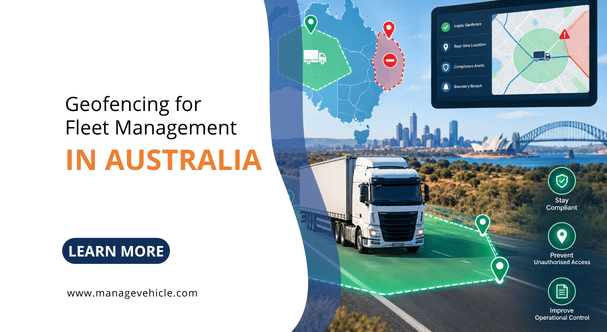
In simple terms, a geofence is a virtual boundary you draw around a real-world location on a digital map. When a GPS-equipped vehicle or asset crosses that boundary (entering or exiting), the fleet management system logs the event and triggers whatever action you have set up. That could be a push notification to you, an alert to the driver, an automated timesheet entry, or a compliance record filed against the vehicle’s trip history.
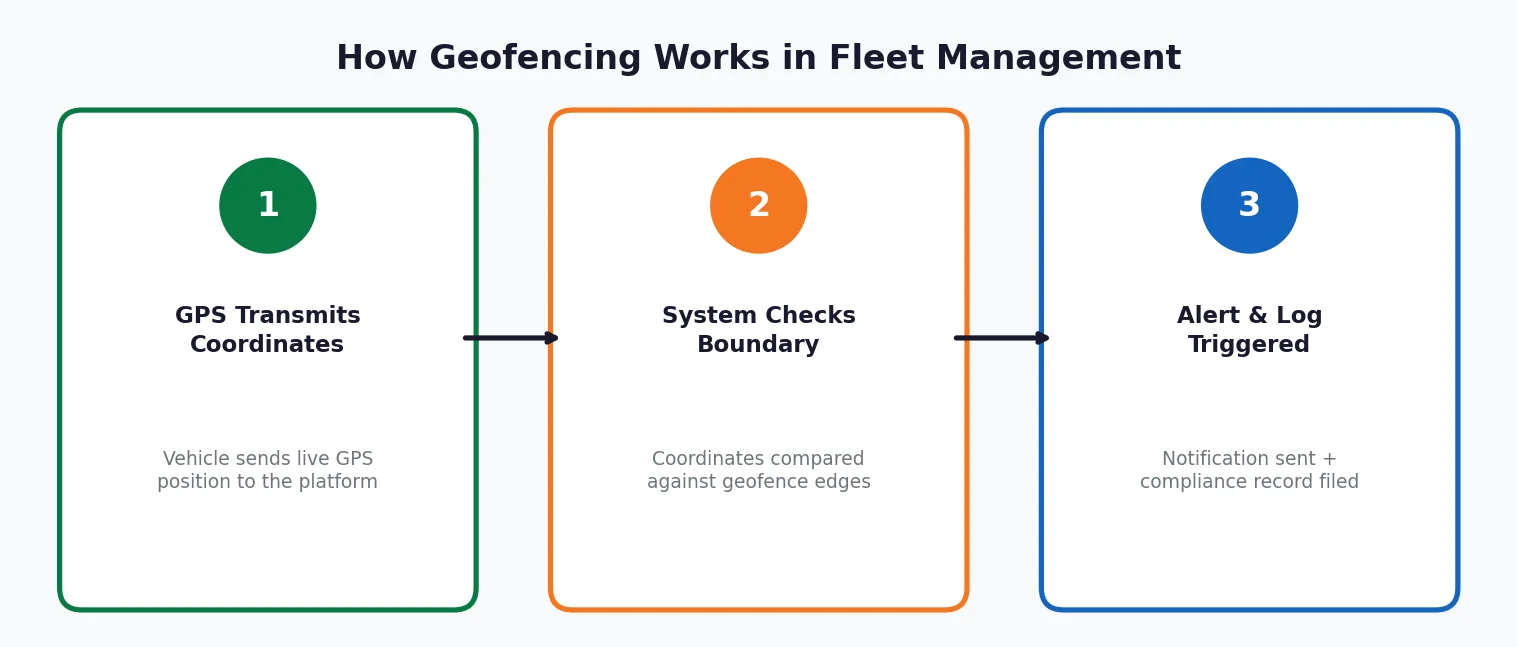
What Is Geofencing

The technology behind it relies on GPS satellite trilateration, which is the same positioning method that powers real-time fleet tracking. Your fleet software takes the vehicle’s live GPS coordinates and compares them against the stored coordinates of each geofence boundary. The moment coordinates overlap, the system registers an event.

There are three common geofence shapes you will see in fleet operations:

  • Circular (radius-based): You pick a centre point and set a radius. Quick to set up for depots, fuel stops, and customer sites. Works well when you do not need pinpoint accuracy at the edges.
  • Polygon (custom-shaped): A multi-point boundary that follows the exact outline of a site. Think construction zones, mining pits, or loading docks. Essential for sites where a few metres actually matter.
  • Corridor (route-based): A band drawn along an approved route. The system alerts you when a vehicle strays outside the corridor. Useful for hazardous goods transport or fixed-route linehaul.

For most Australian fleet operations, you will end up using a mix of all three depending on the site.

Why Geofencing Matters for Australian Fleet Compliance

Chain of Responsibility (CoR) Evidence

Under the HVNL’s Chain of Responsibility framework, every party with control or influence over a transport activity shares a legal duty to ensure safety so far as is reasonably practicable. That includes operators, schedulers, consignors, and loading managers. The NHVR’s 2026 Master Code identifies over 500 recommended controls across 45 transport activities. While the Master Code is not legally mandatory, courts can and will reference it as a benchmark for what “reasonably practicable” looks like in practice.
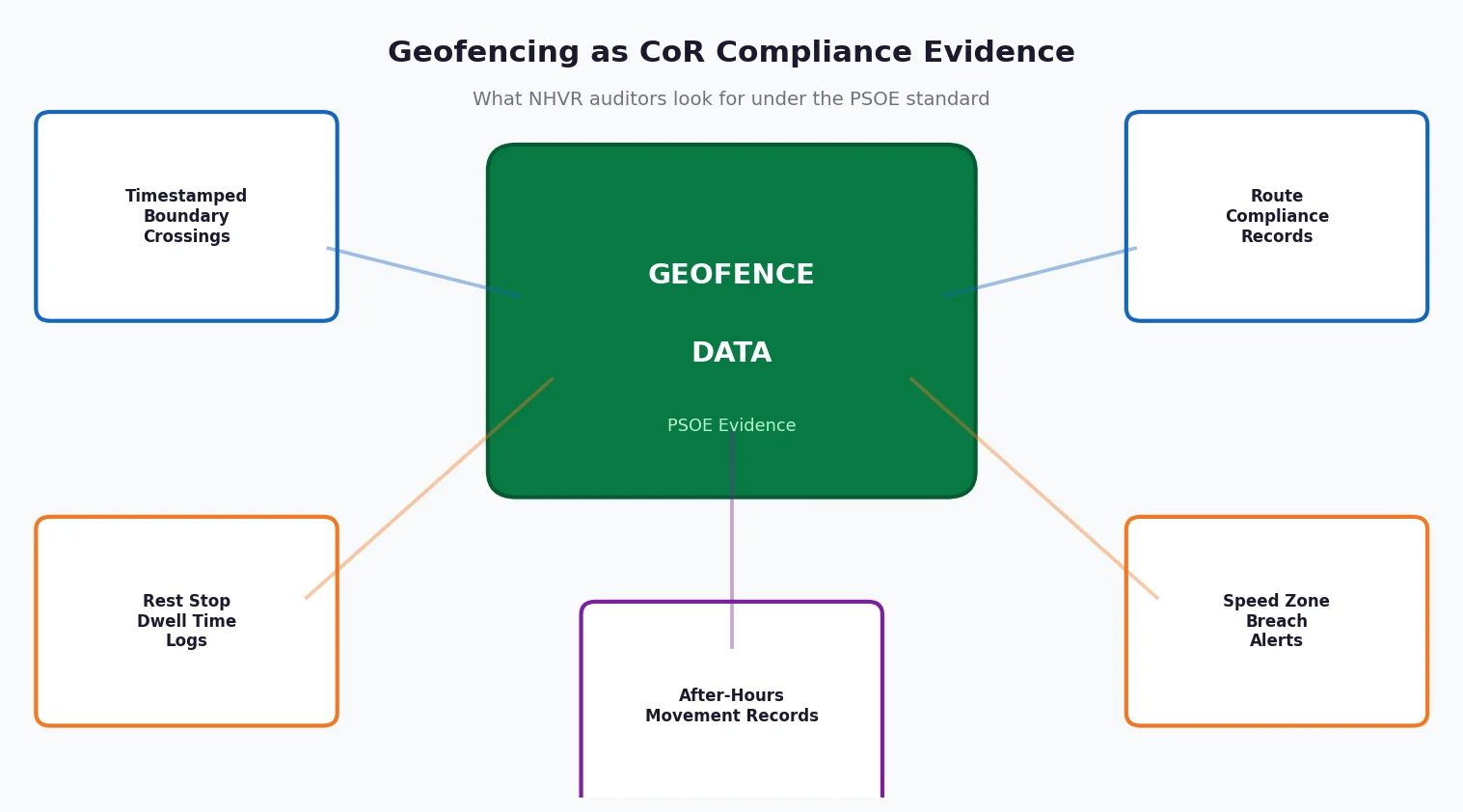
Geofencing cor compliance evidence

So where does geofencing fit? It directly supports several of those controls:

  • Speed management: A geofence with a speed threshold logs every instance a vehicle exceeds the limit within a defined zone. School zones, urban areas, on-site speed limits at mine sites or construction yards. That timestamped record is CoR evidence showing you were actually watching, not just hoping for the best.
  • Route compliance: Corridor geofences prove that vehicles stuck to approved routes. This matters most for dangerous goods transport or routes that need to avoid restricted roads.
  • Loading and dispatch: Geofences around loading bays and dispatch points record arrival and departure times. If a fatigue or scheduling dispute comes up later, those records support a “reasonable steps” defence.

Without this kind of data, an operator facing an NHVR audit is going to struggle to show that their safety controls were anything more than policy documents sitting in a filing cabinet. The PSOE framework specifically tests whether controls are “Operating” (being used day to day) and “Effective” (actually producing the intended safety outcome). Geofence logs are one of the clearest ways to pass both of those tests.

Safety Management System (SMS) Integration

The amended HVNL requires a documented SMS. Geofencing feeds directly into three of the five SMS outcome areas the NHVR assesses:

  1. Speed management: Zone-specific speed alerts and historical compliance rates over time.
  2. Fatigue management: Dwell-time data at rest stops, cross-referenced against driver work and rest hours. This verifies that rest breaks actually happened where and when they were recorded.
  3. Vehicle maintenance: Automated service triggers when a vehicle enters a designated maintenance bay, creating a timestamped record that feeds into your fleet maintenance schedule.

Workplace Safety Obligations

Vehicle incidents are still the number one killer in Australian workplaces. According to Safe Work Australia’s Key WHS Statistics 2025 report, vehicle incidents accounted for 42% of all worker fatalities in 2024. Trucks and semi-trailers featured prominently, and males made up 94% of vehicle-related deaths. The WHS Act defines a vehicle as a workplace, so the PCBU duty of care applies every single time a driver is behind the wheel.

Geofencing supports WHS compliance by flagging hazardous zone entries, enforcing site-specific speed limits, and generating the evidence trail that shows you were actively managing risk. That is the core requirement under both the WHS Act and the HVNL.

Practical Use Cases for Australian Fleets
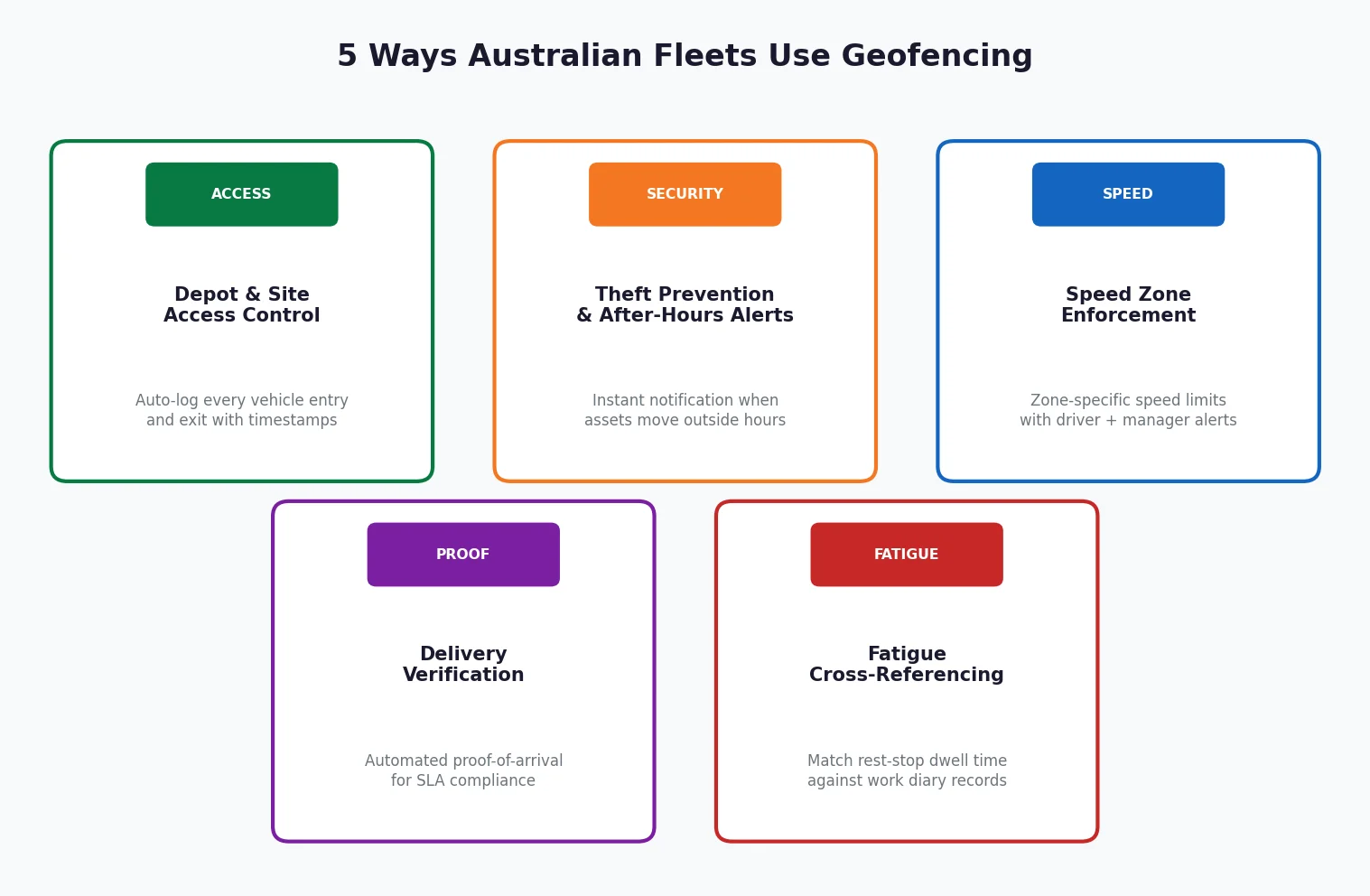
Geofencing fleet use cases

1. Depot and Site Access Control

Draw a polygon geofence around your depot, warehouse, or customer site. Every vehicle entry and exit gets automatically logged with a timestamp, driver ID, and vehicle ID. No manual sign-in sheet needed. This is especially valuable for government fleet operations where audit trails and accountability standards are strict by default.

2. Theft Prevention and After-Hours Alerts

Set a geofence around your yard or equipment storage area and configure an alert for any movement outside business hours. If a vehicle or piece of tracked equipment crosses the boundary at 2 a.m., you get an instant notification. For mining and construction operators managing high-value assets across remote sites, this kind of security layer is not optional. It is essential.

3. Speed Zone Enforcement

Create geofences with embedded speed thresholds around school zones, residential areas, or on-site restricted zones. When a vehicle exceeds the set limit inside the geofence, both the driver and the fleet manager get an alert. The event is logged as a compliance record. Over time, this data builds a reckless driving monitoring profile that supports targeted driver coaching instead of blanket penalties.

4. Customer Delivery Verification

Geofence your customer delivery points to automatically record proof-of-arrival times. This eliminates arguments over late deliveries, supports SLA compliance, and cuts down on the volume of manual ETA enquiry calls your office handles every day. One Australian distribution operator reported that daily ETA enquiry calls dropped from over 40 to fewer than 10 after deploying proximity geofences with automated SMS notifications.

5. Fatigue Cross-Referencing

Geofence designated rest areas and then cross-reference dwell-time data against EWD or work diary records. If a driver’s logbook shows a 30-minute rest break at a particular location, the geofence data should confirm the vehicle was actually stationary at that location for the same period. When the two do not match, that flags a potential false entry, which is a serious red flag in any compliance audit.

How to Set Up Fleet Geofencing Without Alert Fatigue

Alert fatigue is the number one reason geofencing implementations fail. Too many geofences triggering too many notifications. Managers start ignoring them. Then the whole system becomes useless. Here is how to avoid that.

Start With High-Value Zones Only

Begin with the locations that carry the highest compliance or financial risk. Your home depot, your top 10 customer sites, any restricted or hazardous zones, and designated rest stops on your major routes. You can always expand later. Do not try to geofence everything on day one.

Match the Geofence Shape to the Site

Use circular geofences for simple locations like fuel stops and small depots. Use polygon geofences for complex or irregularly shaped sites like construction zones, mine pits, and large warehouses with multiple entry points. Getting the shape wrong is a common source of false boundary-crossing alerts.

Set Meaningful Thresholds

A geofence alert should trigger an action, not just fill up your notification tray. Configure speed thresholds, dwell-time minimums, and after-hours windows that match your actual operational rules. If your site speed limit is 15 km/h, set the threshold at 15 km/h. Do not set it at 10 km/h, because that will generate constant false positives from vehicles manoeuvring at normal crawl speed.

Layer Geofencing With Your Existing Systems

Geofencing delivers the most value when it feeds into your broader fleet management software rather than running as a standalone tool. Integrated systems connect geofence events to maintenance schedules, driver scorecards, IVMS data, and compliance reporting dashboards. That gives you a single, auditable view of every vehicle’s operational and compliance history.

Review and Prune Quarterly

Geofences go stale. Customer sites close, projects end, routes change. Set a quarterly review to deactivate or adjust geofences that no longer match your operations. This keeps alert volume manageable and your compliance data clean.

Geofencing for Fleet Management: Real-Time Tracking vs. Passive Logging

Not every fleet tracking system handles geofencing the same way. The distinction between real-time GPS tracking and passive GPS tracking is important here.

Real-time tracking with geofencing sends you instant alerts the moment a boundary is crossed. This lets you intervene immediately, whether it is a stolen vehicle, an unauthorised after-hours movement, or a speed-zone breach that needs addressing before the driver reaches the next site.

Passive tracking with geofencing logs boundary events for later download and review. That is fine for historical reporting and audit evidence, but it cannot help you prevent an incident that is happening right now.

For compliance-critical operations under the HVNL, particularly those subject to NHVR audits or operating under the Heavy Vehicle Accreditation (HVA) scheme, real-time geofencing is the practical standard. The PSOE audit method assesses whether controls are “Operating” in real time, not just documented after the fact.

The Cost Factor: What Geofencing Adds to Fleet Tracking

Geofencing is typically included as a standard feature within GPS fleet tracking platforms. It is not usually billed as a separate add-on. The real cost is not the technology itself. It is the setup time, the integration with your existing workflows, and the ongoing management of geofence zones.

If you are already running a fleet management system with GPS tracking, activating geofencing is a configuration exercise, not a new investment. The return shows up in reduced manual reporting, fewer disputed deliveries, stronger CoR audit evidence, and faster response to security events.

FAQ

What is geofencing for fleet management?

Geofencing for fleet management is the use of GPS-defined virtual boundaries around locations on a digital map. When a fleet vehicle enters or exits a geofenced zone, the system automatically logs the event and can trigger alerts, compliance records, or workflow actions.

Is geofencing mandatory under the HVNL in Australia?

No. The HVNL does not mandate geofencing by name. However, the amended HVNL (commenced 1 August 2026) requires a documented Safety Management System assessed against the PSOE standard. Geofencing data provides the kind of operating evidence that NHVR auditors look for when checking whether your safety controls are genuinely active and effective.

How does geofencing support Chain of Responsibility (CoR) compliance?

Geofence logs create timestamped records of vehicle movements, speed-zone compliance, site arrivals and departures, and rest-stop dwell times. These records directly support the “reasonable steps” defence under the HVNL and demonstrate active operator oversight, which is a key element the NHVR assesses during CoR investigations.

Can geofencing prevent fleet vehicle theft?

Geofencing on its own does not physically stop theft. But it enables immediate detection. An after-hours boundary-crossing alert notifies the fleet manager the moment a vehicle or asset moves outside an authorised zone, which means a faster response and significantly better recovery odds.

How many geofences should a fleet set up?

Start with your highest-risk and highest-value locations: home depots, major customer sites, restricted zones, and designated rest areas. The most common implementation mistake is creating too many geofences too quickly, which leads to alert fatigue and managers tuning out. Expand gradually based on operational need and review your geofence map every quarter.
Vehicle Tracking vs Fleet Management Software: What’s the Difference?

Vehicle tracking vs fleet management software is one of those comparisons that sounds like splitting hairs until you actually need to buy something. Right now they get used interchangeably in a lot of marketing copy, and that’s honestly a bit misleading.

If you’re trying to work out which one your business actually needs, the short version is this: vehicle tracking tells you where a vehicle is. Fleet management software tells you where it is, whether it’s due for a service, whether the driver’s fatigue hours check out, and whether you’ve got the paperwork to prove all of that to an auditor if it ever comes to that.

What Vehicle Tracking Actually Is

Vehicle tracking answers one question. Where is this vehicle, right now or at some point in the past? A GPS tracker logs location, and most units these days also grab speed and basic route history. You get a live map, a trail of everywhere the vehicle’s been, and usually an alert if it wanders outside an area you’ve set.

That’s genuinely handy on its own. It’s good for proof of delivery, checking a route was actually followed, recovering a stolen vehicle, or just knowing where things are without ringing every driver. But it’s a fairly narrow slice of what running a fleet involves, especially once heavy vehicles and compliance requirements come into it.

Some people call this telematics, and the terms do overlap a lot in everyday use. Strictly speaking, telematics covers a bit more ground again, since it usually pulls in engine diagnostics and driver behaviour data alongside the location piece. Either way, it’s still one layer below the full fleet management picture.

What Fleet Management Software Actually Is

Fleet management software is the fuller operational platform. Vehicle tracking sits inside it as a base layer, and everything else gets built on top: maintenance scheduling tied to odometer or engine-hour readings, fuel and expense tracking, driver behaviour scoring, document storage, and for Australian heavy vehicle operators specifically, compliance tools like Electronic Work Diaries, fatigue records, and Chain of Responsibility evidence.

You notice the difference the moment something actually goes wrong. A vehicle tracker will tell you a truck was speeding. Fleet management software tells you the truck was speeding, flags whether that driver’s done it before, checks it against their work diary for a possible fatigue link, and keeps the whole record somewhere an NHVR auditor can actually use it.

Some platforms package the driver-behaviour side of this into what’s called an in-vehicle monitoring system, or IVMS. It’s not a separate category so much as a specific way of describing that layer within fleet management software.

Vehicle Tracking vs Fleet Management Software: Side-by-Side

Vehicle Tracking Fleet Management Software
Live location and route history Yes Yes
Geofencing and movement alerts Usually Yes
Driver behaviour scoring Rarely Yes
Maintenance scheduling No Yes
Fuel and expense tracking No Yes
Electronic Work Diary/fatigue records No Often built in
Chain of Responsibility (CoR) evidence No Yes
Document and compliance reporting No Yes
Fine for a single ute or small light fleet Often, yes A bit much, but it scales
Suits heavy vehicles under the HVNL Not on its own Built for this


vehicle tracking nested diagram

Why This Actually Matters in Australia

The vehicle tracking vs fleet management software question gets a lot more serious once heavy vehicles and HVNL compliance are involved.

For any fleet running vehicles over 4.5 tonnes GVM, this isn’t just a feature comparison. It’s a compliance question. Under the Heavy Vehicle National Law, Chain of Responsibility parties have to manage safety “so far as is reasonably practicable,” and since the 2026 reforms, that gets assessed using the PSOE method: whether your systems are Present, Suitable, Operating, and Effective.

A standalone tracker can show where a truck was. That’s useful evidence something happened. What it generally can’t show is fatigue compliance, maintenance history, or a documented safety management system, which is exactly what gets examined in an audit. If your fleet includes any heavy vehicles, tracking alone won’t get you through a PSOE-based HVA audit. You need the wider platform.

For light vehicle fleets with no HVNL exposure, that calculation looks different. A good tracker might genuinely cover everything you need, at least until the fleet grows or takes on heavier vehicles.

Which One Do You Actually Need?

Three questions worth asking yourself.

decision framework

Do you run anything over 4.5 tonnes GVM? If yes, fleet management software isn’t really optional. The compliance side alone rules out standalone tracking.

Is the fleet growing? Two vehicles might be fine on tracking alone. Fifteen vehicles with a mix of light and heavy assets need the operational layer that fleet management software adds, since manual tracking in a spreadsheet stops being workable pretty quickly.

Do you ever need to prove something to someone? Insurers, auditors, councils, courts. They increasingly want documented systems, not just raw location pings. If you’d ever need to show what you knew and what you did about it, that’s a fleet management function, not a tracking one.

The Bottom Line

Vehicle tracking isn’t really competing with fleet management software. It’s a feature that’s already inside it. The real question isn’t tracking versus software, it’s whether you only need location data, or whether you need the compliance, maintenance, and reporting layer built around it too. For any fleet with heavy vehicles or real compliance exposure, that question tends to answer itself.

If you’ve landed on fleet management software as the answer, our guide to choosing GPS fleet tracking software in Australia goes through what’s actually worth looking for before you sign anything.

FAQ

Is vehicle tracking the same as fleet management software?

No. Vehicle tracking is one feature (knowing where a vehicle is). Fleet management software is the broader platform, and it includes tracking plus maintenance, compliance, fatigue management, and reporting tools.

Can I use just a vehicle tracker for my heavy vehicle fleet?

Not really, on its own. Heavy vehicle operators under the HVNL need documented compliance evidence (fatigue records, maintenance history, CoR trails) that standalone trackers don’t provide. A basic tracker can support that evidence, but it can’t replace the broader system an audit actually looks for.

When is standalone vehicle tracking enough?

For small fleets of light vehicles with no HVNL exposure, a decent tracker can genuinely do the job, particularly if all you need is location and basic route history.

Does fleet management software cost more than vehicle tracking alone?

Usually, yes, since it covers more ground. But for a fleet with compliance obligations, the real comparison isn’t tracking versus software. It’s the cost of the platform against the cost of failing an audit or a CoR investigation without one.

Do all fleet management platforms include vehicle tracking?

Yes. Vehicle tracking (GPS location, route history) is a baseline feature of pretty much every fleet management platform. It doesn’t work the other way around. Most standalone GPS trackers don’t include the wider compliance and maintenance tools fleet management software has.

Best Vehicle Maintenance System in Australia: Manage Vehicle

An effective vehicle maintenance system in Australia is no longer a luxury, but a necessity for survival and growth. This shift is driven by the need to gain a critical competitive edge in a challenging market.

Cloud-based fleet compliance management system like Manage Vehicle act as the central nervous system for any fleet. It shift maintenance from a reactive to a proactive model, saving significant time and money.

For fleet managers, this upgrade is no longer just about efficiency. It is about gaining a critical competitive edge in a challenging market.

A critical shortage of qualified mechanics across Australia is causing months-long repair delays. For fleets, this isn’t just an inconvenience, it causes major downtime and safety risks.

A proactive maintenance system like Manage Vehicle is now essential to keep your vehicles running and your business safe.

Why Manage Vehicle Maintenance System in Australia is the Best?

Manage Vehicle maintenance system in Australia is a centralized, cloud-driven fleet compliance management tool that helps transport businesses monitor, manage, and optimize the maintenance of their fleet vehicles.

Think of it as the mission control for all your assets. This system goes far beyond simple reminder spreadsheets.

Fleet Maintenance Software in Australia
Move beyond chaotic spreadsheets and into the centralized command center for your entire fleet. | Image Source: VMS-BD

Manage Vehicle leverages telematics, a fusion of GPS, diagnostics, and sensor data, to provide real-time, actionable insights into vehicle health and maintenance schedules.

At its core, the system acts as an operational hub that automates workflows and ensures regulatory compliance. The primary goal is to transition fleet management from a reactive posture, “fix it when it breaks” to a proactive, data-driven strategy.

This approach enhances safety, drastically reduces unplanned downtime, and improves overall productivity and cost-effectiveness.

In practice, this means you can prevent a significant percentage of breakdowns before they even have a chance to occur.

Why Do Australian Transport Businesses Need One Now?

The need for robust vehicle maintenance system in Australia is more pressing than ever due to a confluence of operational, regulatory, and market pressures.

The previously mentioned mechanic shortage is a primary driver, directly impacting your bottom line through extended vehicle downtime.

The rise of complex electric and hybrid vehicles is also changing maintenance needs. With 3.4 million predicted on Australian roads by 2030, having detailed digital vehicle records becomes indispensable.

fleet vehicle maintenance system in Australia
With mechanic wait times stretching for months, a proactive fleet vehicle maintenance system is no longer a luxury, it’s a business essential. | Image Source: Uffizio

From a regulatory standpoint, compliance with local Chain of Responsibility (CoR) laws, safety standards, and emissions regulations is non-negotiable.

A modern fleet software like Manage Vehicle embeds compliance into your daily operations, helping you avoid heavy penalties and ensuring the safety of your drivers and the public.

Finally, in a competitive economic climate, the direct cost savings are undeniable. Strategic maintenance extends vehicle lifecycles and protects profitability.

Furthermore, data-driven insights lead to significant reductions in fuel consumption and expensive, unexpected repairs.

Who Can Benefit from Manage Vehicle Maintenance System in Australia?

The short answer is that any transport or logistics business that relies on vehicles to generate revenue can benefit. However, the value is particularly profound for specific roles and sectors:

1. Fleet Managers and Transport Operators

These professionals are at the frontline, responsible for vehicle uptime, safety, and cost control. Manage Vehicle gives managers a single pane of glass to oversee all operations.

From scheduling services to tracking fuel usage, it centralizes critical tasks like ensuring driver compliance.

fleet vehicle maintenance software in australia
Whether you manage 5 vehicles or 500, gain the clarity and control needed to scale your operations efficiently. | Image Source: Workshop Mate

2. Small to Medium-Sized Fleet Businesses

Growing businesses often feel operational inefficiencies most acutely. Implementing an all-in-one fleet compliance management system like Manage Vehicle provides the structure needed to scale operations.

This allows a business to grow without proportionally increasing administrative overhead or losing control of maintenance costs.

3. Large Fleets and Logistics Companies

For transport businesses with large fleets, automating maintenance and generating fleet-wide reports is critical. This capability is essential for maintaining efficiency and meeting stringent corporate compliance and sustainability targets.

How Does Manage Vehicle Work as an All-in-One Vehicle Maintenance System in Australia?

Manage Vehicle stands out by integrating all critical functions into one seamless, cloud-based vehicle maintenance system in Australia. It operates on a simple but powerful cycle:

  • Data Collection
  • Intelligent Analysis
  • Proactive Action

The process begins with data collection. Manage Vehicle maintenance system aggregates real-time information from your vehicles through integrated telematics, driver reports, and manual inputs.

All-in-One Vehicle Maintenance System in Australia
See how data transforms into action, automating maintenance workflows from real-time alert to completed work order. | Image Source: Shutter Stock

This data encompasses everything from engine fault codes and fuel levels to odometer readings and service history.

Next, the platform performs intelligent analysis. Using this data, Manage Vehicle’s algorithms provide deep fleet insights and generate real-time alerts.

For example, it can notify you of a diagnostic trouble code the moment it appears. It can also automatically schedule a service when a vehicle approaches its kilometre threshold.

Finally, it enables proactive action. The system automates the creation of work orders, tracks parts inventory, and maintains a digital service history for every asset.

This allows managers to dispatch repairs instantly, ensuring small issues are fixed before they escalate into major breakdowns. This forward-thinking method is your key to a more reliable, efficient, and cost-effective fleet.

When Should You Invest in a Pro Fleet Maintenance Software like Manage Vehicle?

The right time to invest is before a major maintenance failure disrupts your operations. Here are key indicators that your business is ready for a professional fleet maintenance system like Manage Vehicle:

1. When Reactive Repairs Are Costing You:

If your maintenance pattern is defined by unexpected breakdowns, leading to high repair bills and urgent calls to mechanics, it’s time for a change. A proactive system pays for itself by preventing these costly incidents.

All-in-One Vehicle Maintenance System in Australia
The best time to invest was yesterday; the second-best time is before your next costly breakdown. | Image Source: FleetGo

2. As Your Fleet Expands:

Managing maintenance for 5 vehicles with spreadsheets might be feasible, but as your fleet grows, the complexity multiplies. Investing in a scalable system when you plan for growth prevents future chaos.

3. When Compliance Becomes a Burden:

If you find it increasingly difficult to keep up with driver logbooks, safety inspections, and CoR regulations, a system that digitizes and automates these processes is no longer an option, it’s a necessity.

Key Features of Manage Vehicle Maintenance Software to Look For in 2025

When evaluating Manage Vehicle maintenance system in Australia, ensure it offers these essential features:

  • Proactive Maintenance and Real-Time Alerts: The system must automate maintenance scheduling by time, distance, or engine hours. It should also provide instant alerts for fault codes and safety issues. This is the core of preventing downtime.
  • Fleet Insights and Daily Reporting: Look for comprehensive analytics that turn raw data into actionable intelligence. This includes cost-per-kilometre reports, fuel usage analysis, and fleet performance dashboards to support strategic decision-making.
Benefits of Manage Vehicle Maintenance Software
Don’t settle for a basic tracker. These are the essential capabilities that define a modern, competitive fleet management solution. | Image Source: TransportSimple
  • Cloud Integration and Mobility: A cloud-based system with a mobile app ensures managers and drivers can access information and receive alerts from anywhere. This keeps the entire team connected and allows for instant issue reporting.
  • Compliance Management: For Australian businesses, features that help manage Chain of Responsibility (CoR), digital logbooks, and vehicle inspection reports (DVIRs) are critical for meeting local legal requirements.

Difference Between Manual Management and Manage Vehicle System

FeatureTraditional/Manual ApproachManage Vehicle System
Maintenance StrategyReactive (fix after break)Proactive (prevent issues before it happens)
SchedulingManual calender, spreadsheet trackingAutomated by odometer, time, ECM data
Issue DetectionRelies on driver reports, visible damageReal-time alerts from vehicle telematics
Data and ReportingManual data entry, static spreadsheetsAutomated fleet insights and live dashboards
CompliancePaper-based logs, prone to errorIntegrated digital checks and audit trails
Cost ControlUnpredictable, high repair costsPredictable scheduling, lower long-term costs

Ready to Transform Your Fleet Operations?

Don’t let another unexpected breakdown or six-month mechanic wait dictate your business’s success. It’s time to move beyond reactive chaos and into the era of proactive, data-driven fleet management.

Experience the power of an all-in-one solution risk-free. We invite you to start a 30-Day Free Trial of Manage Vehicle.

See for yourself how our cloud-integrated platform with real-time alerts and deep fleet insights can lower your costs, boost your productivity, and give you complete peace of mind.

For a limited time, new customers who sign up receive a 20% discount. This offer is available for both B2B and B2C customers.

Click here to fill out the form and claim your 30-Day Free Trial and 20% discount today!

Fleet Management FAQs in 2025: Cut Costs and Boost Efficiency

In today’s challenging landscape, fleet management is essential. It has evolved from an operational goal to the very cornerstone of business survival.

The transition to electric vehicles, new environmental regulations, and the pressure of a competitive labor market are reshaping the industry landscape.

For instance, 2025 data confirms a historic shift: electric fleet vehicles now consistently offer an 11% usage cost advantage over combustion engines, becoming profitable from 80,000 km.

In this article, we try to answer most frequently asked questions on the internet by fleet managers and truck drivers, providing actionable answers to navigate these complex challenges.

1. How Do You Create and Prioritize a Preventive Maintenance Schedule for a Fleet?

Preventive maintenance is the key to a reliable and profitable fleet. Instead of waiting for expensive breakdowns, you schedule maintenance to prevent them. This keeps your vehicles on the road, extends their life, and saves money.

How it works? You create a schedule for each vehicle based on its manual, mileage, and use. Fleet management software can automate this, sending reminders for oil changes, brake checks, and tire rotations.

Top Fleet Management Questions for 2025, Answered
Proactive preventive maintenance is the key to maximizing vehicle uptime and avoiding costly roadside breakdowns. | Image Source: White Label

The payoff is clear! Proactive fleets can reduce yearly repair costs by 25-35% and are significantly safer, as potential problems are fixed before they can cause an accident.

2. What are Your Strategies for Reducing Fleet Operational Costs?

Cut your fleet costs by focusing on three key areas: fuel, vehicles, and drivers. A smart, data-driven approach can reduce your budget by up to 30%.

Fleet Management FAQs to Cut Costs and Boost Efficiency
Combat rising fuel costs with a data-driven management system that tracks consumption and identifies savings opportunities. | Image Source: IndianMart
  • Save on Fuel: Use technology to track spending, coach drivers to avoid wasteful habits like speeding and idling, and optimize routes to reduce mileage.
  • Manage Your Vehicles Smarter: Analyze the total cost of owning each vehicle to know the best time to replace it. For many routes, electric vehicles are now a proven way to lower operating expenses.
  • Invest in Your Drivers: Train your team in fuel-efficient driving. This small investment can pay for itself in months through major savings on fuel and maintenance, while also improving safety.

3. How Do You Ensure All Vehicles are Properly Licensed, Registered, and Inspected on Time?

Avoid costly fines and downtime by managing licenses, registrations, and inspections proactively.

Use a simple, digital system to track all deadlines and send you automatic reminders before anything expires. Store all documents, like insurance and inspection reports, in one central, digital hub for easy access.

Fleet Management FAQs for Managers and Truck Drivers
Stay fully compliant and avoid fines with automated alerts for expiring licenses, registrations, and inspections. | Image Source: Food Logistics

For inspections, use digital forms for daily driver checks and scheduled maintenance. This creates a clear, instant record for your mechanics and ensures you’re always prepared for an audit.

4. What are Your Go-To Strategies for Handling Unexpected Vehicle Breakdowns or Accidents?

When the unexpected happens, a clear, practiced response plan is crucial for minimizing risk, ensuring safety, and resuming operations as quickly as possible. For accidents, safety and protocol come first. The immediate steps are:

2025 Fleet Management, What You Need to Know
From ensuring safety to post-accident reporting, a structured plan minimizes downtime and protects your drivers and assets. | Image Source: 10 Four Truck Repairs
  1. Ensure Safety: Check for injuries and call emergency services if needed. Move to a safe location if possible.
  2. Document the Scene: Gather evidence, including photos of the vehicles, surroundings, and any relevant road conditions. Collect names and contact information of involved parties and witnesses.
  3. Report and Begin Investigation: Immediately report the accident. Then, conduct a vehicle inspection and complete mandated drug and alcohol testing as per NHVR regulations.

For breakdowns, ensure a fast response with clear driver protocols and a trusted repair network. To cut downtime by 25%, shift to predictive maintenance, using data to flag issues up to 15 days before failure.

5. How Do You Plan Routes to Ensure Timely Delivery and Fuel Efficiency?

Route planning is about mapping a possible path from A to B. Route optimization, however, finds the cheapest, fastest, and most fuel-efficient journey.

Real route optimization uses data and algorithms to create the most efficient multi-stop routes in seconds. It analyzes real-time traffic, vehicle specs, and deadlines to minimize distance and fuel use.

Future of Fleet Management, 2025's Top Questions
Smart route planning ensures timely deliveries while minimizing fuel burn and reducing vehicle wear and tear. | Image Source: Motive

The benefits of a mature optimization strategy extend far beyond a single trip.

  • Lower Operational Costs: Fewer miles traveled directly translates to lower fuel bills and reduced vehicle wear and tear.
  • Enhanced Customer Service: Reliable ETAs and on-time deliveries increase customer satisfaction and trust.
  • Improved Driver Morale: Drivers spend less time stuck in traffic and more time being productive, which reduces frustration and improves job satisfaction.
  • Sustainability Gains: By reducing total mileage and idle time, optimized routing directly cuts your fleet’s carbon footprint, supporting corporate ESG goals.

Manage Vehicle: All-in-One Fleet Management Software

While the strategies above are effective on their own, Manage Vehicle is integrated into a single, centralized fleet management system. This software is your fleet’s digital nervous system, bringing smart, data-driven cohesion to every task.

Fleet managers gain a central dashboard for complete control. This allows them to track locations, monitor fuel, schedule maintenance, and manage compliance seamlessly.

Fleet Management Trends, Top Questions Answered
Consolidate your entire operation. Our all-in-one fleet management software puts maintenance, fuel, compliance, and real-time tracking on a single, powerful dashboard. | Image Source: Tool Sense

For drivers, apps like the Manage Vehicle app make daily tasks simple. They streamline logging inspections, receiving routes, and communicating with dispatchers to cut down on paperwork.

Manage Vehicle’s key features to look for include:

  • Preventive Maintenance Scheduling: Automates service reminders based on mileage or engine hours.
  • GPS Tracking and Telematics Integration: Provides real-time vehicle location and driver behavior data.
  • Fuel Management Tools: Tracks consumption and costs.
  • Document Management: Centralizes licenses, registrations, and maintenance records.
  • Reporting and Analytics: Turns operational data into actionable insights for continuous improvement.

Don’t just manage your fleet, master it. Sign up today for a 30-day free trial of our Manage Vehicle app and experience firsthand how our all-in-one platform can drive growth and efficiency in your business.

5 Hidden Costs of Manual Fleet Management & How to Eliminate Them

Think Your Fleet is Running Smoothly with Manual Fleet Management? Think Again! The Silent Profit Drains Costing Aussie Operators Thousands of Dollars.

Imagine this now, you’ve just finished a long haul from Sydney to Melbourne, and the paperwork is piling up. Your driver’s logbooks are a mess, fuel receipts are scattered across the dashboard, and you’re unsure if the vehicle’s maintenance is up to date.

Meanwhile, hidden costs are eating into your profits, and you might not even notice until it’s too late. With rising fuel prices, regulatory complexities, and operational inefficiencies, Australian transport businesses are facing unprecedented challenges.

Manual fleet management, once the industry standard, is now a silent profit killer. In fact, inefficient routing and idle time alone can cost operators tens of thousands of dollars annually.

Curious about what’s draining your bottom line? Now, it is time to explore the five hidden costs of managing your fleet manually and how you can get rid of them forever.

1. Fuel Inefficiency and Poor Routing

When the route planning is done manually without real-time data, it results in inefficient routes, unnecessary miles to drive, and fuel wastage.

Drivers may encounter avoidable traffic, miss time windows, or take longer routes, resulting in higher fuel consumption and increased wear and tear on vehicles.

Do that to your fleet, and the losses are staggering. Studies have shown that poor routing can contribute as much as 20 percent to fuel costs.

2. Administrative Burden and Human Error

Paper dockets, clipboards and spread sheets are not only laborious to fill manually, but also they are subject to errors. Any copied record or lost documentation can lead to invoicing delays, compliance and customer dissatisfaction.

Administrative Burden and Human Error in Manual Fleet Management
While doing manual fleet management for your business can be difficult and may cause administrative burden or human error in compliance regulations. | Image Source: Pinterest

The administrative backlog often forces staff to spend hours on rework instead of value-added tasks.

3. Lack of Visibility and Accountability

Without real-time insights into fleet movements, operators are often in the dark about vehicle locations, job completion status, or driver behaviour.

Lack of Visibility and Accountability in Manual Fleet Management
If operators won’t able to get real-time insights of their fleets during road operations, it is a lack of visibility and accountability. | Image Source: Binary Semantics

This lack of visibility leads to overbooking, under-utilisation of assets, and missed delivery windows, ultimately resulting in customer churn and avoidable overtime payments.

4. Compliance Risks and Penalties

Manual fatigue management, paper-based work diaries, and outdated record-keeping systems make it easy to breach NHVAS or Chain of Responsibility (CoR) regulations.

Compliance Risks and Penalties in Manual Fleet Management
Sometimes drivers forgets to fill-up their work diaries or mentioning their work in the record-keeping that can cause a compliance risk and penalties on the road. | Image Source: Fleet Connection

This can lead to fines, loss of business and reputation in case of failure to do so. Manual processes are also not agile enough to accommodate the changes in regulations.

5. Unplanned Downtime and Reactive Maintenance

Reactive maintenance, fixing vehicles only when they break down, is a major cost driver. Unexpected repairs lead to costly downtime, delayed deliveries, and lost customer trust.

Unplanned Downtime and Reactive Maintenance in Manual Fleet Management
What if your vehicle breaks down on the middle of the road and you face unplanned downtime or reactive maintenance during any road operation? | Image Source: Torque by Ryder

Without proactive maintenance schedules, minor issues can escalate into major expenses, impacting your bottom line and operational efficiency.

Here’s Your All-in-One Solution: Manage Vehicle App

Why let these hidden costs eat into your profits when you can leverage technology to eliminate them? Manage Vehicle is an Australian-built fleet management system designed specifically for transport operators.

Here’s how it addresses each of these challenges:

  • Fuel Efficiency: Live GPS tracking and optimisation of routes minimise unnecessary miles to travel and save your idle time.
  • Administrative Automation: Digital PODs, invoicing, and driver communication tools minimise manual errors.
  • Real-time Visibility: Geofencing and asset tracking provide full oversight of fleet movements.
  • Compliance Made Easy: Automated work diaries, fatigue management, and digital documentation ensure adherence to regulations.
  • Proactive Maintenance: Automated servicing reminders and defect reporting keep your fleet road-ready.

Why Choose Manage Vehicle?

  • Tailored for Australian Operators and Drivers: Built to comply with local regulations and designed for the unique challenges of the Australian transport industry.
  • Comprehensive Features: From telematics and smart dashcams to driver behaviour monitoring and maintenance scheduling, everything you need is in one application.
  • Proven Results: Users report 22% reductions in downtime, 20% savings in maintenance costs, and 15% improvements in fuel efficiency.
  • 24/7 Support: Our technical team will be there always to assist you in any issue facing during road operations.

Manual fleet management is no longer sustainable in today’s competitive landscape. The hidden costs whether from inefficient routing, administrative errors, or compliance risks can significantly impact your profitability.

Stop using manual fleet management for your transport or logistic business. Book a demo with Manage Vehicle today and take the first step toward a smarter, more efficient fleet.

How AI-Powered Fleet Management Reduces Operational Costs?

Just think of reducing the operating expenses of your fleet by 15-25% overnight. With AI-powered fleet management system, that’s not a dream – it’s today’s reality.

Australia’s truck drivers face a perfect storm: crippling fuel prices, a 30,000-driver shortage reported by Australian Trucking Association in 2023, and rising maintenance expenses.

Add unpredictable road conditions and compliance pressures, and profit margins vanish like mirages on the Nullarbor highway. Traditional fleet management can’t keep pace—but cloud-integrated solutions just like Manage Vehicle are rewriting the rules.

Why Fleet Operational Costs are Spiraling Out of Control?

Operational costs for Australian fleets surged 18% in 2023, driven by fuel volatility and maintenance delays as per ABS. Initiatives such as paper logbooks and reactive repairs are costly to the company in hours and dollars. Without real-time insights, managers fly blind while costs soar.

Fleet Management Software for Operational Cost
Manage Vehicle’s fleet management software can breakdown fleet cost in an easy and effective way. | Image Source: Trackobit.com

Fleet management system based on AI turns raw data into actionable strategies, addressing the largest money sinks of fuel, maintenance, and labour. Similarly, logistic company called Linfox saved 12% on fuel consumption with the help of AI routing (AFR). Let’s break down how it works.

Cloud-driven Route Optimisation: Fuel Savings on Autopilot

Traffic, weather, and vehicle specifications are factors analysed by smart routing algorithms in planning the most time-saving, safe, and fuel-efficient routes.

One Melbourne fleet saved $48,000 monthly by avoiding traffic snarls and excessive idling. AI-powered fleet management tool also reduces hard accelerations and harsh decelerations-lopping 5 to 15% of fuel they burn.Less fuel used means lower emissions and happier ESG reports.

Predictive Maintenance: No More Costly Surprises

Breakdowns cost Australian fleets $3.1 billion yearly in delays and tow fees, as per National Transport Commission. Cloud-based fleet management system does this in changing by anticipating failures in advance.

Predictive Maintenance by AI-powered Fleet Management
Fleet businesses can save much more by doing predictive maintenance with the help of AI-integrated fleet management tool. | Image Source: AssetWorks UK

The sensor can detect engine strain, tyre wear and battery condition. The system then schedules servicing during downtime—avoiding roadside crises. One Brisbane operator cut maintenance overheads by 30% and extended vehicle lifespans by 2 years.

Driver Safety: Your Secret Weapon Against Liability Costs

According to Monash University 2022 report, fatigue and distraction cause 43% of Australian truck accidents. Cloud-powered fleet management tools like live dash cams and fatigue alerts reduce risks.

Real-time alerts warn managers of unsafe behaviour like swerving or night-driving fatigue. Training programs then target weak spots. Result? Fewer accidents, lower insurance premiums, and protected reputations.

Real-Time Tracking: Squeeze Every Drop from Your Assets

Know exactly where vehicles are—and how they’re performing. AI-based fleet tracking spots inefficiencies like unauthorised stops or inefficient cargo loads.

Cloud-based Fleet Management Software Helps in Real-Time Tracking
With the help of cloud-based fleet management software, many logistics and transport business can track their loaded vehicles in real-time. | Image Source: CloudApper

One NSW fleet boosted utilisation rates by 22% by reassigning underused vehicles instantly. Less idle time = more jobs completed daily. Bonus – Customers love accurate ETAs.

Compliance Automation: Avoid Costly Penalties

Chain of Responsibility (CoR) fines reach $300,000 per breach. Cloud-based fleet management application automates logbooks, licence checks, and rest-period alerts. Digital records replace error-prone paperwork. Automated reports prove compliance during audits—saving hours of admin stress.

Rely on Cloud-based Manage Vehicle Fleet Management for 24/7

Melbourne, Victoria-located cloud-based fleet solution, Manage Vehicle is turning your smartphones into command centres. MV Driver or MV Operator are available on Playstore and App Store.

Manage Vehicle provides every AI-integrated vehicle management tools discussed into one intuitive app such as:

  • Fuel Intelligence: Live MPG tracking + optimised routes
  • Health Monitoring: Predictive maintenance alerts
  • Driver Safety Scores: Behaviour analytics + coaching tips
  • Compliance Hub: Auto logbooks + audit trails

“I was amazed to get all services under one roof. They know the technology very well. Avi and his customer support team has helped me on every small question I have” — Rusty Bajwa, from Flying Horse Transport

Operational costs will keep rising—but our cloud-based Manage Vehicle fleet management system lets you rise faster. We deliver ROI in under 6 months for 89% of users. Why wait?

Try Manage Vehicle Free Trial for 30 Days! Download now on Playstore, App Store or book a demo and reduce your costs by 20%.

What Affects Truck Driving Behaviour? Key Factors and Solutions

Truck driving behaviour creates substantial effects on both road safety and operational efficiency in addition to vehicle durability.

Fatigue, together with overspeeding, harsh acceleration and hard braking and crashes, represents the significant safety challenges in the trucking industry.

Fleet managers, along with truck drivers and transport operators, must understand the origins of such behaviours to execute effective prevention plans through fleet and compliance software.

Key Factors Affecting Truck Driving Behaviour

Fatigue and Distraction

Truck accidents occur primarily because of driver fatigue. Hostile work situations because of tight delivery schedules create fatigue, as do very long driving shifts. 

Silent pressure from delivery deadlines drives truckers to forego rest breaks and reduce sleep, which erodes their focus and reaction performance.

Inadequate sleep exacerbates this issue. Inadequate rest routines coupled with irregular sleep schedules reduce drivers’ attention span, thus raising the risk of accidents.

Overspeeding

The practice of going beyond posted speed limits emerges from drivers’ time constraints along with their need to finish journeys fast.

Drivers who choose to operate at speeds exceeding posted limits reduce their responsiveness to unexpected objects and experience increased stopping distances that put them at higher risk of collision.

Moreover, some drivers struggle to assess the safety risks of speeding in both harsh weather and unknown terrain situations, which generates additional safety threats.

Harsh Acceleration and Hard Braking

Fast acceleration and hard braking indicate either unsafe or unprofessional driving behaviour. Various conditions, including tailgating combined with sudden obstacles and distractions, push people to show such driving behaviours. 

The persistent application of sudden breaking motion reveals that a driver maintains unsafe distances from other vehicles, thus increasing the risk of rear-end collisions.

Driving practices that combine aggressive behaviour with inattentiveness cause both safety hazards and accelerate vehicle wear, which drives up maintenance expenses.

Crashes in Truck Driving

As a whole, a combination of the previously stated elements leads to such crashes. The combination of driving while drowsy, together with fast driving speeds and aggressive maneuvers, sharply increases the risk of vehicle collisions. 

Heat waves, unsafe terrain, and equipment breakdowns create additional threat factors that increase driving hazards.

Discover More: Fleet Management Software: Streamline Operations Efficiently

Preventing Unsafe Truck Driving Behavior with Fleet and Compliance Software (FCS)

Fleet and compliance software (FCS) provides detailed solutions to track vehicle operation performance, which also enhances road safety. The real-time capabilities of FCS enable fleet managers to detect unsafe driving behaviours so they can effectively respond to them.

Monitoring and Managing Driver Fatigue

Advanced FCS system monitors driver hours to alert managers about approaching maximum driving periods, thereby reducing incidents caused by driver fatigue. 

The technology detects when drivers become fatigued or distracted, so it provides immediate notifications to stop potential accidents.

Controlling Over Speeding

FCS creates speed limits that trigger warning systems after threshold violations occur. The system’s real-time monitoring functionality allows instant launch of corrective actions, which support traffic speed compliance while strengthening road safety.

Now Trending: Transport Compliance Software: Is Your Fleet Business Compliant?

Reducing Harsh Acceleration and Hard Braking

FCS systems equipped with telematics detect abrupt speed changes and powerful braking activities for fleet manager analysis.

Fleet managers utilize data analysis to find aggressive driving patterns, which allows them to design focused training initiatives for improved safety behind the wheel.

Preventing Crashes Through Comprehensive Truck Driving Behaviour Monitoring

FCS delivers executives with complete operational understanding by tracking various fleet operation components.

A detailed oversight system helps fleet managers make proactive safety interventions to prevent crashes, which leads to improved fleet safety levels.

Truck driving behaviour needs attention because it remains the key factor for securing safe fleet operations that are both efficient and compliant.

How we drive our trucks causes many accidents due to two main risks: tiredness and unsafe speeds accompanied by aggressive speed changes and rough stops.

Why Implement Manage Vehicle’s Fleet and Compliance Software?

Data-driven tools from fleet and compliance software packages allow transport operators and fleet managers to observe driver actions while generating insights for performance enhancement in safety and operational performance.

The fleet and compliance software from Manage Vehicle represents an outstanding system for tracking truck driving conduct. 

Through real-time monitoring capabilities, together with data analytics and adaptable warning systems, fleet managers can identify at-risk behaviours and preserve safe practices while meeting regulatory requirements.

Fleet Management Software: Streamline Operations Efficiently

Transport companies need fleet management software to make their operations more efficient. Fleet management software gives precise details about vehicle positions and provides details on driver actions to support more decisive decision-making.

Software for vehicle management handles scheduled maintenance while tracking routes and checking for compliance.

The new system stops staff from making bad decisions, which helps team leaders concentrate on growth activities and gives us a more substantial market advantage.

Core Features of Fleet Management Software

1. Real-Time Vehicle Tracking

Fleet management software helps organizations keep track of vehicle locations as they happen. Managers use GPS tracking to see the exact spot of every vehicle in their fleet.

Team performance improves when managers view the fleet’s current location because they can respond faster to unplanned situations during dispatching operations. It makes our whole system work better while keeping operations under perfect control.

Real-time tracking supports better customer service as it shows correct delivery time forecasts and timely progress reports.

Truthfully sharing delivery information helps create customer trust because the market demands accurate, on-time shipping performance today.

2. Route Optimisation

Efficient route planning helps companies both save energy and reach customers sooner. The fleet management system combines roadway details with delivery requirements and travel records to find the most efficient delivery paths.

Businesses achieve lower operation expenses by adjusting their delivery routes to better ones. With optimized delivery routes, companies can serve more customers within established deadlines and create superior service experiences.

Effective delivery route planning helps companies drive less fuel and preserves our planet.

Route optimization helps companies manage their fleet operations by supporting them in following environmental regulations and keeping their social promises.

3. Driver Behavior Monitoring

Checking driver actions helps keep traffic safe while making sure drivers follow the rules.

Fleet management solutions track essential driving behaviour facts, including which speeds drivers use most often plus how forcefully they brake and idle their engines.

By analyzing this data, managers can identify risky driving patterns and implement targeted training programs to address these issues. This proactive approach leads to a safer driving environment and reduces the likelihood of accidents.

By training drivers to follow safe techniques, people can pay less for their vehicle insurance. Companies that use monitoring systems to show their dedication to safety may get insurance price reductions from their providers.

Don’t Miss: Fatigue Detection Camera System: Enhancing Driver Safety

Benefits of Implementing Fleet Management Software

1. Cost Reduction

When companies use fleet management software to plan more innovative routes and watch their fuel usage, they make their operations more efficient and cost-effective.

This system helps our technicians find and fix issues sooner than maintenance is needed so our vehicles keep running longer and need fewer repairs.

Automatic task management helps both cut employee paperwork needs and lowers the chance of human mistakes at work. These savings allow the organization to gain financial success.

2. Enhanced Safety and Compliance

Keeping drivers and vehicles safe stands as the main objective for fleet management. Fleet management software tracks how drivers behave and makes sure they follow safety rules while following industry regulations.

Thanks to real-time reports about speed and harsh braking events, managers can solve problems before they get out of control. By taking action ahead of time, this system makes our fleets safer and performs better.

Our software tracks businesses must follow, including driver work hour restrictions and vehicle inspection schedules. The system tracks vehicle records to help them maintain compliance and prevent regulatory penalties.

3. Improved Customer Satisfaction

When delivery happens on schedule and service is clearly shared with customers, they are pleased. Fleet management software provides accurate delivery estimates and real-time updates, building trust and loyalty for repeat business and referrals.

Being able to quickly adjust to changes, like last-minute delivery requests or route changes, helps companies meet customer needs better. So, this software improves overall service quality.

Challenges in Adopting Fleet Management Software

1. Integration with Existing Systems

Working with new software in old systems creates difficulties because it needs to work with current technology, so businesses need more support resources to function correctly.

Select fleet management software that works across many platforms to integrate into current technology without creating problems.

Professional vendors who assist throughout system integration help solve common integration problems. Effective implementation depends on both preparation and system evaluations.

2. Data Security Concerns

As our modern life moves online, our digital data faces more significant protection challenges. Fleet Management Software manages private data about vehicle real-time tracking and driver profiles. Securing access to this data must be our top priority.

By setting strong security standards and performing routine data checks with encryption, the accuracy of our data remains protected. You lower data security risks by working with specialist security software companies.

Also Read: Transportation Management Software: How It Optimises Logistics?

Future Trends in Fleet Management Software

1. Artificial Intelligence

Fleet management systems with artificial intelligence technology predict outcomes and take control of decisions to automate operations.

Artificial Intelligence analyzes vehicle data to determine upcoming maintenance requirements while processing historic route information to suggest better paths and helps vehicles operate independently.

AI tools have become necessary for businesses to win against current market competition. When companies adopt new technology, they can maintain their competitiveness while creating better ways to succeed.

The use of artificial intelligence systems helps develop better safety technologies, which lower crash frequency and help drivers drive better.

2. Adoption of Electric Vehicles

When businesses make sustainability their top priority, they find that electric vehicles make better fleet choices. Fleet management software takes on the unique operating requirements of managing electric cars.

Our vehicle management system checks battery status and arranges optimal charging times to find nearby charging stations—our system guards against downtime, which enables regular business activity.

Using fleet management software for EVs helps businesses cut their carbon footprint and lower operating costs. Advancing EV technology provides long-term savings and tax incentives and enhances brand reputation for eco-conscious companies.

Maximizing Efficiency with Manage Vehicle’s Fleet Management System

Manage Vehicle’s fleet management system meets all transportation and logistics companies’ requirements. Our system provides real-time updates that let us save money by optimizing routes plus monitoring driver safety during operations.

The system supports green initiatives and electric vehicle operations to demonstrate its unique approach.

This system helps companies improve their services better, follow regulations, and make their resources work more efficiently.

No matter their fleet size, transportation businesses benefit from fleet management software because it helps them understand and automate operations.

Stay tuned for more interesting blogs regarding fleet and compliance management solutions on Manage Vehicle. If you have any queries, do not hesitate to contact us.

Why You Should Keep an Electronic Work Diary (EWD)?

An Electronic Work Diary (EWD) is an essential tool for modern truck drivers, providing an accurate and efficient way to record work and rest hours.

Regulatory requirements are met with greater precision by EWDs, ensuring compliance with fatigue management laws, unlike traditional written diaries. But why exactly should you keep an EWD?

The article dissects the benefits and responsibilities and warns of the doom that awaits the ones who don’t use this critical tool.

EWDs are not just about meeting legal obligations; they also promote safer and more efficient driving practices.

They help truck drivers focus on the road by reducing administrative burdens and preventing errors associated with manual record-keeping.

Having an EWD assures the drivers and fleet managers that they are complying with the industry standards and protecting themselves from possible penalties.

Why You Should Use an Electronic Work Diary

Electronic Work Diaries offer significant advantages over traditional written logs. To start with, they increase compliance with the National Heavy Vehicle Regulator (NHVR) regarding automatic recording of work and rest hours.

EWDs relieve the drivers from the mandatory requirement without the pressure of manual calculations or possible errors.

Safety is another critical benefit. By providing real-time alerts about impending work-hour limits, EWDs help drivers avoid fatigue-related incidents. Fatigue is one of the major causes of accidents that occur within the trucking industry.

At the same time, the use of an electronic work diary minimizes the risk of fatigue by inducing timely breaks and rest periods.

Efficiency is equally essential. With an EWD, administrative tasks are streamlined, significantly reducing the time spent on paperwork.

It not only allows drivers to focus on their primary job—delivering goods safely and on time—but also empowers fleet managers with accurate and accessible data for audits and operational planning, making them feel more efficient and in control.

What Happens If You Don’t Carry an EWD?

Another thing to consider is that driving without an Electronic Work Diary creates a lot of problems. In addition, it leaves the door for them to violate the working-hours regulations unintentionally.

The absence of real-time tracking makes it challenging to monitor fatigue levels, thus putting them in danger of having an accident on the road.

The consequences of non-compliance can be severe. Driving is not free from penalties, fines, or suspension from the driving license for violation of traffic rules.

Continuous infringement or violation of traffic law may land one into legal entanglement and disqualify a person from driving altogether. Moreover, the driver needs to face an $8,000 maximum penalty and $800 in infringement violation.

It’s not just a concern for the driver. It seriously affects the performance of the institution and the company.

Penalties for Record Information Errors

Mistakes in recording hours of work can be costly. Fines can go into hundreds and sometimes thousands of dollars just for an error that contains incomplete and inaccurate record keeping.

Being fined for these will weigh heavily on the drivers and also on fleet operators, mainly if the incidences are repeat ones.

If there are any record information errors in the written or electronic work diary, the driver needs to pay a $2000 maximum penalty and $200 for infringement violation.

Beyond the financial impact, record errors can damage trust between drivers, employers, and regulators. In order to make the trucking profession conforming and accountable, it is mandatory to keep comprehensive records.

An EWD eliminates the guesswork, providing a reliable solution to this common issue.

Responsibilities: When a Written Work Diary is Filled, Lost, or Stolen

If a written work diary becomes filled, it is the driver’s responsibility to notify the regulator promptly. EWDs ensure complement-based submissions in record keeping for adhering to the requirements of fatigue management legislation.

As mentioned in the HVNL rules, the driver will have to pay a maximum fine of $3,980 in penalty and $398 for infringement violations regarding the authority to notify after filling the work diary.

In the event that a written work diary is lost or stolen, the driver must report the incident to the regulator as soon as possible. If the diary is later found or returned, truck drivers need to hand over it to the regulator.

If a driver fails to report to the regulator about his written work diary lost or stolen, then he will have to pay $3,980 in maximum penalty and $398 for infringement violation.

In several cases, drivers, who are also known as record keepers, fail to notify the regulator after their electronic work diary is destroyed, lost or stolen. They will need to pay $8,000 in maximum penalty and $800 for infringement violation.

Such transparency ensures the integrity of the system by preventing possible misuse of the diary.

What Record Keepers Must Do for EWD Maintenance

The record-keepers play a vital role in the use of electronic work diaries. Once an EWD is complete, the record keepers have to archive the data and prepare the device to accept new entries.

Proper archiving ensures compliance and provides a reliable backup of critical information. Moreover, drivers need to do EWD maintenance for smooth vehicle operations.

If an e-work diary is destroyed, lost, or stolen, the record keeper must take immediate action to replace the device. Also, they have to do maintenance if the electronic work diary is not in working order or malfunctions.

Bring back lost data wherever possible for seamless continuity in records; for example, where the EWD breaks, immediate repairs or replacements would be essential for that compliance to avoid potential penalties.

If drivers forget to keep their electronic work diaries, then they will be fined $8,000 in maximum penalty.

Proper Use of Electronic Work Diaries

Using an EWD correctly is vital for compliance and operational efficiency. These devices must be part of an approved electronic recording system to meet regulatory standards.

Drivers and operators should ensure their EWD is certified by the relevant certification authority and functioning correctly before use.

The certification process involves details of the certification process, ensuring that the EWD is a reliable and compliant tool for the trucking industry.

Tampering with an EWD, or even suspected tampering, is a serious offence. It would infringe on the whole system and invite penalties and suspensions of operating privileges.

Tampering can include some examples of tampering that must treat EWDs as essential tools for safety compliance that should always remain under integrity.

Laws governing the Heavy Vehicle National Law restricts tampering with electronic work diaries. Such violations may incur a maximum penalty of $8,000 under the HVNL.

Not just that, drivers must not tamper with the approved EWD system while using it during vehicle operation. Drivers will need to pay an infringement infraction fine of $13,310.

Read More: Fuel Data Software: Its Crucial Role in Fleet Management

Work Diary Exemptions and Relevant Documentation

There may be specific situations whereby a driver may operate under the work diary rebate. The driver still has a responsibility, however, of keeping all notices relevant to the exemption on hand.

These documents can include specific examples of relevant documents, and truck operators need to present them to the regulator upon request as proof of eligibility for the exemption.

If there’s a driver offence to remove pages from a written work diary, then they have to face $13,310 in maximum penalty for infringement violations, as per HVNL rules.

Not only that, but drivers must also always have one copy of the permit attached to the exemption. As electronic work diaries allow high visibility, they also protect the driver and the employer from potential legal issues.

An EWD promotes surety in compliance and accountability. Proper maintenance of other forms of document management is essential to maintain documentation as well.

Offenders who break the provisions of work diary exemptions may face maximum fines of up to $8000 and $800 infringement penalties. In breach of these work diary exemptions, an offender incurs penalties.

Every driver who needs an exemption from the work diary should have all the relevant paperwork ready, including a photocopy of the permit. The fine for this offence is $3,980, along with an immediate penalty of $398 under the HVNL.

Protecting Information in an Electronic Work Diary

It is essential to keep all data recorded in an EWD sensitive to ensure privacy and compliance with regulations. The information recorded in EWD is valuable for the efficiency and compliance with the electronic work diary regulations.

The prescription is a privacy law against unauthorized use or access to EWD data. One can land into serious trouble. It draws attention to data safety; it makes drivers and operators feel secure and respected.

To secure the record information of a driver, it should be very high security, and I agree with that. Drivers and operators must ensure that authorized personnel can only access the EWD data and use it solely for its intended purpose.

If drivers fail to follow the duty of confidentiality for protecting significant electronic work diary information, then they will be fined a maximum penalty of $26,610.

Moreover, if there’s any change between forms of work diary, they will have to pay $2,000 and $200 for violation of infringement rules.

So, an electronic work diary protects the integrity of the system and upholds industry standards.

Why Choose Manage Vehicle ?

Manage Vehicle is built for Aussie Transport business to help manage day to day Vehicle operation, Record keeping, Vehicle Maintenance, NCR, Toolbox, Training, Driver Work Diary, Job planning and Dispatch, Driver Shift management and so on. Manage Vehicle is not EWD approved yet but in the process to get approval. Manage Vehicle wants to helps business manage both kind of driver who want to use EWD and other who want to continue with Paper based work diary. Using EWD app is only a small part of compliance and operations in Transport Business. When you have drivers with half with EWD and half using paper based, it make extra difficult to manage the work on multiple system. Manage Vehicle aims to solve it – all in one platform.

By embracing this technology, drivers and fleet operators can enhance their operations and minimize risks.

Manage Vehicle’s fleet management system is a simple and trustworthy solution for truck drivers striving to maintain fleet operations effortlessly.

With its advanced features and robust compliance tools, it ensures that you stay on the right side of the law while focusing on what matters most-delivering goods safely and efficiently.

B-Double Brake Defect Notice Issued for Safety Breach

A routine check on December 13, 2024, reported a B-double brake defect, raising significant risks to safety in the transport industry. Most importantly, the NHVR found gross brake defects in an overloaded B-double and issued a defect notice to call for the industry to practice strict maintenance because risks would never disappear.

This incident shows how neglecting brake safety can endanger drivers and everyone on the road. NHVR’s action clearly indicates that fleet operators must always comply with safety measures to avoid the disastrous effects of accidents, injuries, and lawsuits.

NHVR’s Notice on B-Double Brake Defect

The NHVR, as Australia’s national regulator for all vehicles over 4.5 tonnes gross vehicle mass, issued a Notice on B-Double Brake Defect. This notice is a formal alarm to all fleet operators concerning the necessity of brake safety maintenance in all heavy vehicles.

The NHVR detected a brake malfunction during a routine inspection of a laden B-double, a term used to describe a heavy load, and intervened. The regulators issued a defect notice because the defective braking system threatened public safety almost immediately.

In this condition, routine and scheduled brake checks and preventive maintenance checks will also be substantially less relevant.

The NHVR, as the national regulator for all heavy vehicles over 4.5 tonnes, reiterates its commitment to enforcing safety standards by identifying such issues during intercepts.

Fleet managers and drivers should pay attention to this important notice: the benefit of preventive and periodic on-road inspections is to mitigate safety risks and reduce downtime.

Far exceeding any penalties, it may assess for noncompliance resulting from a lack of maintenance.

The Risks of a Laden B-Double Brake Defect

A loaded B-double with faulty brakes can be a dangerous threat. They carry heavy things and need perfectly working braking systems to manage their inertia safely. Just a little malfunction can lead to a complete loss of control, jackknifing, or terrible collisions.

Furthermore, laden trailers exacerbate braking issues due to uneven weight distribution. Poorly maintained brakes increase stopping distances and the risk of accidents in high-traffic or downhill areas.

Addressing b-double brake defects can prevent such catastrophic outcomes and promptly protect drivers and the public from the potential devastation of a serious accident.

Also Read: Aussie Truck Driver Greg Davies Fined $580, Scolded Over Logbook Date Error

Why B-Double Brake Defect Notices Matter in Fleet Management?

Fleet businesses must stop ignoring brake defects because they directly affect operational safety and efficiency. Issues with B-double brakes can affect the efficiency of the vehicle, the driver, delivery schedules, and the company’s reputation. Brake systems need active management for compliance and risk reduction.

Learn all about defects notices such as NHVR since they will basically require fleet operators to use them and prioritize safety. These notices also reinforce the importance of establishing a culture of accountability within the industry. As fleet operators, it’s your responsibility to ensure that safety is always a top priority.

Hazards and Risks Associated with B-Double Brake Defect

The worst hazards that occur when a b-double brake defect is omitted are an overall reduction in braking capability and a resultant increase in the risk of accidents that may lead to liability problems at law.

The most gruesome consequence of defective brakes might be roll-over or multi-vehicle collisions, resulting in casualties and property damage.

Adverse weather or challenging terrain significantly reduces the risks, where braking precision becomes critical.

An instant of neglect can allow damage to become irreversible and also reduce promptness in maintenance, fifthly making fleet operators see brake failures as very high-priority defects.

Prioritizing Safety and Innovation in Fleet Maintenance

The NHVR’s highlighted defect of a brake on a b-double has put in the spotlight the need to maintain fleets vigilantly.

Remember, as fleet managers, you have the power to ensure that the equipment and protocols are regularly put through their paces, with appropriate attention given to repair and maintenance as needed.

You are the most important element of that safety priority in fleet operations.

Good fleet management software will transform the braking system. It shall be capable of early detection of brake failure and can inform the driver and manager via an information transfer feature in real-time.

A flawless preventive maintenance schedule should follow this. This technology offers peace of mind when security is prioritized in operations without much downtime or cost.