Geofencing for Fleet Management in Australia: How It Works and Why Compliance Depends on It (2026)

If you manage a fleet in Australia, you have probably already seen geofencing as a feature listed somewhere inside your tracking platform. Maybe you switched it on. Maybe you didn’t. But here is what a lot of operators miss: geofencing for fleet management is not just a “nice to have” feature for seeing dots move on a map. In 2026, it has become one of the most practical tools you can use to build compliance evidence, protect your assets, and keep the NHVR off your back.

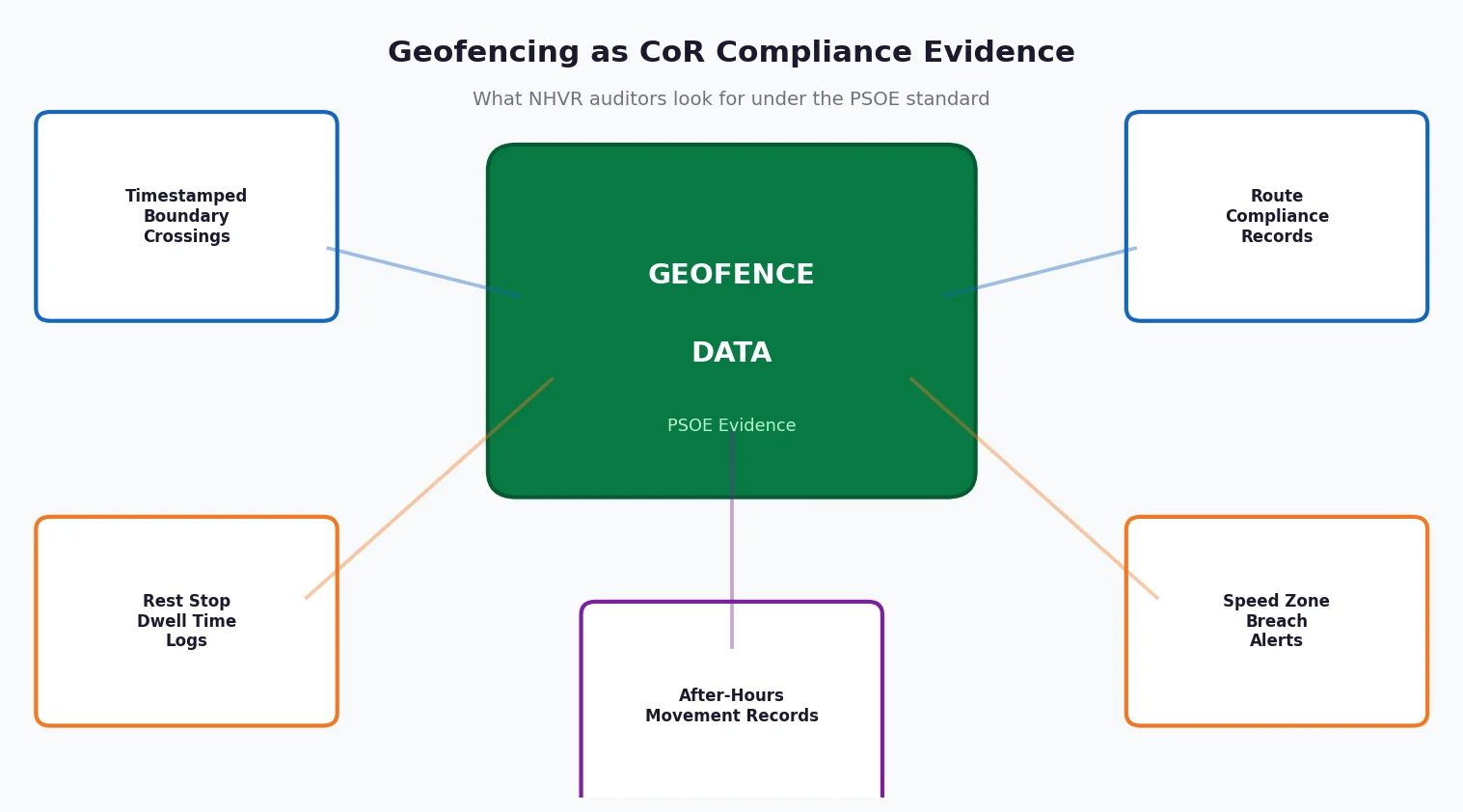
The amended Heavy Vehicle National Law (HVNL), which kicked in on 1 August 2026, now requires every Chain of Responsibility (CoR) party to maintain a documented Safety Management System (SMS). That system gets assessed against the PSOE standard (Present, Suitable, Operating, Effective). The NHVR does not specifically mandate geofencing. But the kind of evidence geofencing produces, things like timestamped boundary crossings, speed-zone alerts, dwell-time logs, and after-hours movement records, is exactly what an auditor wants to see when they are checking whether your safety controls are genuinely working day to day.

This guide walks through how geofencing works in a fleet context, the specific compliance and safety benefits it delivers for Australian operators, and how to set it up without drowning in false alerts.

What Is Geofencing and How Does It Work in Fleet Management?

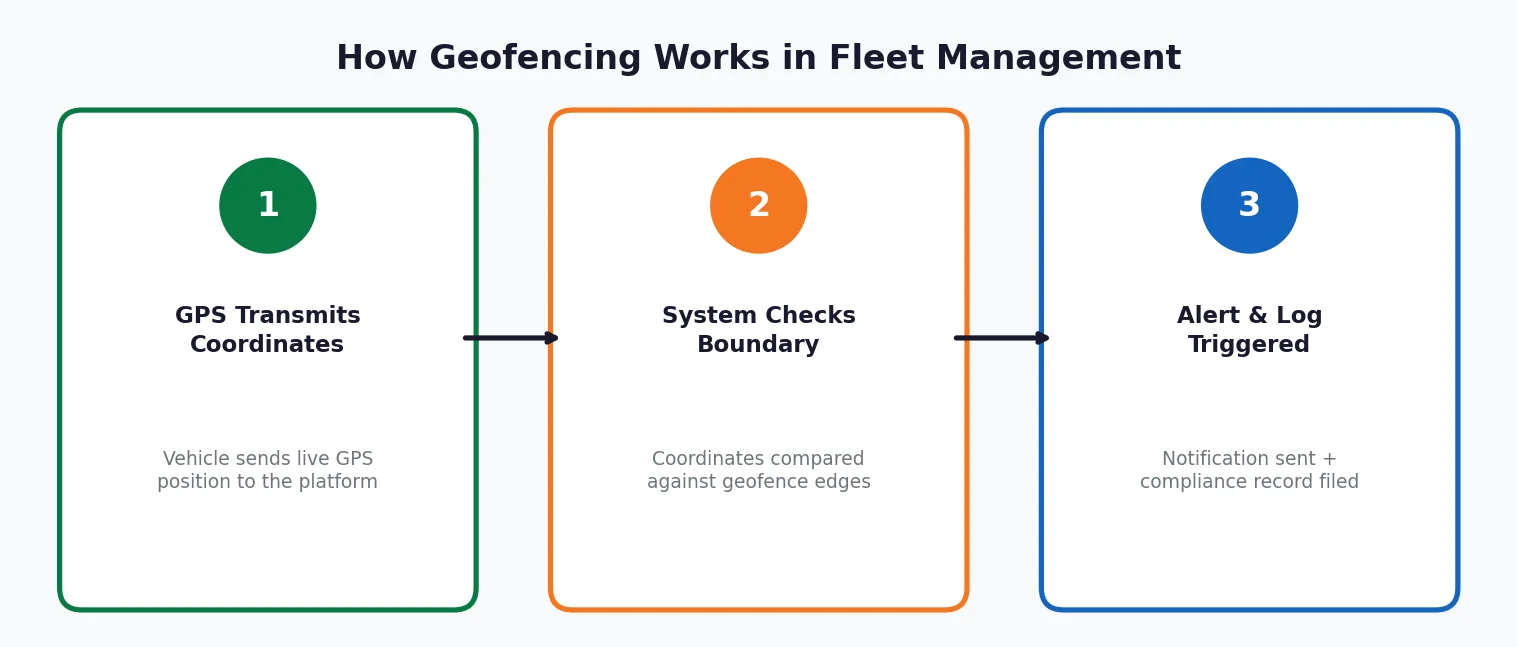
In simple terms, a geofence is a virtual boundary you draw around a real-world location on a digital map. When a GPS-equipped vehicle or asset crosses that boundary (entering or exiting), the fleet management system logs the event and triggers whatever action you have set up. That could be a push notification to you, an alert to the driver, an automated timesheet entry, or a compliance record filed against the vehicle’s trip history.
What Is Geofencing

The technology behind it relies on GPS satellite trilateration, which is the same positioning method that powers real-time fleet tracking. Your fleet software takes the vehicle’s live GPS coordinates and compares them against the stored coordinates of each geofence boundary. The moment coordinates overlap, the system registers an event.

There are three common geofence shapes you will see in fleet operations:

  • Circular (radius-based): You pick a centre point and set a radius. Quick to set up for depots, fuel stops, and customer sites. Works well when you do not need pinpoint accuracy at the edges.
  • Polygon (custom-shaped): A multi-point boundary that follows the exact outline of a site. Think construction zones, mining pits, or loading docks. Essential for sites where a few metres actually matter.
  • Corridor (route-based): A band drawn along an approved route. The system alerts you when a vehicle strays outside the corridor. Useful for hazardous goods transport or fixed-route linehaul.

For most Australian fleet operations, you will end up using a mix of all three depending on the site.

Why Geofencing Matters for Australian Fleet Compliance

Chain of Responsibility (CoR) Evidence

Under the HVNL’s Chain of Responsibility framework, every party with control or influence over a transport activity shares a legal duty to ensure safety so far as is reasonably practicable. That includes operators, schedulers, consignors, and loading managers. The NHVR’s 2026 Master Code identifies over 500 recommended controls across 45 transport activities. While the Master Code is not legally mandatory, courts can and will reference it as a benchmark for what “reasonably practicable” looks like in practice.
Geofencing cor compliance evidence

So where does geofencing fit? It directly supports several of those controls:

  • Speed management: A geofence with a speed threshold logs every instance a vehicle exceeds the limit within a defined zone. School zones, urban areas, on-site speed limits at mine sites or construction yards. That timestamped record is CoR evidence showing you were actually watching, not just hoping for the best.
  • Route compliance: Corridor geofences prove that vehicles stuck to approved routes. This matters most for dangerous goods transport or routes that need to avoid restricted roads.
  • Loading and dispatch: Geofences around loading bays and dispatch points record arrival and departure times. If a fatigue or scheduling dispute comes up later, those records support a “reasonable steps” defence.

Without this kind of data, an operator facing an NHVR audit is going to struggle to show that their safety controls were anything more than policy documents sitting in a filing cabinet. The PSOE framework specifically tests whether controls are “Operating” (being used day to day) and “Effective” (actually producing the intended safety outcome). Geofence logs are one of the clearest ways to pass both of those tests.

Safety Management System (SMS) Integration

The amended HVNL requires a documented SMS. Geofencing feeds directly into three of the five SMS outcome areas the NHVR assesses:

  1. Speed management: Zone-specific speed alerts and historical compliance rates over time.
  2. Fatigue management: Dwell-time data at rest stops, cross-referenced against driver work and rest hours. This verifies that rest breaks actually happened where and when they were recorded.
  3. Vehicle maintenance: Automated service triggers when a vehicle enters a designated maintenance bay, creating a timestamped record that feeds into your fleet maintenance schedule.

Workplace Safety Obligations

Vehicle incidents are still the number one killer in Australian workplaces. According to Safe Work Australia’s Key WHS Statistics 2025 report, vehicle incidents accounted for 42% of all worker fatalities in 2024. Trucks and semi-trailers featured prominently, and males made up 94% of vehicle-related deaths. The WHS Act defines a vehicle as a workplace, so the PCBU duty of care applies every single time a driver is behind the wheel.

Geofencing supports WHS compliance by flagging hazardous zone entries, enforcing site-specific speed limits, and generating the evidence trail that shows you were actively managing risk. That is the core requirement under both the WHS Act and the HVNL.

Practical Use Cases for Australian Fleets
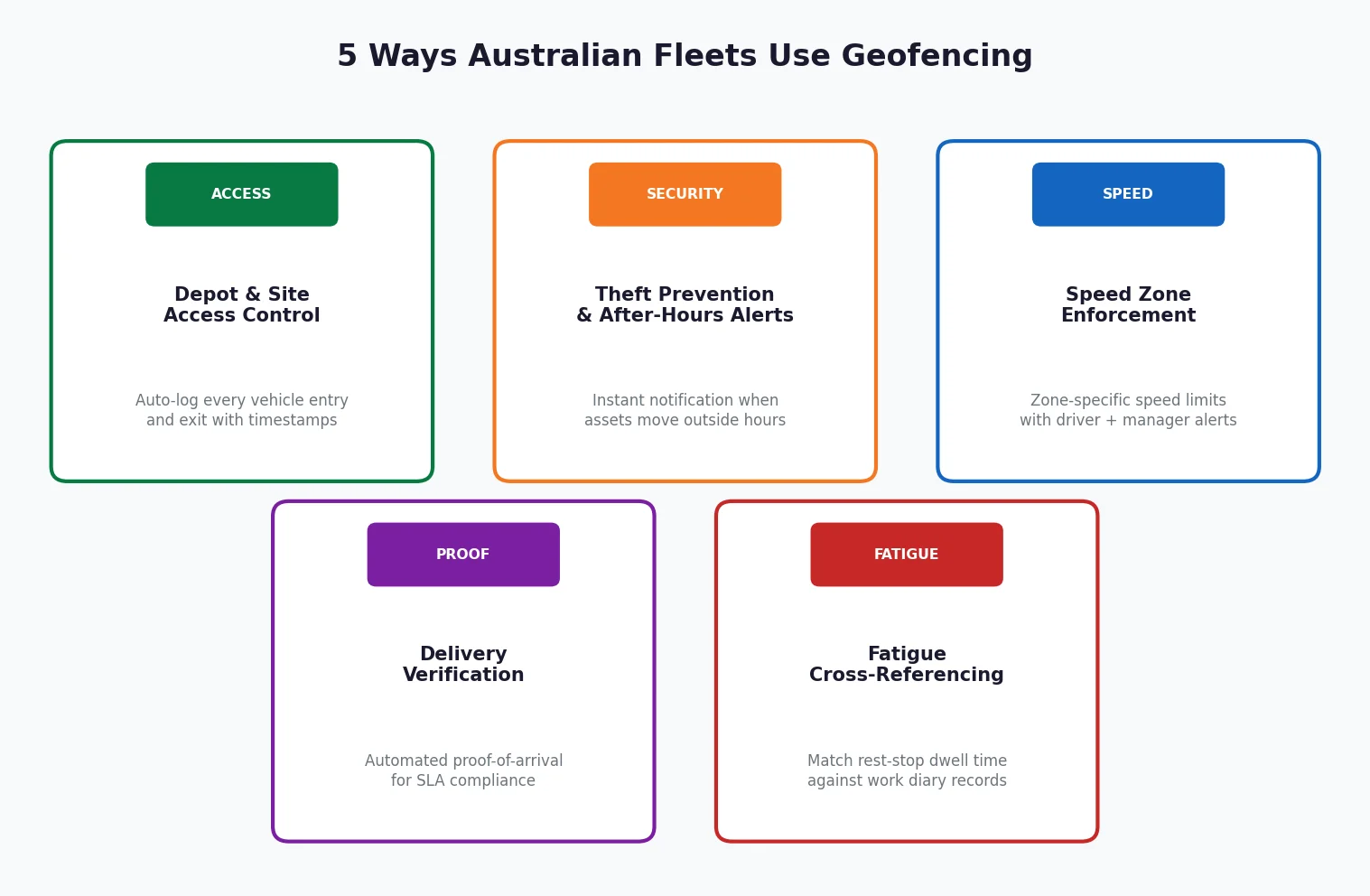
Geofencing fleet use cases

1. Depot and Site Access Control

Draw a polygon geofence around your depot, warehouse, or customer site. Every vehicle entry and exit gets automatically logged with a timestamp, driver ID, and vehicle ID. No manual sign-in sheet needed. This is especially valuable for government fleet operations where audit trails and accountability standards are strict by default.

2. Theft Prevention and After-Hours Alerts

Set a geofence around your yard or equipment storage area and configure an alert for any movement outside business hours. If a vehicle or piece of tracked equipment crosses the boundary at 2 a.m., you get an instant notification. For mining and construction operators managing high-value assets across remote sites, this kind of security layer is not optional. It is essential.

3. Speed Zone Enforcement

Create geofences with embedded speed thresholds around school zones, residential areas, or on-site restricted zones. When a vehicle exceeds the set limit inside the geofence, both the driver and the fleet manager get an alert. The event is logged as a compliance record. Over time, this data builds a reckless driving monitoring profile that supports targeted driver coaching instead of blanket penalties.

4. Customer Delivery Verification

Geofence your customer delivery points to automatically record proof-of-arrival times. This eliminates arguments over late deliveries, supports SLA compliance, and cuts down on the volume of manual ETA enquiry calls your office handles every day. One Australian distribution operator reported that daily ETA enquiry calls dropped from over 40 to fewer than 10 after deploying proximity geofences with automated SMS notifications.

5. Fatigue Cross-Referencing

Geofence designated rest areas and then cross-reference dwell-time data against EWD or work diary records. If a driver’s logbook shows a 30-minute rest break at a particular location, the geofence data should confirm the vehicle was actually stationary at that location for the same period. When the two do not match, that flags a potential false entry, which is a serious red flag in any compliance audit.

How to Set Up Fleet Geofencing Without Alert Fatigue

Alert fatigue is the number one reason geofencing implementations fail. Too many geofences triggering too many notifications. Managers start ignoring them. Then the whole system becomes useless. Here is how to avoid that.

Start With High-Value Zones Only

Begin with the locations that carry the highest compliance or financial risk. Your home depot, your top 10 customer sites, any restricted or hazardous zones, and designated rest stops on your major routes. You can always expand later. Do not try to geofence everything on day one.

Match the Geofence Shape to the Site

Use circular geofences for simple locations like fuel stops and small depots. Use polygon geofences for complex or irregularly shaped sites like construction zones, mine pits, and large warehouses with multiple entry points. Getting the shape wrong is a common source of false boundary-crossing alerts.

Set Meaningful Thresholds

A geofence alert should trigger an action, not just fill up your notification tray. Configure speed thresholds, dwell-time minimums, and after-hours windows that match your actual operational rules. If your site speed limit is 15 km/h, set the threshold at 15 km/h. Do not set it at 10 km/h, because that will generate constant false positives from vehicles manoeuvring at normal crawl speed.

Layer Geofencing With Your Existing Systems

Geofencing delivers the most value when it feeds into your broader fleet management software rather than running as a standalone tool. Integrated systems connect geofence events to maintenance schedules, driver scorecards, IVMS data, and compliance reporting dashboards. That gives you a single, auditable view of every vehicle’s operational and compliance history.

Review and Prune Quarterly

Geofences go stale. Customer sites close, projects end, routes change. Set a quarterly review to deactivate or adjust geofences that no longer match your operations. This keeps alert volume manageable and your compliance data clean.

Geofencing for Fleet Management: Real-Time Tracking vs. Passive Logging

Not every fleet tracking system handles geofencing the same way. The distinction between real-time GPS tracking and passive GPS tracking is important here.

Real-time tracking with geofencing sends you instant alerts the moment a boundary is crossed. This lets you intervene immediately, whether it is a stolen vehicle, an unauthorised after-hours movement, or a speed-zone breach that needs addressing before the driver reaches the next site.

Passive tracking with geofencing logs boundary events for later download and review. That is fine for historical reporting and audit evidence, but it cannot help you prevent an incident that is happening right now.

For compliance-critical operations under the HVNL, particularly those subject to NHVR audits or operating under the Heavy Vehicle Accreditation (HVA) scheme, real-time geofencing is the practical standard. The PSOE audit method assesses whether controls are “Operating” in real time, not just documented after the fact.

The Cost Factor: What Geofencing Adds to Fleet Tracking

Geofencing is typically included as a standard feature within GPS fleet tracking platforms. It is not usually billed as a separate add-on. The real cost is not the technology itself. It is the setup time, the integration with your existing workflows, and the ongoing management of geofence zones.

If you are already running a fleet management system with GPS tracking, activating geofencing is a configuration exercise, not a new investment. The return shows up in reduced manual reporting, fewer disputed deliveries, stronger CoR audit evidence, and faster response to security events.

FAQ

What is geofencing for fleet management?

Geofencing for fleet management is the use of GPS-defined virtual boundaries around locations on a digital map. When a fleet vehicle enters or exits a geofenced zone, the system automatically logs the event and can trigger alerts, compliance records, or workflow actions.

Is geofencing mandatory under the HVNL in Australia?

No. The HVNL does not mandate geofencing by name. However, the amended HVNL (commenced 1 August 2026) requires a documented Safety Management System assessed against the PSOE standard. Geofencing data provides the kind of operating evidence that NHVR auditors look for when checking whether your safety controls are genuinely active and effective.

How does geofencing support Chain of Responsibility (CoR) compliance?

Geofence logs create timestamped records of vehicle movements, speed-zone compliance, site arrivals and departures, and rest-stop dwell times. These records directly support the “reasonable steps” defence under the HVNL and demonstrate active operator oversight, which is a key element the NHVR assesses during CoR investigations.

Can geofencing prevent fleet vehicle theft?

Geofencing on its own does not physically stop theft. But it enables immediate detection. An after-hours boundary-crossing alert notifies the fleet manager the moment a vehicle or asset moves outside an authorised zone, which means a faster response and significantly better recovery odds.

How many geofences should a fleet set up?

Start with your highest-risk and highest-value locations: home depots, major customer sites, restricted zones, and designated rest areas. The most common implementation mistake is creating too many geofences too quickly, which leads to alert fatigue and managers tuning out. Expand gradually based on operational need and review your geofence map every quarter.

How to Become a Fleet Manager in Australia: A 2025 Guide

Are you ready to steer your career as a fleet manager, where technology and transportation merge to create one of Australia’s most dynamic professions?

The Australian fleet management market is shifting into high gear. In 2024, it reached a valuation of $806.40 million, and it’s projected to accelerate to over $2 billion by 2033, growing at a striking 9.80% annually.

This explosive growth is fueled by a rapid technology adoption, the installed base of fleet management systems in Australia and New Zealand is forecast to grow at a CAGR of 11.5%, exceeding 2.4 million units by 2027.

For aspiring fleet managers, this translates into unprecedented opportunity. This article provides the roadmap to navigate this promising career path, from required qualifications to the tools that will make you successful.

How to Become a Fleet Manager in Australia?

Becoming a fleet manager typically follows a path that blends formal education, practical experience, and specific skill development. There’s no single mandated degree, but a structured approach will fast-track your career.

fleet manager job description
Fleet manager should have skills like budgeting and financial management, maintaining detailed driver records, vehicle and maintenance knowledge.

1. Education and Training Pathways

  • Foundation: A background in business, logistics, or supply chain is ideal.
  • Formal Qualifications:
    • Certificate IV or Diploma in Automotive Management.
    • Certificate III in Driving Operations (for those in the transport industry).
  • Specialized Certifications: Pursue credentials in Chain of Responsibility (CoR) and Fatigue Risk Management.

2. Gaining the Right Experience

  • Start from the ground up in entry-level roles like:
    • Fleet Coordinator
    • Dispatcher
    • Transport Allocator
  • Gain practical knowledge in vehicle maintenance, route planning, fuel efficiency, and daily coordination of drivers and mechanics.
  • Build invaluable operational experience to understand real-world challenges and complexities.

3. Essential Skills for Success

A successful fleet manager needs a diverse skill set:

  • Analytical Skills: The role is increasingly data-driven, requiring you to analyze performance metrics and telematics data to optimize operations and reduce costs.
  • Leadership and Communication: You must effectively lead a team of drivers and maintenance staff and communicate clearly with both upper management and frontline personnel.
  • Problem Solving: The ability to quickly address and resolve issues, from vehicle breakdowns to scheduling conflicts, is essential in this fast-paced environment.
  • Technical Proficiency: Familiarity with fleet management software, GPS tracking systems, and telematics is no longer a bonus but a core requirement of the job.

Is Fleet Management a Good Career?

Fleet management is not just a good career. It’s a strategically important role with strong growth prospects and opportunities for advancement across a diverse range of industries.

Fleet Manager in Australia
Fleet management is a good career for those who are willing to pursue as a fleet manager because of its strong growth in Australia over recent years.

1. Job Outlook and Opportunities

  • Strong Growth: The profession has grown significantly, with the number of fleet managers in Australia increasing from 2,500 to 3,000 in a recent five-year period.
  • Diverse Sectors: Fleet managers are vital in:
    • Logistics and Transportation
    • Construction
    • Public Services (example as police, ambulances)
    • Corporate Fleets
  • Varied Job Titles: Common entry-level roles include:
    • Fleet Coordinator
    • Transport Allocator
    • Fleet Controller

2. Why Should Someone Hire You as a Fleet Manager?

This is your chance to highlight your unique blend of skills. A compelling answer would focus on your ability to:

  • Drive cost-saving initiatives through data analysis, negotiating with suppliers, and optimizing routes.
  • Ensure strict safety and regulatory compliance, minimizing risk for the company.
  • Leverage technology to improve efficiency, from telematics to fleet management software.
  • Lead and mentor drivers and staff, fostering a positive work environment and a strong safety culture.

The role is both challenging and rewarding, offering the satisfaction of overseeing complex operations and making a tangible impact on a company’s bottom line and operational excellence.

Fleet Manager Salary in Australia as of 2025

A career in fleet management offers competitive financial rewards, with salary varying significantly based on experience, fleet size, and industry.

The table below outlines the typical salary ranges you can expect in Australia:

Experience LevelTypical Annual SalaryMonthly Equivalent (Pre-tax)
Entry-Level (0-2 years)$45,000 – $65,000$3,750 – $5,416
Mid-Career (3-7 years)$65,000 – $90,000$5,416 – $7,500
Senior/Experienced (8+ years)$90,000 – $120,000+$7,500 – $10,000+
Data Source: OXMAINT

These figures align with other data showing that a full-time Fleet Manager in Australia generally earns about $2,170 per week, which is approximately $112,840 per year.

Your compensation will also be influenced by your location, the specific industry, and your success in implementing cost-saving measures.

Here’s How Manage Vehicle Makes A Fleet Manager’s Job Easy

In today’s demanding environment, a fleet manager’s success is heavily dependent on the tools they use.

Modern fleet management software like Manage Vehicle is designed to automate routine tasks, provide real-time insights, and consolidate complex operations into a single, manageable platform.

Manage Vehicle Makes Easy Job For Fleet Manager
Manage Vehicle helps as a useful tool for fleet managers to simplified fleet and compliance management, streamlining daily operations, and data-driven decision making.

1. Centralized Fleet and Compliance Management

  • Centralized Platform: Manage everything in one place, eliminating paperwork and spreadsheets.
  • Core Features:
    • Digital vehicle service and repair records.
    • Automated preventive maintenance alerts.
    • Comprehensive driver management tools.
  • Ensures Compliance: Integrates Chain of Responsibility (CoR) and Fatigue Management systems.
  • Key Outcome: Saves administrative time and drastically reduces compliance risks.

2. Streamlined Daily Operations

  • Streamlines core workflows from planning to proof-of-delivery.
  • Efficient job dispatch and allocation for drivers and fleet.
  • Digital pre-start inspections for instant fault reporting.
  • Electronic Proof of Delivery (POD) with customer signatures.
  • Integrated in-vehicle chat to keep everyone connected and accountable.

3. Data Driven Decision Making

  • Advanced Telematics: Integrates GPS tracking, live dashcams, and AI-powered safety cameras.
  • AI Safety Features: Includes fatigue and distraction detection for drivers.
  • Data-Driven Insights: Enables route optimization, targeted driver coaching, and strategic decisions on fleet costs.
  • Proactive Management: Provides a clear operational view to move from reactive problem-solving to strategic management.

Ready to transform complex fleet challenges into streamlined successes? Discover how Manage Vehicle can empower you to become a more effective, data-driven, and strategic fleet manager. Explore our platform today and take the first step towards mastering your fleet.

Why Cost Management is the Lifeline of Your Fleet Business?

Cost management turns a crisis like an unexpected engine failure, with its idling driver, wasted fuel, and client complaints, from a daily reality into a controlled, predictable event.

Recently, a mid-sized logistics company faced a $20,000 loss in a single month from unscheduled repairs and fuel inefficiencies, underscoring why proactive cost management is no longer optional, it’s essential for survival.

With industry benchmarks revealing that trucking fleets incur a cost per mile (CPM) of $0.31, significantly higher than the cross-industry average of $0.24, the pressure to optimize expenses is intensifying.

Factors like aging vehicles, erratic fuel prices, and driver shortages exacerbate these challenges, making it clear; without a strategic approach to cost management, profitability slips away mile by mile.

Cost Management Tackles Maintenance or Operational Costs

Fleet expenses extend far beyond fuel and repairs. Understanding and controlling these costs is the first step toward sustainable operations. Key areas to address include:

Cost Management Tackling Fleet Maintenance and Operational Costs
Manage Vehicle can assist you in cost management for your heavy vehicle maintenance and operational costs.
  • Preventive Maintenance Over Reactive Repairs:

Delaying maintenance leads to costlier breakdowns. Fleets with aging vehicles 10 plus years face up to 35% higher CPM due to frequent repairs.

Implementing scheduled maintenance reduces unexpected downtime and extends asset lifespan.

  • Fuel Efficiency Optimisation:

Fuel constitutes 25% of per-mile costs. Strategies like route optimization, reducing idling which wastes 1 gallon per hour, and driver training on efficient driving can cut fuel consumption by 10 to 14 percent.

  • Data-Driven Decision Making:

Tracking metrics like Cost per Mile (CPM) and Total Cost of Ownership (TCO) helps identify inefficiencies.

For example, the median TCO for trucking assets is $19,612 nearly double the industry average highlighting the need for granular cost analysis.

  • Labor and Indirect Costs

Driver wages, insurance rising by 5 to 10% annually, and administrative overheads are often overlooked. Integrating these into cost calculations ensures a holistic view.

  • Leveraging Technology

Telematics and AI-driven tools like Manage Vehicle provide real-time insights into driver behavior, fuel usage, and maintenance needs, enabling proactive interventions.

Pro Tip: Vehicles over 10 years old cost up to 35% more per mile to operate. Build a replacement plan based on CPM and TCO, not just odometer readings.

Manage Vehicle Gives Fleet Cost Control to Owners

To tackle these challenges, fleets need integrated tools that simplify complexity. Manage Vehicle, a cloud-based fleet maintenance platform, centralizes operations and transforms data into actionable insights. Its features include:

Manage Vehicle for Cost Management
Manage Vehicle gives you 24/7 real-time alerts on your truck with telematics-integrated GPS tracking system.
  • Automated Maintenance Scheduling: Set reminders for services based on mileage, hours, or fuel consumption to prevent costly breakdowns.
  • Real Time Cost Tracking: Monitor CPM and TCO trends per asset, route, or driver to identify inefficiencies.
  • Fuel Management Integration: Sync with fuel cards and telematics to track consumption, reduce idling, and flag irregularities.
  • Digital Inspections and Compliance: Replace paper checklists with customizable mobile forms to ensure safety and regulatory adherence.
  • Inventory and Parts Management: Track spare parts usage, set reorder alerts, and avoid overstocking or emergency purchases.
  • Reporting and Analytics: Generate custom reports on asset health, repair history, and operational costs to guide decisions.

By consolidating these functions, Manage Vehicle helps fleets reduce downtime, slash maintenance costs, and improve fuel efficiency, all from a single dashboard.

“The smart dash cams and telematics devices have really improved how we manage our fleet. We can see everything in real time, which helps with planning routes and saving on fuel. The asset management tools keep our vehicles in top shape,” says Gill Australian Transport, our customer since 2020.

Transform your fleet into a profit center, try Manage Vehicle free today!

Transport Compliance Software: Is Your Fleet Business Compliant?

Fleet operators need transport compliance software to handle the many transportation rules that regulate the industry. The system makes compliance work automatic while tracking driver actions and maintaining vehicle conditions to produce better results.

In today’s fast-paced logistics environment, staying compliant with ever-evolving regulations can be daunting. Cargo transport compliance software gives fleet leaders instant details they need to take prompt action about compliance.

Moreover, the fleet compliance system protects against violations that bring penalties. Our system makes sure teams stay responsible and open in their work.

The Role of Transport Compliance Software in Fleet Management

Transport compliance software helps fleet management run all required compliance processes automatically. Our system monitors driver activities and ELD logs while setting automatic vehicle maintenance schedules.

By bringing these functions together, the software lessens the workload for administrators and reduces mistakes. This fleet and compliance system carefully meets all compliance requirements.

Moreover, the integration of transport compliance software with existing fleet management systems enhances data accuracy and accessibility. Fleet managers can access reports that strengthen compliance, streamline operations, and improve safety.

Enhancing Driver Compliance and Safety

Supervising how drivers behave helps companies keep their safety regulations in place. The software tracks transport compliance by recording how fast drivers go and how they turn the wheel and brake while measuring total vehicle downtime.

Fleet managers can use this data to spot risky behaviours. By doing so, they can create specific training programs to address these issues. Our transportation compliance software helps companies prevent accidents and follow safety requirements.

The software automatically records driving and rest periods to ensure HOS compliance. This compliance system prevents driver fatigue and helps avoid costly violations. Real-time alerts keep managers and drivers informed about HOS limits, ensuring proactive compliance.

Also Read: Fatigue Detection Camera System: Enhancing Driver Safety

Transportation Compliance Software Streamlining Vehicle Maintenance and Inspection Processes

Maintaining vehicles according to schedule with thorough checks helps companies meet all standards while saving time and resources. Transport compliance software watches vehicle health to signal issues to managers so maintenance problems stand less chance of happening.

This tool saves complete records of maintenance work and quality checks that help prove industry compliance during audits. Organized documentation proves that a firm follows official rules and makes audits easier when audited.

Being prepared helps avoid penalties and improves the organization’s relationship with regulatory bodies. Our fleet and compliance software build a positive first impression, which allows users to trust us more.

Real-Time Monitoring and Reporting Capabilities

The main benefit of transport compliance software is its ability to track and show current results in real time. The system continually collects data to show fleet managers the real-time status of all compliance measures.

Our fast response system lets us find and remedy compliance problems right away so minor problems don’t turn into significant violations. Our daily monitoring helps us prevent issues from growing and keeps our system running well.

Moreover, customizable dashboards and automated reporting features enable managers to focus on specific compliance metrics relevant to their operations. Strategic focus allows us to direct resources to critical areas, enhancing compliance management effectiveness.

Creating in-depth reports not only enhances our understanding but also fosters clear and open communication with stakeholders and regulatory authorities. This transparency builds trust and ensures everyone is on the same page.

Discover: Fleet Management Software: Streamline Operations Efficiently

Integration with Telematics and Other Fleet Technologies

Integrating transport compliance software with telematics and other fleet technologies amplifies its effectiveness. Telematics systems help track vehicles using GPS, provide vehicle health information, and collect data on how drivers behave.

Compliance software can use this information to create a better solution for meeting requirements. This integration enables a unified platform where all relevant data is consolidated, simplifying management and reporting processes.

Telematics data connected to compliance software produces accurate route routes. Our system tracks vehicles while overseeing compliance with both materials safety standards and weight restrictions.

A transportation regulation tracking system lets businesses keep to the rules while enhancing their operations. By optimizing routes and reducing fuel expenses, it completes transportation regulations obligations. A transportation industry competitor needs these gains.

Adapting to Regulatory Changes

Transportation needs to respond quickly to constant changes in government regulations to stay compliant. Fleet compliance software changes its rules to follow new industry rules.

This new feature maintains fleet compliance with rules while freeing you from manual rule updates. Moving away from the compliance burden lets you work with a better fleet management system.

Our software sends updates about government changes so you can plan. Our system gives companies the tools they need to follow the rules today while also showing they’re thinking ahead.

Your operations require regular compliance updates to run without interruption when new rules emerge. Your efforts to stay ahead of regulations benefit both your business and your capabilities to handle challenges effectively.

Interesting to Read: Pro Tips for Driving Safely Near Oversized Load Vehicles

Why is Transport Compliance Software Essential for Fleet Success?

Fleet companies need transport compliance software to follow official rules. It helps users by running their compliance work plus tracking driver actions and vehicle states with live updates.

This advanced commercial fleet management system strengthens both safety operations and saves businesses money on violation consequences. Businesses can now simplify their systems and protect both their staff and their equipment better.

Transport compliance software shows that a company follows the rules and runs its business at its best. Our program makes workers responsible and helps us build trust with our clients and industry controllers.

Using technology for transport compliance helps companies succeed more reliably and build their future.

If you enjoy reading engaging blogs like this one, stay ahead in the game by choosing Manage Vehicle as your transportation compliance software as a service.

Fleet Management Tips: Know How To Manage Heavy Vehicles?

Fleet management tips encompass paying attention to a safety, compliance, operational efficiency and vehicle tracking matrix.

Fleet Management involves more than adherence to NHVR compliance standards or implementing Fatigue and Distraction Detection Technology (FDDT)—it involves asset management, driver monitoring, transport scheduling, and so much more.

These practices facilitate reduced risk and improved productivity in businesses.

Fleet Management Tips: Master the Art of Managing Heavy Vehicles Like a Pro!

A coordinated structure and the right tools – managing a fleet as such will definitely yield results. Below are some improvements to implement within operations:

On Fatigue and Distraction Detection

Heavy vehicle operators face significant risks from driver fatigue and distracted driving. The Fatigue and Distraction Detection Technology (FDDT) monitors a driver’s real-time behaviour and triggers alarms for the driver and fleet managers when the driver is at risk of extreme fatigue.

Fleet management tips assure further road safety while remaining compliant with NHVR guidelines.

On Assets and Maintenance

Tracking vehicles and equipment along with their maintenance schedule is a must. Well-maintained fleets would significantly reduce downtime, surefire unexpected repair costs, and ensure compliance with safety measures.

Digital asset management systems give immediate, real-time insights into asset performance and maintenance. 

With an integrated online platform, you can also easily keep track of all the asset, mass, and maintenance checklists to present at the time of audit.

Also Read: Save Costs with Manage Vehicle’s Maintenance Reminders

Mass Management

Use digital mass management tools to monitor weight distribution in line with NHVR standards. Create reports and store them well for a smooth audit process.

Compliance Management

Compliance is critical and helps avoid penalties associated with the NHVR set criteria. It involves organising driver work-rest schedules, up-to-date maintenance records, checklists, and vehicle types’ compliance with safety and structural standards.

Software solutions that help keep operators audit-ready integrate the compliance aspect. Many of Manage Vehicle’s clients have achieved high success rates on audits due to their use of Compliance Management tools.

Transport Management

Coordinating routes, tracking deliveries, and managing delivery schedules go a long way toward satisfying every customer.

Advanced transport management systems have tools to optimise routes, reduce fuel consumption, and monitor delivery timelines, keeping operations smooth and on time.

How to Manage Heavy Vehicles? Know Fleet Management Tips

Modern software solutions specially designed for fleet operators make managing heavy vehicles easy. These solutions can simplify the timely completion of work, automate monotonous compliance tasks, and improve overall fleet efficiency.

Fleet management software usually provides:

  • Real-time Tracking Vehicle: You’ll know where your vehicles are and what your drivers are doing.
  • Automated Compliance: Stop keeping manual records and fulfilling expectations of NHVR because we have made your compliance documentation easy.
  • Maintenance Scheduling: Remember servicing reminders and expensive breakdowns.
  • Driver Safety Tools: FDDT and EWDs for safer road use.

Manage Vehicle develops software that specialises in meeting the needs of fleet operators. It incorporates all these amenities into one holistic application, making it easier for fleets to manage compliance, safety, and efficiency.

With Manage Vehicle, you would reduce operational stress, increasing business productivity.

Why You Should Choose Manage Vehicle for More Fleet Management Tips?

Choosing Manage Vehicle is choosing simplicity and reliability. Here is what makes us different:

  • All-encompassing solutions: Software covering everything from compliance management to driver safety tools is available in one place.
  • Audit-Ready Systems: Passing NHVR audit becomes easy with an automated record-keeping and easy reporting tool.
  • Customer-Centric Approach: As such, we will keep updating and offer our support for industry changes to help you adapt.
  • Affordable: Affordable and mostly scalable to small-to-medium enterprises.

Switch to Manage Vehicle and change the way you manage your fleet.

Don’t hesitate to contact us today at [email protected] or visit our website to learn more.

The Top Fleet Management Software in Australia

Fleet management software is an invaluable tool for many businesses in the freight and trucking industry, whether they run a small fleet of vehicles or manage a large, vast set of assets.

Vehicle management software is essential in ensuring these fleets’ efficient, safe, and cost-effective operation.

In this article, we examine the significance of fleet management reports and explore how they improve various aspects of fleet operations.

What does Fleet Management Software do?

Fleet management software breaks down critical data about your fleet’s performance. They pull information from telematics systems, GPS trackers, maintenance logs, and driver reports.

The software analyzes and presents this data in a clear, actionable format. Ultimately, this helps fleet managers make more educated and informed decisions, which improves overall performance.

Key Elements of Vehicle Management Software

  1. Vehicle Performance Metrics: A vehicle management software will obtain and provide detailed performance information on each vehicle. Its fuel efficiency, mileage, engine diagnostics, and maintenance history constitute such metrics.

    Monitoring these metrics will allow for fleet managers to plan their preventive maintenance schedule and fuel optimisation, saving operational costs.
  2. Driver Behavior Analysis: Many fleet software management include driver behaviour analysis, tracking speeding, harsh braking, and idling time.

    This data helps fleet managers identify avenues where driver training may be needed to improve safety as per NHVR standards. It also helps when addressing potential liability issues.
  3. Route Optimization: Advanced vehicle management software can provide suggestions into route efficiency.

    By analysing routes taken, idling time and traffic conditions, the organisation can then use the best possible route and thus consume less fuel in delivering products. The result- improved customer satisfaction because of on-time services.
  4. Compliance Checking: Fleet management software guarantee that companies in the regulated industry comply with regulatory standards.

    Such examples may include hours-of-service compliance for drivers, inspection of vehicles, etc. Furthermore, compliance deters violations and enhances overall safety.
  5. Inventory Management: Some systems connect fleet reports with inventory tracking. This confirms that goods are moved efficiently, avoiding stockouts, and preventing overstocking.

Benefits of Fleet Management Software

  1. Cost Reduction: Fleet management software help identify cost optimizations like better routing, smaller fuel usage, or reduced maintenance costs in businesses. Such savings can have significant impacts on the bottom line.
  2. Better Safety: Vehicle management software create a safer driving environment by monitoring driver behaviour and setting ground for corrective actions when needed. This reduces the risk of accidents.
  3. Improved Customer Service: Efficient route planning and on-time deliveries improve customer satisfaction and loyalty. With real-time tracking capabilities, companies can also provide customers with accurate delivery estimates.
  4. Data-Driven Decision Making: Fleet management software provide valuable data that can inform strategic decisions, such as whether to expand the vehicle, replace aging vehicles, or invest in new technology. Fleets can base these decisions on empirical data rather than guesswork.

Efficient vehicle management software is critical to staying competitive. Fleet reporting software empowers businesses with concrete performance, safety, cost savings, and compliance insights.

Companies that embrace this technology gain an edge in customer service, safety, and efficiency. As the tech evolves, fleet management software will only grow in importance—helping businesses shape a smarter, greener future.

Fleet Management Software for Small Businesses

Is Fleet Management Software beneficial for Small Businesses? In today’s fast-moving business world, effectively managing your fleet of vehicles is important for staying ahead, whether you’re a small or large company. Small businesses, especially, need to make sure their fleet operations are running smoothly to save money, boost productivity, and make sure deliveries or services happen on time. This is where fleet management software and telematics can make a big difference. They bring a bunch of benefits that can really change how small fleet businesses take care of their group of vehicles.

Explore fleet management software for small businesses. Optimise operations, enhance efficiency, and ensure timely services. Learn more now!

Understanding Fleet Management Software and Telematics

Fleet management software is a comprehensive tool designed to simplify and streamline various aspects of fleet operations. It involves using technology to gather, analyse, and leverage data from vehicles in real-time. Telematics, on the other hand, involves the integration of telecommunications and informatics to enable the remote exchange of information related to vehicle behavior and performance.

Top 6 Benefits for Small Businesses

Here are 6 key advantages that small businesses can enjoy by incorporating fleet management software into their operations and industry:

1. Cost Savings

One of the primary advantages of implementing fleet management software is cost savings. Small businesses can efficiently track fuel consumption, monitor vehicle maintenance schedules, and identify inefficiencies, helping to reduce operational expenses significantly.

2. Enhanced Productivity

Fleet management solutions offer real-time GPS tracking, allowing businesses to monitor vehicle locations, routes, and traffic conditions. This information enables smarter route planning, leading to optimised delivery schedules and increased productivity.

3. Timely Deliveries and Services

For businesses that rely on timely deliveries or services, fleet management software ensures that vehicles are on track and deliveries are made promptly. This not only enhances customer satisfaction but also builds a reputation for reliability.

4. Improved Driver Management

Fleet management solutions provide insights into driver behavior, including speeding, harsh braking, and idling. This information empowers small business owners to address unsafe driving habits and provide training where necessary, promoting safer driving practices.

5. Maintenance Management

Regular vehicle maintenance is essential to prevent breakdowns and extend the lifespan of vehicles. Fleet management software can automate maintenance schedules, issue reminders, and even diagnose vehicle issues in advance, reducing downtime.

6. Geo-fencing and Real-time Tracking

With GPS and geo-fencing capabilities, businesses can define virtual boundaries for their vehicles. This feature alerts fleet managers if a vehicle deviates from its assigned route or enters a restricted area, enabling quick action in case of emergencies or unauthorised use.

Choosing the Right Software for Small Fleet

choose-the-best-fleet-management-software

When selecting a fleet management solution for a small business, it’s crucial to consider factors such as scalability, ease of use, and customer support. Look for software that offers a user-friendly interface, customisable features, and integration with other business tools.

Also, choosing fleet management solution for your small business is a decision that can greatly impact your operations.

Here’s a guide on how to select the ideal solution tailored to your small fleet’s needs:

#1: Scalability

Ensure that the software can grow with your business. As your fleet expands, the solution should accommodate the increasing number of vehicles and data without compromising performance.

#2: Ease of Use

Opt for a solution with an intuitive interface that doesn’t require extensive training for your team to start using it effectively. A user-friendly platform will save time and reduce the learning curve.

#3: Customisation

Every business is unique, so the software should allow customisation to suit your specific requirements. Look for a solution that lets you tailor features and settings according to your fleet’s operations and goals.

#4: Integration Capability

Seamless integration with other business tools and software you already use is crucial. This helps to centralise data and streamline processes, preventing information silos and reducing manual data entry.

#5: Comprehensive Reporting

The solution should provide detailed and actionable reports. Access to accurate data about fuel consumption, maintenance schedules, driver behavior, and more will enable informed decision-making.

#6: Real-time Tracking and Alerts

Ensure the software offers real-time GPS tracking, geo-fencing, and alerts. These features keep you updated on vehicle locations and deviations from routes, enabling prompt responses to unexpected situations.

#7: Maintenance Management

Look for a solution that automates maintenance scheduling and alerts. Preventive maintenance can extend the lifespan of your vehicles and reduce unexpected breakdowns.

#8: Customer Support

A responsive and helpful customer support team is essential. Technical issues or questions can arise, and having dependable support ensures you get the most out of the software.

#9: Data Security

Your fleet’s data is sensitive and valuable. Make sure the software provider follows robust security protocols to safeguard your information from breaches or unauthorised access.

#10: Reviews and Recommendations

Research and read reviews from other small businesses that have used the software. Their experiences can provide insights into how well the solution fits your needs.

#11: Cost-effectiveness

While it’s important to invest in quality software, consider the cost in relation to the benefits it offers. The solution should offer a good return on investment through improved efficiency and reduced costs.

By carefully considering these factors, you can confidently choose a fleet management solution that aligns with your small business’s goals, enhances your operations, and contributes to overall growth.

Conclusion

In the world of small business, efficiency and effectiveness are paramount. Fleet management software and telematics offer an integrated solution that empowers small businesses to optimise their fleet operations, reduce costs, enhance productivity, and ensure timely deliveries or services. By leveraging these advanced technologies, small businesses can stay competitive, build customer trust, and pave the way for sustainable growth in a dynamic market.

Investing in a robust fleet management solution is no longer a luxury; it’s a necessity for small businesses aiming to thrive in today’s highly competitive business environment. With features ranging from real-time GPS tracking and geo-fencing to maintenance management and driver behavior analysis, these tools offer a comprehensive solution to the challenges faced by fleet managers in both small and large enterprises alike.

Fleet Management Challenges Faced by Fleet Managers

Fleet managers are responsible for overseeing a company’s fleet of vehicles, which can include trucks, cars, vans, buses, and more. They face a range of challenges that can impact the efficiency, safety, and cost-effectiveness of their operations.

Here are the top challenges faced by fleet managers:

  • Vehicle Maintenance and Downtime
  • Fuel Costs
  • Driver Management
  • Route Optimisation
  • Compliance and Regulations
  • Data Management
  • Technology Implementation
  • Cost Control
  • Safety and Risk Management
  • Environmental Impact
  • Vehicle Selection and Replacement
  • Communication and Coordination

Top 7 Challenges of Fleet Managers with Solutions

In today’s world, fleet managers, regardless of their fleet’s size or the industry they’re in, are facing with similar challenges. We’ve compiled the top seven challenges faced by fleet managers while managing fleet. Whether you’re overseeing a small group of vehicles or an entire fleet, remember, you’re not alone in tackling these concerns.

top-7-fleet-management-challenges

“Fleet managers, like other managers, often encounter challenges centered around boosting productivity and reducing costs. These shared challenges stem from the need to efficiently manage resources, streamline operations, and maintain profitability. However, what sets fleet managers apart is their unique mix of solutions that combine technology and creative strategy.“

Some of the common challenges faced by fleet managers include:

1. Vehicle Maintenance and Downtime

Keeping a fleet of vehicles in good working condition is essential for minimising downtime and maximising operational efficiency. Coordinating regular maintenance, addressing breakdowns, and managing repairs can be a complex and time-consuming task.

Fleet Challenges: Fleet managers tackle challenges by planning regular checkups, dealing with sudden breakdowns, and handling repairs. They need to organise when and where maintenance happens for various vehicle types, which takes time and effort. When vehicles break down unexpectedly, quick decisions are needed on whether to fix them on the spot or get replacements. Repairing vehicles, whether for minor issues or major overhauls, adds to the complexity.

Solution (Services and Maintenance Reminders): Balancing the need for upkeep with minimising downtime is a constant puzzle. New technologies such as fleet management software help by diagnosing vehicle problems. Fleet management software is a valuable tool for tackling vehicle maintenance and downtime challenges. It predicts maintenance needs through real-time monitoring, schedules tasks proactively, and tracks maintenance histories. This automation streamlines upkeep, enhances efficiency, and reduces unplanned downtime, enabling fleet managers to keep their vehicles in optimal working condition.

2.Fuel Costs

Expenses are a significant portion of a fleet’s operating budget. Fleet managers need to find ways to reduce fuel consumption, optimise routes to minimise mileage, and implement fuel-efficient driving practices to keep costs in check.

Challenges: Fleet managers often face significant challenges with fuel costs. They need to figure out how to lower the amount of fuel their vehicles use, choose the best routes to travel shorter distances, and encourage drivers to use fuel more efficiently. These challenges can be tough to handle, but finding smart solutions is crucial to managing expenses and keeping the fleet running smoothly.

Solution (Fuel and expenses analytics): To combat fuel cost challenges, implementing fuel and expenses analytics is key. This technology tracks fuel use, analyses routes, and monitors driver habits. It helps identify inefficient driving practices, offers targeted training, and optimises routes for less mileage and fuel use. These insights empower fleet managers to make informed decisions, cut costs, and ensure efficient fleet operations.

3.Driver Management

Ensuring that drivers are skilled, safe, and compliant with regulations is crucial. Fleet managers need to monitor driver behavior, enforce safety protocols, provide training, and manage driver schedules effectively.

Challenges: Driver management poses significant challenges for fleet managers. They must handle various aspects, like ensuring driver safety, following regulations, encouraging responsible driving, and creating efficient schedules. Dealing with different driver personalities and skills while tackling issues such as fatigue and turnover requires strong communication and leadership. Striking a balance between maintaining a positive work environment and upholding operational standards is crucial in the ever-changing landscape of driver management.

Solution (Electronic Work Sheet (EWS): To address the challenges of driver management, integrating EWS solutions can prove highly beneficial. EWSs offer a digital platform for recording driver activities, ensuring compliance with regulations while minimising paperwork. These solutions provide real-time insights into driving hours, rest breaks, and other essential data, helping prevent driver fatigue and maintain regulatory compliance.

By automating record-keeping and fostering transparent communication, EWDs simplify driver management, enhance safety, and streamline scheduling. This technology empowers fleet managers to maintain efficient operations while effectively addressing the multifaceted challenges associated with driver management.

4.Route Optimisation

Efficient route planning can help reduce mileage, lower fuel consumption, and improve delivery times. Fleet managers must consider factors like traffic, weather conditions, customer demands, and vehicle capabilities to optimise routes.

Challenges: Fleet managers encounter several challenges when it comes to optimising routes. They need to navigate through factors like changing traffic conditions, road closures, and weather disruptions. Balancing delivery efficiency with customer expectations is tricky. Coordinating diverse delivery points and schedules while minimising mileage can be complex. Integrating real-time data, technology, and driver availability adds another layer of intricacy.

Solution (Route and Location History): To tackle the challenges of route optimisation, implementing Route and Location History solutions can be highly effective. By analysing past routes and real-time location data, fleet managers can plan smarter routes, minimise delays, and meet customer expectations more effectively. Integrating technology for live traffic updates enhances adaptability, ensuring efficient and accurate deliveries.

5.Compliance and Regulations

Fleet operations are subject to various regulations and compliance standards, including safety regulations, environmental requirements, and hours-of-service rules for drivers. Keeping up with these regulations and ensuring compliance can be challenging.

Challenges: Fleet managers face difficulties when it comes to following compliance and regulations. They have to navigate through various rules and requirements, making sure vehicles and drivers meet safety and environmental standards. Keeping up with changing regulations and managing paperwork can feel like a lot. It’s important to balance operational needs with legal obligations. Fleet managers play a key role in training drivers to follow rules and keeping accurate records to meet compliance demands.

Solution (Documents Management and Reporting): To address the challenges of compliance and regulations, implementing Documents Management and Reporting solutions is highly effective. These solutions streamline the process of organising and tracking required documents, such as licenses, permits, and inspection reports.

Automated reporting tools help fleet managers stay on top of regulatory changes and deadlines. This approach ensures that all necessary paperwork is up-to-date and accessible, reducing the risk of fines and penalties. By integrating technology for efficient document management and timely reporting, fleet managers can navigate compliance complexities with greater ease and confidence.

6. Safety and Risk Management

Ensuring the safety of both drivers and the public is paramount. Fleet managers must implement safety protocols, monitor driver behavior, and address risky practices to reduce accidents and associated liabilities.

Challenges: Fleet managers face difficulties in safety and risk management. They need to uphold safety protocols, monitor driver conduct, and mitigate risky behaviors to prevent accidents and liabilities.

Solution (Smart Dashcams): To address safety and risk management challenges, implementing Intelligent AI Smart Dashcams can be instrumental. These advanced dashcams monitor driver behavior, detect risky actions, and provide real-time alerts. By capturing critical incidents and generating actionable insights, these dashcams enhance safety, support driver training, and mitigate potential liabilities.

7. Fleet Driver & Job Allocation

This challenge is a common one faced by almost all fleet managers and organisations. The task involves juggling various factors such as driver availability, vehicle compatibility, and efficient route planning while still meeting customer demands.

Challenges: Fleet managers encounter difficulties while assigning jobs to fleet drivers. They need to balance driver availability, skills, vehicle compatibility, and efficient route planning. Meeting customer demands, optimising schedules, and ensuring timely deliveries add complexity to the task.

Solution (Drivers and Job Assignment): To address challenges in job assignment, focusing on drivers is crucial. Fleet managers can create a system that considers driver availability, skill sets, and vehicle suitability. By implementing efficient route planning tools and optimising schedules, managers can meet customer demands and ensure timely deliveries. This driver-centric approach streamlines job allocation, enhances operational efficiency, and ultimately improves customer satisfaction.

Conclusion

Fleet managers confront universal challenges that span fleet sizes and industries, impacting operations, safety, and costs. Yet, solutions are at hand. Technologies like fleet management software and compliance management software empower managers to optimise maintenance, fuel efficiency, and driver safety. Route optimisation, Electronic Work Diaries (EWDs) and documents management solutions further enhance efficiency. As these challenges bind fleet managers together, their commitment to innovative solutions and adaptable strategies drives success across the diverse landscape of fleet management.

We hope that our comprehensive exploration of the top seven challenges faced by fleet managers, along with their corresponding solutions, has provided valuable insights. By looking into these challenges and their solutions, we aim to assist fleet managers in navigating the complexities of their roles with enhanced confidence and effectiveness.

Minimising Operational Costs with Fleet Management Solutions

Steering the helm of a large or small fleet comes with its own set of unique challenges. One of the key concerns for businesses in a volume-based industry is managing operational costs. Each vehicle needs regular maintenance, fuel costs add up quickly, and compliance issues could lead to significant fines. With these ongoing expenditures, finding ways to reduce operational costs are imperative for the financial health of any business that depends on a fleet for operations. Fortunately, with advances in technology and software, it’s now easier than ever to minimise these costs and boost efficiency through the use of fleet management software like Manage Vehicle’s solutions. This blog post will provide an in-depth view of how fleet management software can aid businesses in reducing operational costs and ameliorating efficiency.

Manage Vehicle’s fleet management software is specifically designed to be a game-changer in managing fleets’ expenses. One of the significant expenditures—fuel—can dramatically be reduced by effectively utilising the data-driven insights this software provides. It helps fleet managers track and manage fuel usage while also identifying issues such as fuel theft or inefficient driving behaviour that might be inflating fuel expenses unnecessarily.

Maintenance is another critical operational cost for any fleet. Instead of reacting to problems as they occur, utilise Manage Vehicle’s preventive maintenance feature to stay a step ahead. By scheduling regular maintenance checks and keeping an eye on vehicle condition through dashboards, businesses can avoid expensive repairs and downtime that can affect their bottom line.

Furthermore, Manage Vehicle’s software is not just about maintenance schedules and fuel consumption. It also helps with compliance, ensuring fleets meet legal and industry-specific regulations, therefore preventing hefty fines and penalties related to breaches of standards.

Reducing Fuel Costs through Data-Driven Insights

One of the significant expenditures—fuel—can dramatically be reduced by effectively utilising the data-driven insights provided by Manage Vehicle’s fleet management software. This innovative software helps fleet managers track and manage fuel usage while identifying issues such as fuel theft or inefficient driving behaviour that might be inflating fuel expenses unnecessarily. Fuel cost reduction involves implementing several strategies:

1. Monitoring Driving Behaviour: By flagging inefficient driving patterns such as sudden acceleration and excessive idling, the software helps improve overall fuel efficiency.

2. Route Optimisation: The software can suggest the most fuel-effective routes, ensuring that drivers take the shortest and most efficient routes to their destinations, saving time and fuel costs.

3. Identifying Fuel Theft: Misuses of fuel cards and unauthorised refuelling can be identified quickly through the software, thereby deterring fuel theft within the organisation.

Emphasising Preventative Maintenance

Maintenance is another critical operational cost for any fleet. Instead of reacting to problems as they occur, utilise Manage Vehicle’s preventative maintenance feature to stay a step ahead. By scheduling regular maintenance checks and keeping an eye on vehicle condition through dashboards, businesses can avoid expensive repairs and downtime that can affect their bottom line. Key benefits of a proactive maintenance strategy include:

1. Decreased Downtime: Vehicles undergo maintenance at regular, scheduled intervals, reducing the likelihood of unexpected downtimes and costly repairs.

2. Extended Life of Vehicles: By taking care of minor issues before they become major problems, businesses can ensure their vehicles have a longer operational life.

3. Improved Safety: Regularly maintained vehicles are more dependable and less prone to breakdowns, resulting in fewer accidents and injuries.

4. Reduced Costs: The ability to address potential maintenance issues before they escalate can lead to substantial cost savings for businesses in the long term.

Ensuring Compliance to Avoid Fines and Penalties

Manage Vehicle’s software not only offers cost-saving benefits through fuel management and preventative maintenance but also helps with compliance, ensuring fleets meet legal and industry-specific regulations. Keeping up with industry standards and guidelines prevents hefty fines, penalties, and liability relating to breaches of policies. The software fosters compliance by:

1. Streamlining Record-Keeping: Manage Vehicle’s software simplifies the process of record-keeping for vehicle maintenance, inspections, and services, thereby aiding with regulatory compliance.

2. Monitoring Driver Certifications and Licences: Having well-trained and certified drivers is critical to maintaining compliance standards. The software makes it easy to monitor and manage drivers’ certifications, licences, and renewal dates.

3. Offering Real-Time Alerts and Notifications: Managers can set up reminders for upcoming inspections, registrations, and certifications, ensuring they stay up-to-date with compliance requirements.

Utilising Technology for Fleet Optimisation

With the adoption of telematics, GPS tracking, and advanced software solutions, fleet managers can now harness the power of technology for fleet optimisation. Manage Vehicle’s software provides a comprehensive platform that takes advantage of these technologies to deliver actionable insights that help to identify inefficiencies and improve overall fleet performance. The software’s capabilities include:

1. Real-Time Vehicle Tracking: Gain insights into the location and status of every asset in the fleet in real time, enhancing productivity and improving response times.

2. Integrations with Other Software Solutions: Manage Vehicle’s software is compatible with various third-party applications, enhancing its functionality and introducing opportunities for further cost savings and efficiency improvements.

3. Customisable Reporting: Access insightful reports that can be customised according to business needs, allowing for informed decision-making and resource allocation.

Conclusion

Leveraging the power of Manage Vehicle’s fleet management software can significantly improve a fleet’s operational efficiency and reduce costs. Through careful monitoring, proactive maintenance, and compliance-focused features, businesses can avoid unnecessary expenses while maximising the performance and longevity of their fleet. Investing in fleet management tools not only addresses immediate cost-saving needs but also lays the foundation for long-term success and growth in a competitive, modern business landscape. 

Manage Vehicle’s smart fleet management system is the solution you’ve been searching for. With our software, you can easily run your fleet smoothly on the road, saving you time and money. Plus, you’ll have peace of mind knowing that you’re in compliance with all regulations. Don’t wait any longer to upgrade your fleet management. Contact us today and experience the benefits of modern technology.

Enhancing Driver Safety with Manage Vehicle’s Fleet Management Software

Driver safety fleet management software is becoming essential for fleet-based businesses. The safety of drivers is a top priority – accidents and injuries not only cause significant harm to drivers but can also result in costly equipment damage, lost productivity, and reputational damage.

Fleet management software, like Manage Vehicle’s innovative solutions, offers a wealth of functionality that can be used to bolster driver safety and encourage responsible driving habits. From real-time monitoring of driver behaviour to the provision of comprehensive safety-related training resources and support for compliance with relevant regulations, fleet management software can play a pivotal role in creating a culture of safety and responsibility within your fleet operations.

In this blog post, we’ll discuss how Manage Vehicle’s fleet management software is uniquely geared towards fostering a safer driving environment, with a focus on driver monitoring, training, compliance management and accident prevention. 

Our aim is to show you how your fleet can benefit from software-driven safety initiatives, leading to fewer accidents, a healthier workforce and a more favourable reputation within the industry. Stay tuned as we explore the various ways in which fleet management software can contribute to driver safety and, ultimately, the success of your fleet-based business.

Real-Time Driver Monitoring for Improved Safety

One key aspect of driver safety lies in the ability to monitor and assess individual driving habits. Manage Vehicle’s fleet management software provides real-time data on driver behaviour, including essential metrics such as speed, braking patterns and sudden acceleration or deceleration. By regularly analysing this information, fleet managers can identify potentially dangerous driving habits and work proactively with drivers to correct them.

Enhancing Driver Safety with Manage Vehicle’s Fleet Management Software

Driver safety is an important priority for any fleet manager. In order to protect both drivers and vehicles, it is essential to have efficient fleet management software in place. Such software allows fleet managers to monitor and manage their fleet in real-time, helping to ensure that drivers are safe and vehicles are secure. Here are the ways how fleet management software help enhance driver safety: 

Encouraging Adherence to Safety Regulations

Compliance with safety regulations is essential to ensuring the well-being of drivers and avoiding costly fines and penalties for your business. Manage Vehicle’s software is designed to support compliance with relevant regulations, helping businesses maintain their licence to operate and protect workers on the road. Key features include:

  • Document Storage and Tracking: The software allows for easy storage and management of critical safety documents such as vehicle inspection reports, driver certifications and insurance policies, ensuring that the information is readily accessible for compliance-related purposes.
  • Alert and Notification System: The system provides timely notifications and reminders for upcoming compliance milestones such as routine inspections, licence renewals and driver training sessions.
  • Tailored to Local Regulations: Manage Vehicle’s software is designed to help fleet managers adhere to Australian regulations, giving fleet managers extra confidence that they’re meeting the requirements specific to their area.

Safety-Focused Training and Education

Effective training and education are vital components of a safer fleet environment. Manage Vehicle’s software includes a range of resources designed to support driver training and safety:

  • Online Courses: The software offers access to online training courses and educational material, covering topics such as defensive driving techniques, vehicle maintenance and hazard identification.
  • In-House Training Plans: Manage Vehicle’s software can help fleet managers develop in-house training plans tailored to their drivers’ unique needs, ensuring that training efforts focus on the right areas for improvement.
  • Reporting and Progress Tracking: The software enables managers to track individual driver progress and certifications, ensuring that everyone stays up to date with their safety-related training and development.

Accident Prevention Through Proactive Fleet Maintenance

Preventative maintenance is key to keeping your fleet in optimal condition and reducing the likelihood of accidents caused by mechanical failures. Manage Vehicle’s fleet management software includes features designed to streamline the maintenance process, such as:

  • Scheduling and Reminders: The software helps fleet managers ensure regular maintenance checks are made by sending automated reminders and scheduling appointments with mechanics.
  • Maintenance History Tracking: The software keeps track of each vehicle’s maintenance history, making it easy for fleet managers to stay on top of potential issues before they escalate into more severe concerns.
  • Predictive Maintenance: The software can calculate when parts might need replacement and identify routine maintenance tasks that can help prolong the vehicle’s life and prevent problems from occurring.

Conclusion

Fostering a culture of safety within your fleet operations is not just a matter of meeting regulatory requirements – it’s about protecting your most valuable assets: your drivers. By leveraging the power of Manage Vehicle’s fleet management software, you can take a proactive approach to driver safety through monitoring, training and education, compliance management and accident prevention.

A focus on driver safety contributes to a more positive reputation within the industry and, ultimately, a healthier, more successful business. As we continue to highlight the benefits of fleet management software, stay tuned for more educational, informative and helpful posts on how Manage Vehicle’s innovative solutions can drive better results for your fleet. 

Looking for the best company vehicle management software to help you manage your company’s vehicles more efficiently and effectively? Look no further than Manage Vehicle! Our fleet management software and compliance system is designed to help both large and small fleets monitor compliance, manage maintenance and reduce fuel costs. With features like real-time GPS tracking, fuel usage monitoring and customisable reports, our software is the perfect solution for any company looking to streamline their vehicle management processes. Whether you have a few vehicles or an entire fleet, our software can help you save time, reduce costs and improve overall efficiency. Contact us today to learn more about how Manage Vehicle can help your company with vehicle management!