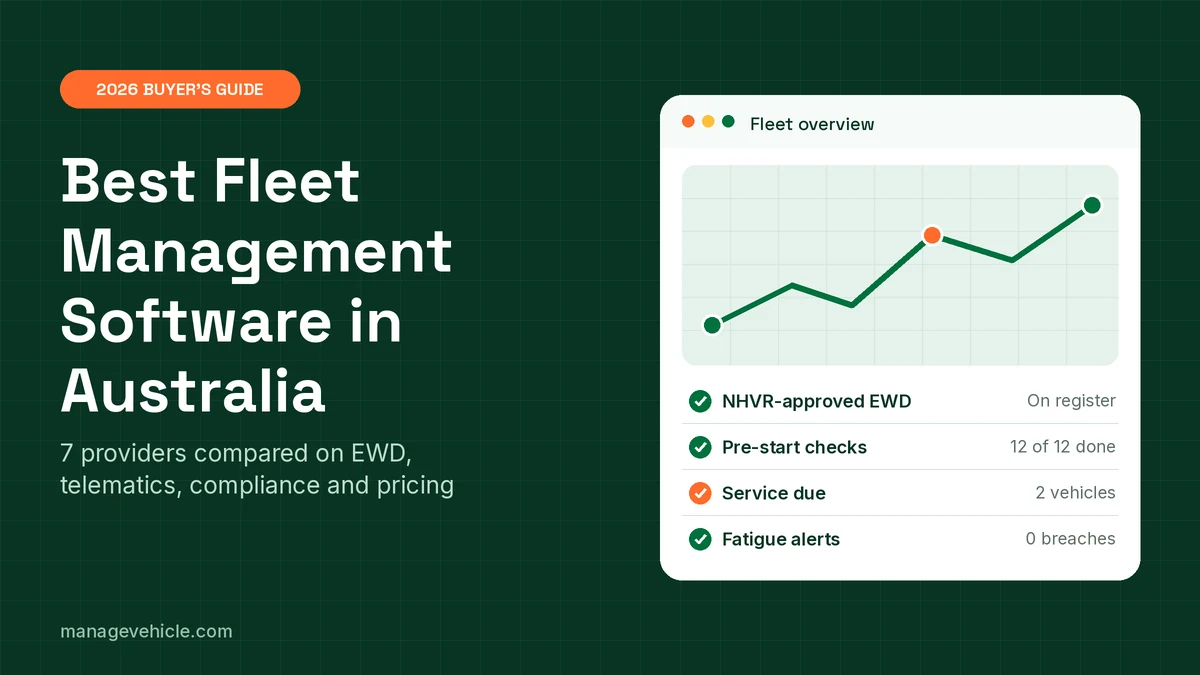
Best fleet management software in Australia 2026 buyer’s guide with a fleet overview dashboard showing EWD, pre-start and service status Featured image: WebP, under 100 KB.
Finding the best fleet management software in Australia is harder in 2026 than it was a few years ago. The amended Heavy Vehicle National Law started on 1 August 2026, auditors now want proof that your safety systems actually work, and most vendors claim to do everything. This guide compares five full fleet management platforms that Australian transport operators commonly shortlist, feature by feature, plus two specialist tools worth knowing about. It also shows you what to check before you sign anything.
A quick disclosure: this guide is written by the Manage Vehicle team, and our own product is on the list. We have tried to be fair. Every competitor claim below comes from the provider’s own website, official product material or a public register, checked on 12 November 2026, and we have been upfront about where other providers are a better fit than us.
How we compared fleet management software
There is no single “best” system for every fleet. A 6-truck local operator and a 300-vehicle interstate carrier need different things. So instead of a ranking, we looked at each provider against the criteria that matter most to Australian heavy vehicle operators:
- NHVR-approved EWD. Only electronic work diaries listed on the NHVR EWD register can legally replace a written work diary. We checked every provider against the live register.
- GPS and telematics. Live tracking, trip history, geofencing and engine data.
- Compliance tools beyond fatigue. Pre-starts, fit for duty, maintenance records, incident reporting and audit-ready reports for Chain of Responsibility and Heavy Vehicle Accreditation.
- Certified telematics. Whether the provider offers TCA-certified applications such as IAP, TMA or Smart On-Board Mass, which matter if you run higher mass or restricted access vehicles.
- Transport operations. Whether the same system handles job dispatch, proof of delivery and invoicing, or whether you need a separate transport management system for that.
- Hardware flexibility. Whether you must buy their devices or can use what you already have.
- Pricing transparency. Whether pricing is published or quote-only.
Best fleet management software in Australia: feature comparison
Most fleet platforms track vehicles. The real difference is how much of your operation runs in one place. This table compares the five full platforms on the features Australian transport operators use day to day.
| Feature | Manage Vehicle | Teletrac Navman | MTData | Netstar Australia | Geotab |
| GPS tracking and geofencing | ✓ | ✓ | ✓ | ✓ | ✓ |
| NHVR-approved EWD | ✓ | ✓ | ✓ | ✓ | Via partner (Logmaster) |
| Pre-start checks and defects | ✓ | ✓ | ✓ | ✓ | Not listed |
| Maintenance scheduling | ✓ | ✓ | ✓ | ✓ | ✓ |
| Fuel management | ✓ | ✓ | ✓ | Not listed | ✓ |
| Dashcams and video | ✓ | ✓ | ✓ | ✓ | Via partners |
| Driver behaviour monitoring | ✓ | ✓ | ✓ | ✓ | ✓ |
| Job dispatch and proof of delivery | ✓ | ✓ | ✓ | Job details via Garmin | Via partners |
| Invoicing and Xero integration | ✓ | Not listed | Not listed | Not listed | Not listed |
| Mass management | ✓ | ✓ | ✓ | Not listed | Not listed |
| Works with your existing hardware | ✓ | Own hardware | Own hardware | Own hardware | Own devices |
| Published pricing | ✓ | No | No | Entry plan only | No |
✓ means the feature is listed on the provider’s own website or official product material as of 12 November 2026. “Not listed” means we couldn’t find it there, not that it is definitely unavailable, so ask the provider. EWD status was checked against the NHVR register, which changes (Drivalink’s approval was cancelled from 1 April 2026).
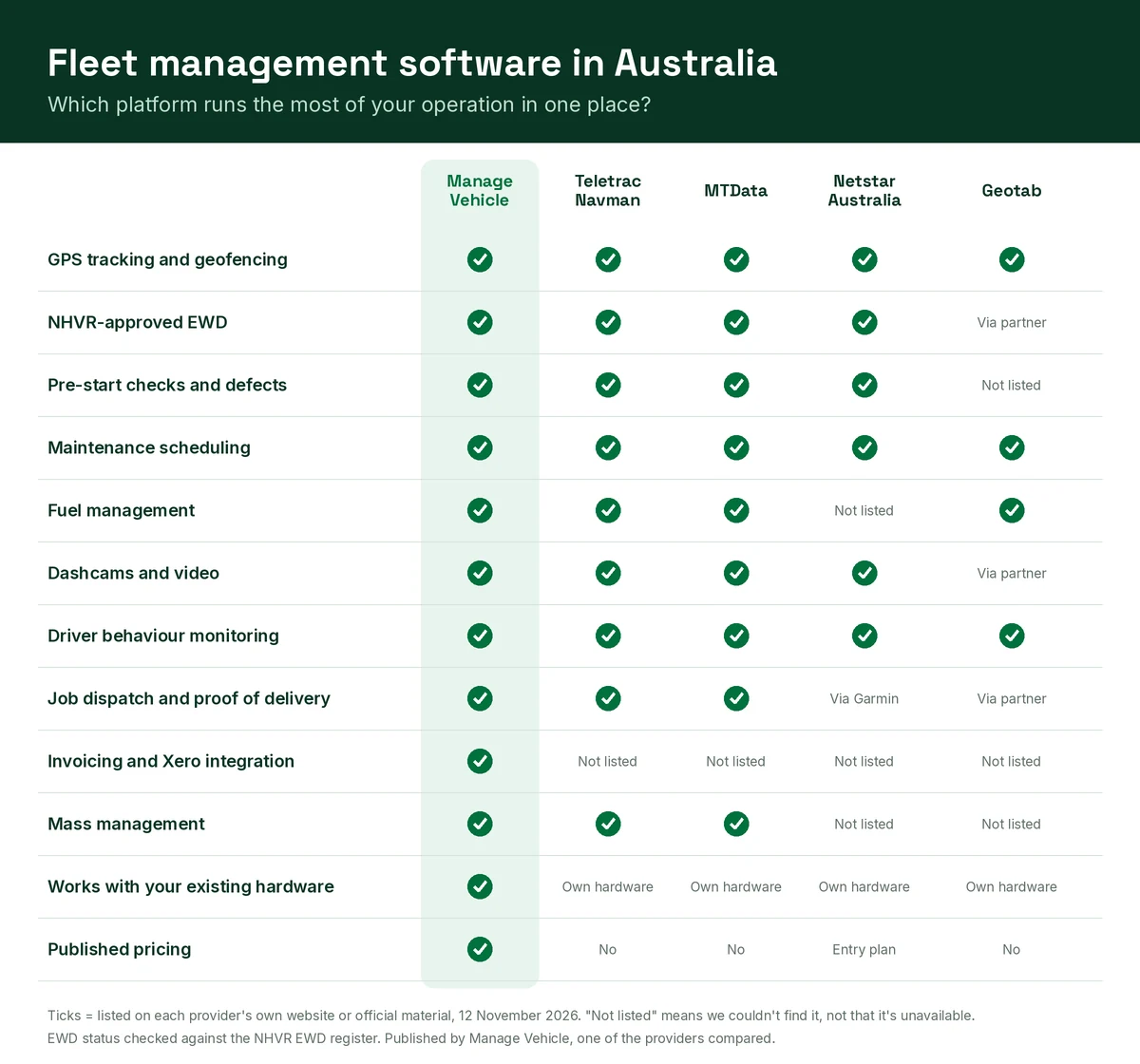
Feature comparison of five fleet management software platforms in Australia, covering EWD, dispatch, invoicing, maintenance, dashcams and pricing Image: feature comparison graphic, WebP, under 100 KB. Also works as a social share image.
Where Manage Vehicle stands out
To be fair to the others, Teletrac Navman and MTData are both broad platforms, and they match us on tracking, EWD, maintenance, video and dispatch. Where Manage Vehicle is different is that it also covers the business side of a transport operation. Jobs, proof of delivery and invoicing flow into Xero from the same system that holds your fatigue, maintenance and compliance records. On top of that, it works with hardware you may already own, and the pricing is published with no lock-in contract.
That’s the gap most operators feel: a fleet system for the trucks, a transport system for the jobs, and spreadsheets in between. If you want one system for all of it, that’s what we built Manage Vehicle to be.
The 5 best fleet management software platforms for Australian operators
1. Manage Vehicle
Best for: transport operators who want fleet, compliance and transport operations in one connected system.
Manage Vehicle is Australian-built fleet management software for transport operators. Its electronic work diary, MV Driver, was added to the NHVR EWD register on 22 September 2026 (certificate MANV-2026-001) and supports Standard, BFM, AFM and WA rule sets, including solo and two-up configurations.
Strengths
- One system covers GPS tracking, the NHVR-approved EWD, fatigue alerts, pre-starts, maintenance, fuel, dashcams, driver behaviour, incidents and mass compliance.
- It also runs the transport side: job planning and dispatch, driver and vehicle allocation, proof of delivery with sign-on-glass, and invoicing with Xero integration.
- Works with hardware you may already own, including Teltonika, Stonkam, Jimi IoT and Digital Matter devices, so you are not forced into a hardware swap.
- Published pricing: an introductory $30 per vehicle per month (regular $50), with unlimited drivers and jobs, no setup fees and no lock-in contract.
- ISO 9001 certified, with local Australian support.
Limitations
- Our EWD approval is newer than some on this list, which have been on the register since 2020 or 2021.
- If your operation depends on TCA-certified IAP or Smart On-Board Mass, talk to us first about your setup. A specialist such as MTData has a longer track record in that area.
2. Teletrac Navman
Best for: mid-sized and large fleets that want a well-known enterprise platform.
Teletrac Navman is one of the biggest names in Australian telematics. Its TN360 platform covers tracking, driver behaviour, maintenance and reporting, and its Sentinel EWD is on the NHVR register. Its Australian materials say customer data is hosted on servers located in Australia, and some of its devices are TCA type-approved for regulatory applications.
Strengths: mature platform, wide feature set, long history with Australian heavy vehicle fleets, Australian data hosting.
Limitations: pricing is not published, so you will need a quote, and contract terms vary. Smaller operators may find they are paying for features they never use.
3. MTData
Best for: heavy haulage operators who need certified telematics for mass and road access.
MTData is an Australian telematics provider whose EWD (Talon and Swift) has been on the NHVR register since December 2020. Its web software, Hawk-Eye, works with Talon, an in-cab driver tablet that handles fatigue, pre-trip checks, fit for duty declarations, jobs and electronic documents. Through Transport Compliance Services, MTData offers TCA-certified IAP, TMA and Smart On-Board Mass, with integrations for several major on-board scale brands.
Strengths: strongest option here for IAP, TMA and On-Board Mass, a dedicated in-cab device, and a long Australian track record.
Limitations: it is a hardware-led solution, so expect upfront hardware costs. Optional modules are priced separately.
4. Netstar Australia
Best for: fleets that like Garmin-based in-cab navigation and want an EWD on the same device.
Netstar’s EWD was one of the earliest approved, with NHVR approval for its Garmin Fleet 7XX series from January 2021. It is now available on Garmin and Android devices. Netstar also offers GPS tracking, maintenance management and an entry-level tracking plan that it advertises from $15 a month.
Strengths: Garmin integration for navigation and job data, an established EWD, and a low-cost entry point for basic tracking.
Limitations: full fleet management pricing is quote-based, and the entry plan covers tracking rather than the complete compliance toolset.
5. Geotab
Best for: larger or mixed fleets that want an open platform they can connect to other systems.
Geotab’s MyGeotab platform is known for its open API and large marketplace of add-ons. For fatigue compliance in Australia, Geotab partners with Logmaster, whose EWD is on the NHVR register and integrates with MyGeotab. Geotab is sold through partners in Australia, including EROAD, which offers a Geotab heavy vehicle solution.
Strengths: very flexible, strong integrations, good for fleets that already use other business software they want to connect.
Limitations: the EWD is a partner product rather than Geotab’s own, and because you buy through a reseller, your support experience depends on that partner.
Specialist tools: when you only need part of the picture
These two aren’t full fleet management platforms, but they come up a lot when operators research EWDs and compliance.
Netcorp: a free EWD
Netcorp offers its NHVR-approved EWD to Australian operators at no cost, with no subscription and no per-driver fee. Operators manage drivers, record keepers and fatigue records through an online portal. Netcorp has also provided GPS tracking and telematics services for more than 25 years. It’s a low-risk way to move off paper diaries, but the EWD covers work and rest records only, so you’ll still need somewhere for maintenance, jobs and the rest of your compliance records.
Hubfleet: compliance and SMS first
Hubfleet describes itself as a digital safety management system rather than fleet management software. Its EWD is on the NHVR register, and it covers pre-starts, fit for duty, mass and maintenance records, incident reporting and risk management. It doesn’t provide its own GPS tracking. Instead, it cross-checks EWD data against tracking from your GPS provider through integrations. It suits operators whose main focus is SMS and audit evidence, and who already have tracking sorted.
How to choose fleet management software for your fleet
Picking the best fleet management software comes down to matching the system to how your business actually runs. Work through these questions before you book any demos.
Checklist graphic: 7 questions to ask before choosing fleet management software Image: checklist graphic, WebP, under 100 KB.
- Is the EWD on the NHVR register right now? Check the register yourself, not the sales brochure. Approvals can be cancelled, and only listed systems can replace a written work diary. The NHVR is also introducing a Generation 2.0 EWD framework, although existing approved systems stay approved.
- Do you need one system or several? Some operators are happy with separate tracking, EWD and maintenance tools. Others lose hours copying data between them. If an auditor asks for fatigue, maintenance and driver records together, a single system makes that much faster.
- Can you keep your current hardware? Replacing devices across a fleet is expensive and means trucks off the road for installs. Ask which devices each provider supports.
- Do you need certified telematics? If you run under IAP, TMA or Smart On-Board Mass schemes, check which applications the provider is certified for with TCA. If you don’t, don’t pay for it.
- What does it really cost over three years? Monthly fees are only part of it. Add hardware, installation, setup fees, training and the cost of leaving if it doesn’t work out. Our breakdown of GPS fleet tracking costs in Australia covers the hidden costs in detail.
- Will your drivers actually use it? A system drivers hate leads to missed entries and messy records. Ask for a driver trial, not just a manager demo.
- Who answers the phone? When a driver’s diary won’t sync at a roadside check, you want local support that understands Australian fatigue rules.
If you run a smaller operation, our guide to small fleet management software explains which features matter for fleets of a few vehicles and which you can skip.
What fleet management software costs in Australia
Most providers charge per vehicle per month, and many don’t publish prices at all. From what is public on providers’ own sites, entry-level tracking plans start around $15 a month, and full compliance platforms that include an EWD typically cost more per vehicle. Hardware, installation and contract length can change the total far more than the headline monthly fee.
Two things are worth knowing. First, an EWD on its own can be free, as Netcorp’s is, but you still need the rest of your compliance and maintenance records somewhere. Second, the cost of getting it wrong is high: under the amended HVNL, Category 1 Chain of Responsibility breaches can reach $4,230,550 for a company, and the fatigue duty penalty has risen to $26,610. See our article on fatigue duty penalties in 2026 for the details.
So, which is the best fleet management software for you?
Here is the short version:
- You want fleet, compliance, jobs and invoicing in one system, with published pricing: Manage Vehicle.
- You run heavy haulage under IAP, TMA or On-Board Mass: MTData is hard to beat.
- You want an established enterprise platform and don’t mind a quote process: Teletrac Navman.
- You only want to replace paper diaries for now: Netcorp’s free EWD.
- You want an open platform to connect to other systems: Geotab, through a partner.
- SMS and audit evidence are your top priority and your tracking is already sorted: Hubfleet.
Whatever you shortlist, book demos with two or three providers, ask each one the seven questions above, and check the NHVR register before you sign. If you’re still learning the basics, start with our explainer on what fleet management software is.
Want to see how Manage Vehicle runs tracking, the EWD, maintenance, jobs and invoicing in one system? See our pricing or book a free demo, and we’ll set it up around your fleet.
Frequently asked questions
What is the best fleet management software for small businesses in Australia?
For a small fleet, the best fleet management software is usually the one that covers your compliance needs without paying for enterprise features you won’t use. Look for an NHVR-approved EWD, simple maintenance reminders, published pricing and no long lock-in contract. Manage Vehicle, Netstar’s entry plan and Netcorp’s free EWD are common starting points for smaller operators.
Which fleet management software is best for compliance reporting?
Systems that keep fatigue, maintenance, pre-start, incident and driver records in one place make compliance reporting fastest, because you can pull audit evidence without combining spreadsheets. Manage Vehicle keeps all of these together with jobs and invoicing, while Hubfleet focuses on the compliance and SMS side. Whichever you choose, check that the EWD is on the NHVR register.
How much does fleet management software cost per vehicle in Australia?
It varies widely. Basic GPS tracking plans start from around $15 per vehicle per month, while full compliance platforms cost more. Many providers, including Teletrac Navman and Geotab’s partners, only give prices on request. Always compare the total cost over the contract, including hardware and installation.
Is an electronic work diary compulsory in Australia?
No. The written National Driver Work Diary is still a legal way to record work and rest. An EWD is a voluntary alternative, but if you use one, it must be approved by the NHVR and listed on the EWD register.
Which providers have an NHVR-approved EWD?
As of 12 November 2026, the NHVR register lists 13 approved EWDs, including Manage Vehicle (MV Driver), Teletrac Navman (Sentinel), MTData (Talon and Swift), Netstar Australia, Netcorp, Logmaster and Hubfleet. Check the NHVR EWD register for the current list.