Driver behaviour monitoring that helps you coach, not just catch
Speeding, harsh braking and sharp cornering cost you in fines, fuel, wear and risk. ManageVehicle’s driver behaviour monitoring flags them the same day, so you can have the right conversation with the right driver.

- NHVR-approved EWD
- ISO 9001 certified
- Serving fleets since 2021
Finding out about bad driving when the fine turns up
What changes when risky driving shows up the same day, not on the fine.
Before ManageVehicle
- Finding out about speeding when the fine turns up
- Complaints from the public about “that truck”
- Coaching based on rumours
- Good drivers treated the same as risky ones
- Brakes and tyres wearing out early
After ManageVehicle
- Speeding flagged the same day
- Events with time, place and driver to check the facts
- Reports that show who needs help and with what
- Clear comparisons that recognise safe driving
- Harsh braking and acceleration tracked and reduced
What is driver behaviour monitoring?
Driver behaviour monitoring uses GPS and telematics data to record how vehicles are driven, such as speeding, harsh braking, acceleration and cornering, so you can spot risk and coach drivers.
- 01
GPS and telematics
Measures speed and movement.
- 02
Event detection
Picks up speeding and harsh events.
- 03
ManageVehicle
Ties each event to the driver.
- 04
Reports and coaching
Trends, alerts, and follow-up.
From a harsh brake on the road to a better driver
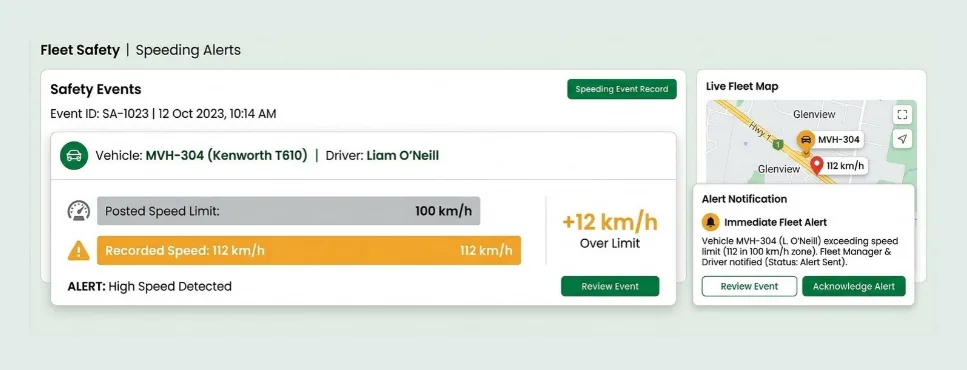
Know about speeding as it happens
Telematics speeding alerts, before the fine arrives.
Speed is measured by the tracker in each vehicle and checked against the threshold you set. When a vehicle goes over, your team gets a safety alert with the time, place and driver, and an in-cab buzzer warns the driver straight away.
What your team can do:
- Speed thresholds you set in the portal
- Alerts for serious speeding
- Events by driver and location
Spot harsh braking, acceleration and cornering
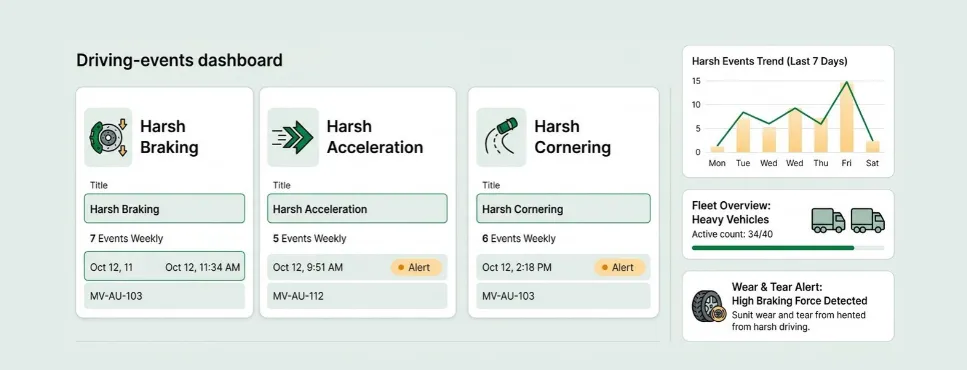
Less risk, less wear and tear.
Harsh events are early warning signs of risky driving and they wear out brakes and tyres. ManageVehicle records each one so patterns are easy to see.
What your team can do:
- Harsh braking events
- Harsh acceleration events
- Sharp cornering events
See how each driver is tracking
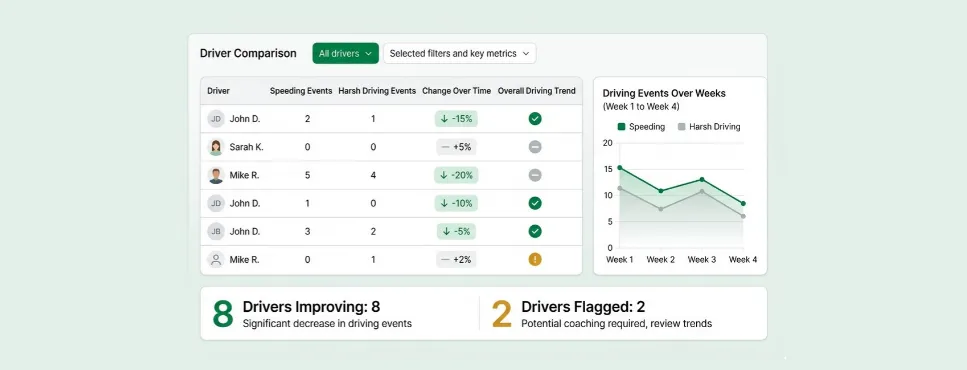
Fair, data-backed comparisons.
Use it as a driver tracking system to compare drivers on speeding and harsh events over time. Find the few who need coaching and the many who deserve a pat on the back.
What your team can do:
- Events per driver
- Trends over weeks and months
- Compare across the fleet
- Shift safety reports for every driver
Turn data into better driving
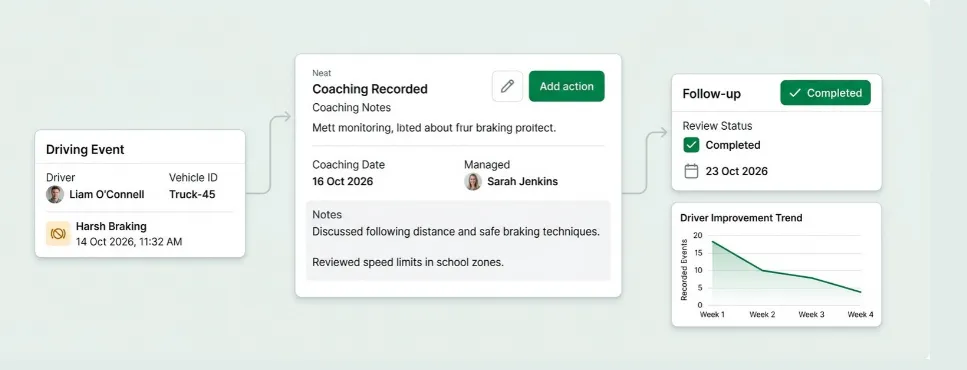
A record of what you did about it.
Log coaching conversations against the events that triggered them. Over time, you can see whether coaching is working.
What your team can do:
- Add coaching notes
- Track follow-ups
- See improvement over time
Alerts that match how your fleet runs
The right alert to the right person.
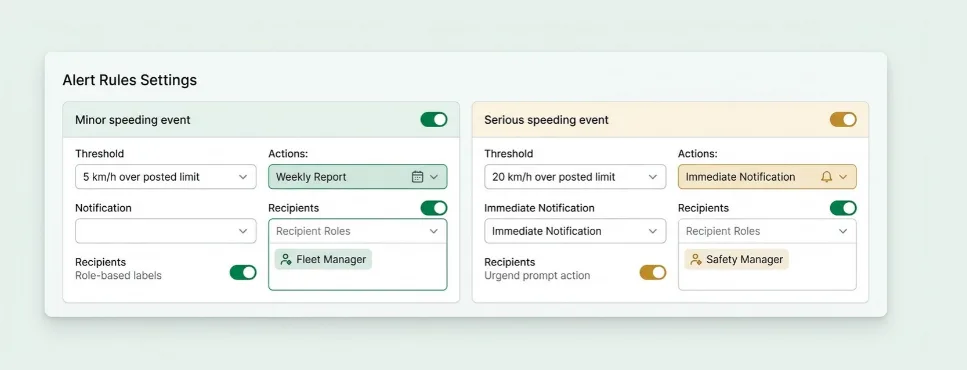
Choose which events trigger alerts and who receives them. A small speed over the limit might go in a weekly report; a big one might need a call today.
What your team can do:
- Set alert thresholds
- Choose who gets notified
- Different rules per vehicle type
How to deal with risky drivers: a coaching playbook
Catching risky driving is the easy part. Changing it takes a fair, repeatable process. Here’s the one we see work, and where ManageVehicle fits in each step.
-
1. Write the rules down
Put speed, phone use and safe driving expectations in a driving policy every driver signs. Drivers can’t follow rules they’ve never seen.
In ManageVehicle Set speed thresholds and alert rules to match your policy
-
2. Look for patterns, not one-offs
One harsh brake can be a kangaroo. Five a week is a habit. Coach on patterns.
In ManageVehicle Events per driver, with trends over weeks and months
-
3. Talk with the facts
Sit down with the driver and go through the events: time, place and speed. Ask what happened before you decide.
In ManageVehicle Every event shows time, place, speed and driver, with video where dashcams are fitted
-
4. Agree on a fix and write it down
Agree on one or two specific changes, and note the conversation.
In ManageVehicle Coaching notes logged against the events that triggered them
-
5. Check back
Review the same driver’s events a few weeks later. If it hasn’t changed, escalate under your policy.
In ManageVehicle Follow-ups tracked, and before-and-after trends
-
6. Recognise good driving
Point out the drivers with the cleanest records. People repeat what gets noticed.
In ManageVehicle Fleet-wide comparisons that show your safest drivers
Under Chain of Responsibility, this kind of record is part of showing the reasonable steps you take. Read our Chain of Responsibility guide.
Stop asking “who’s driving like that?”
The questions that come up after a complaint or a fine, answered with fleet driver monitoring data.
Who was driving Truck 9 at 4pm?
Check the event’s driver.
Was it really speeding?
Check the speed against your threshold.
Who brakes hardest in the fleet?
Compare harsh braking by driver.
Is coaching making a difference?
Review trends over time.
Who’s our safest driver this month?
Open the driver report.
Driving records that show you take safety seriously
Monitoring speed and driving behaviour is part of the reasonable steps you take under Chain of Responsibility. Under the HVNL, it’s an offence to ask, direct or contract a driver in a way that would make them speed, including schedules that can’t be met at the limit. See the NHVR’s advice on prohibited requests and contracts.
Speed records by driver and time
Every event over your set threshold, recorded with time and place.
Coaching on record
Show what you did after every serious event.
Works with your EWD
Behaviour shows how they drove. MV Driver, our NHVR-approved EWD, shows how long.
Better driving means fewer incidents, less fuel and slower wear on brakes and tyres. It can help with insurance too. Insurance broker CBI notes that telematics data on driver behaviour can support lower commercial motor premiums (CBI: the role of telematics in commercial motor insurance). Want a checklist for your own fleet? Read reckless driving in a commercial fleet: a monitoring checklist.
Connected driver behaviour and fleet operations
Driving data tells a bigger story when it sits next to video, fatigue and costs.
-
Behaviour + dashcams
Back every event with video
A connected safety record can include
- Event clip
- Speed at the time
- Location
- Driver and vehicle
-
Behaviour + fatigue
Spot when tiredness shows up in driving
Fatigue insights can include
- Late-shift events
- Hours worked
- Fatigue alerts
- Follow-up
-
Behaviour + fuel
See what driving costs at the pump
Cost insights can include
- Fuel used per vehicle
- Idle time
- Harsh acceleration
- Cost per km
-
Behaviour + maintenance
Link driving style to wear and tear
Maintenance records can include
- Brake and tyre repairs
- Defects
- Service history
- Events per vehicle
-
Reports & insights
Turn events into driver reports
Behaviour reports can include
- Speeding by driver
- Harsh events
- Trends over time
- Coaching completed
-
Australian fleet operations
Built for Australian roads
What you get
- In-cab speeding alarms
- Web and mobile access
- Australian customer support
- Designed for commercial fleets
Speed and driving events are read from the vehicle by Vehicle Telematics. See how it works for transport and logistics, passenger transport and rental vehicles. For the bigger picture on why drivers drive the way they do, read truck driving behaviour: key factors and solutions.
Speed alerts vs driver behaviour monitoring
A speed alert tells you one thing happened. Behaviour monitoring shows you patterns and what to do about them.
Basic speed alerts
One alert per event.
- Speeding notifications
- No driver context
- No trends
- No follow-up record
Driver behaviour monitoring
Driver behaviour inside your fleet management platform, for the full picture of how your fleet drives.
- Speeding against your own thresholds
- Harsh braking, acceleration and cornering
- Driver reports and trends
- Coaching notes and follow-up
- Links to video and fatigue data
Driver behaviour monitoring FAQs
What is driver behaviour monitoring?
It uses GPS and telematics data to record how vehicles are driven, including speeding, harsh braking, acceleration and cornering. Unlike basic driver tracking software, ManageVehicle ties each event to the driver so you can coach them.
What events does it track?
Speeding against the thresholds you set, plus harsh braking, harsh acceleration, sharp cornering and idling. With smart dashcams, you can add fatigue, distraction and phone use events too.
How quickly will I know about speeding?
Events are recorded as they happen, and you can set alerts so serious speeding reaches your team straight away, by app notification, email or SMS.
Is it fair to drivers?
It’s fairer than guesswork. Events come with time, place and speed, and the same data shows which drivers are doing a great job.
Can I set different rules for different vehicles?
Yes. Set alert thresholds and rules by vehicle type, so heavy vehicles and light vehicles are treated appropriately.
Does driver behaviour affect fuel costs?
Yes. Harsh acceleration, speeding and idling all push fuel use up. Pair this with Fuel Management to see the cost.
Can I record coaching conversations?
Yes. Add notes against the events that triggered the conversation and track follow-ups over time.
Do I need extra hardware?
Driver behaviour monitoring runs on a GPS or telematics device in each vehicle. If you already have compatible devices, you can often keep them. If not, we’ll supply them, priced separately from the software. Fatigue and distraction alerts also need AI-enabled cameras.
How do I deal with a driver who keeps speeding?
Look at the pattern, not one event. Go through the events with the driver, agree on a change, note it, and check their record again a few weeks later. If nothing changes, follow the steps in your driving policy. Our coaching playbook above walks through each step.
Do I need to tell drivers they’re being monitored?
Yes, in most cases. Workplace surveillance rules vary by state, and NSW and the ACT have specific notice requirements. Tell drivers what’s recorded and why before monitoring starts. Our guide to the legal side of vehicle tracking covers the basics.
Explore more
-
Smart Dashcams
Smart dashcams that record road and cab footage with the location, speed and driver for every event.
Explore Smart Dashcams -
Electronic Work Diary (EWD)
MV Driver, our NHVR-approved electronic work diary, records work and rest on the driver’s phone with fatigue alerts and audit-ready records.
Explore Electronic Work Diary (EWD) -
Compliance Reporting
Fleet compliance reporting with licences, rego and inspections in one place, expiry reminders and audit-ready reports.
Explore Compliance Reporting
See driver behaviour monitoring on your fleet
In a 30-minute demo, we’ll show you how speeding and harsh driving events, driver reports and coaching records work for your fleet, and which trackers suit your vehicles.
- Tailored to your fleet size
- Advice on the right hardware
- Local Australian support team
See ManageVehicle in action
Tell us a bit about your fleet and we’ll be in touch within one business day.