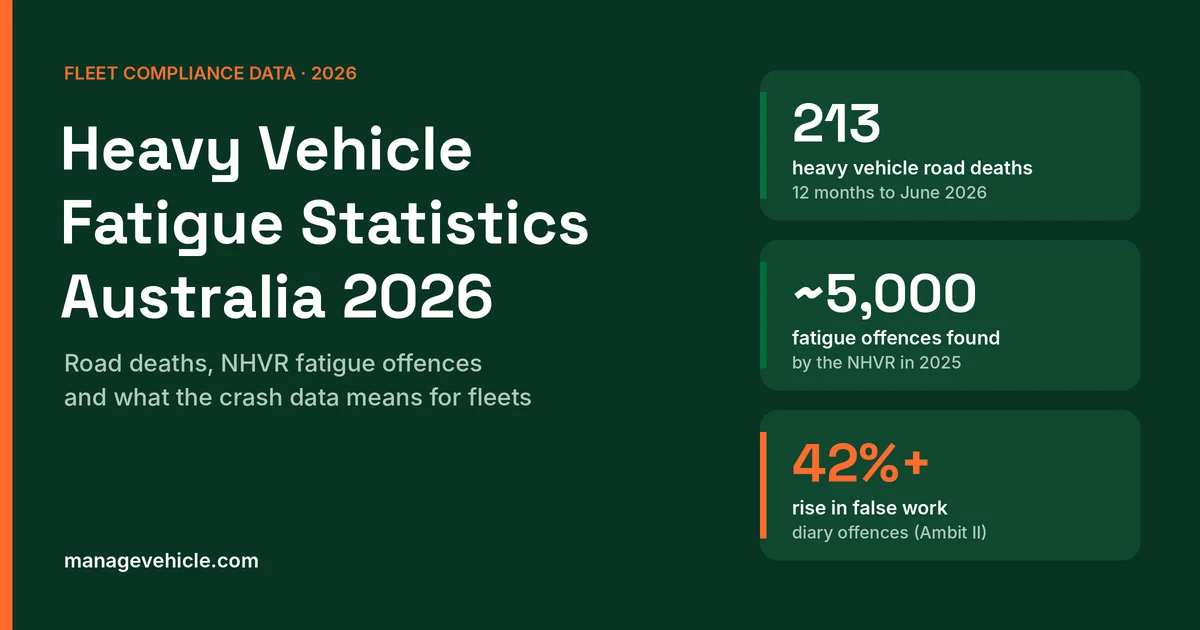
The latest heavy vehicle fatigue statistics tell two stories at once. Roadside, the National Heavy Vehicle Regulator (NHVR) is catching more fatigue offences than ever, and a growing share of them involve falsified work diaries. In the insurance data, fatigue-related major crashes have dropped sharply.
Both things can be true, and what sits between them matters to anyone running trucks. Below we pull together the most recent national and state figures, explain where each number comes from, and look at what they mean for your fatigue management in 2026.
Key numbers at a glance
| Statistic | Figure | Source |
| Road deaths in crashes involving heavy vehicles (12 months to June 2026) | 213, up 4.9% | BITRE / ARDD |
| Deaths in crashes involving articulated trucks (same period) | 116, up 16% | BITRE / ARDD |
| Fatigue offences detected by the NHVR in 2025 | Almost 5,000 | NHVR |
| Fatigue share of all breaches the NHVR detected in 2025 | More than 23% | NHVR |
| Fatigue non-compliance rate, Operation Ambit II (March 2026) | 5.3%, up from 4.7% | NHVR |
| Increase in false and misleading work diary offences (Ambit II) | More than 42% | NHVR |
| Fatigue-related major crashes per 10,000 heavy vehicles (2025) | 2.5, down from 5.8 | NTARC 2026 report |
| Maximum penalty for breaching the fatigue duty | $26,610 | Amended HVNL |
A quick note on the data: the crash figures count every death in a crash where a heavy vehicle was involved, regardless of who was at fault or what caused it. They are not fatigue deaths. Fatigue-specific figures come from enforcement data and crash investigations, which we cover separately below.
Heavy vehicle road deaths in Australia
213 people died in crashes involving heavy vehicles in the 12 months to June 2026, up 4.9% on the year before, according to the Bureau of Infrastructure and Transport Research Economics (BITRE) quarterly heavy vehicle road deaths report. That is about one in six of the 1,330 road deaths recorded nationally in the same period.
The headline hides a split between truck types:
- Articulated trucks: 116 deaths, up 16% and the highest of the last five years. NSW drove most of the rise, going from 27 to 45.
- Heavy rigid trucks: 79 deaths, down 17.7%.
- Buses: 24 deaths, up 20%.
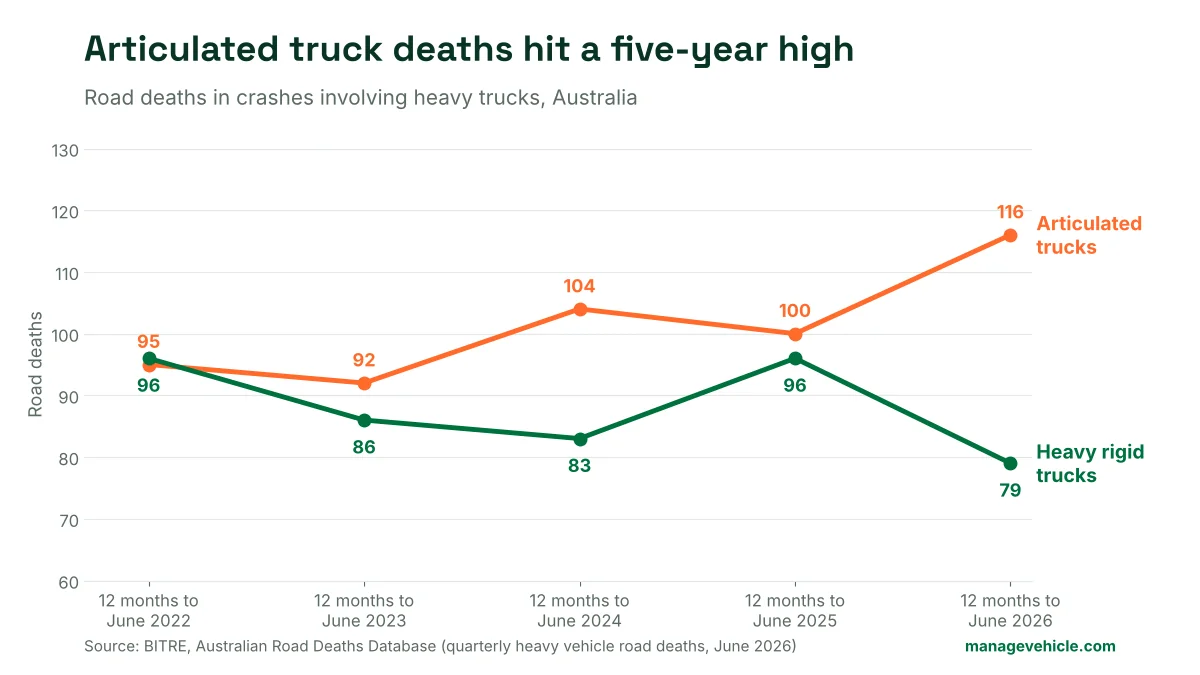
By calendar year, heavy vehicle deaths went from 185 in 2021 to 210 in 2025, with a peak of 220 in 2023. Articulated trucks matter most to a fatigue discussion because they do the long-haul, overnight and remote work where fatigue risk concentrates.
Remember that these numbers count deaths in any crash where a heavy vehicle was involved. In many fatal multi-vehicle crashes, the other driver was at fault. The figures show where risk sits on the road, not how many crashes fatigue caused.
NHVR fatigue enforcement statistics
The NHVR found almost 5,000 fatigue offences in 2025, which it describes as nearly 100 drivers a week taking unsafe risks. Fatigue made up more than 23% of all breaches the regulator detected that year, according to the NHVR.
Operation Ambit II results (March 2026)
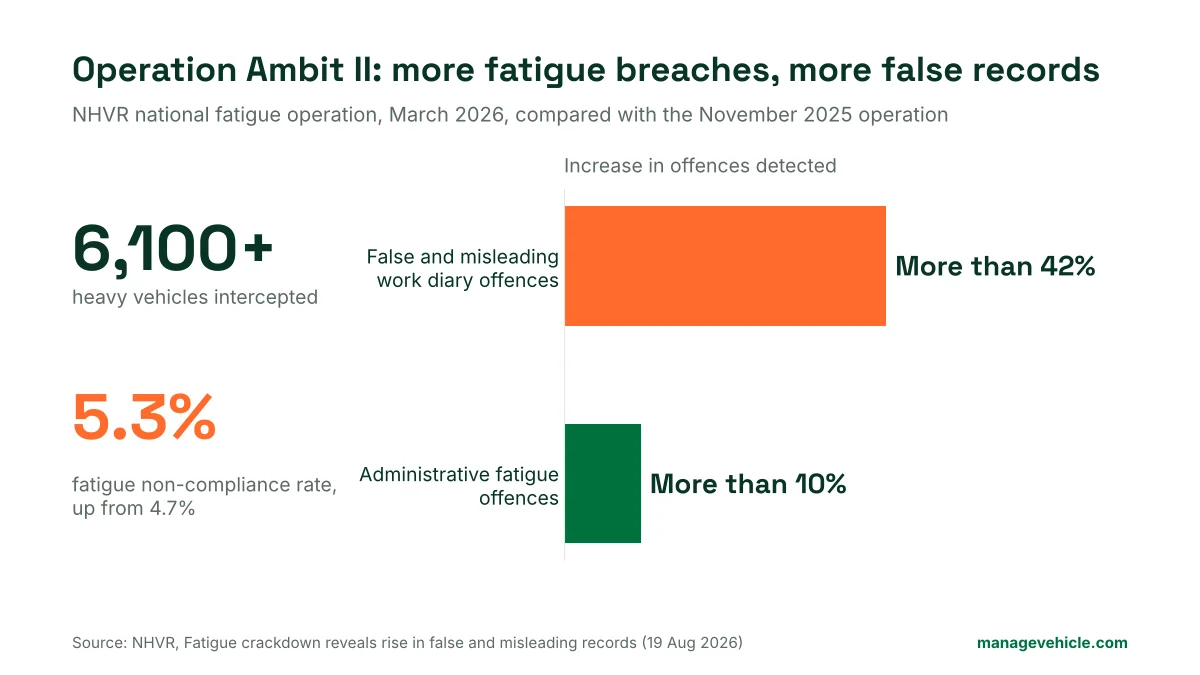
Operation Ambit II was a national fatigue blitz run with police in NSW, Queensland, South Australia, Victoria and Tasmania. The NHVR released the results in August 2026:
- More than 6,100 heavy vehicles were intercepted.
- More than 1 in 10 were non-compliant in some way.
- The fatigue non-compliance rate rose to 5.3%, from 4.7% in the November 2025 operation.
- Close to 150 fatigue-related offences were detected, and nearly half were critical breaches.
- False and misleading work diary offences rose by more than 42%.
- Administrative fatigue offences, such as not carrying a work diary or not recording start times, rose by more than 10%.
The NHVR says fatigue offences have grown in both number and severity over the past three years, and it still lists driver fatigue as one of the three main contributors to fatal heavy vehicle crashes.
Falsified records are the growing problem
The jump in false entries is the stat that should worry operators most, because it points to deliberate hiding rather than honest mistakes. A targeted NHVR operation reported by Big Rigs in November 2026 looked at four operators whose drivers kept using the short recall-to-duty provision after long rest breaks. Of 15 drivers intercepted, 14 had made false or misleading entries, with 77 false entries, 67 fatigue offences and 19 critical breaches found.
Timing matters too. During its 2024 Christmas operation, the NHVR found that fatigue offences happened at a higher rate at night, even with fewer trucks on the road. Our guide to night driving fatigue rules covers what the HVNL requires for night work.
Fatigue in heavy vehicle crash investigations
Fatigue-related major crashes fell 56.9% in 2025, from 5.8 to 2.5 incidents per 10,000 heavy vehicles, according to the 2026 NTARC Major Incident Investigation Report. The report is produced by the National Truck Accident Research Centre (NTARC) with NRSPP and Monash University Accident Research Centre, and it studies insured heavy vehicle losses over $50,000.
Other findings from the same report:
- Human-factor incidents fell 17.6% to 67.6 per 10,000 heavy vehicles, but still made up 54.7% of all major incidents.
- Inattention or distraction remained the top human factor at 13.8% of major incidents, even after falling 32%.
- Major loss claims over $50,000 fell 22.3%.
The long-term trend is just as telling. In NTARC’s earlier reports, fatigue was behind 27.3% of major incidents in 2005. After national driving hours reforms and standard work diaries arrived in 2008, that share fell to around 8% and stayed low.
Why offences are up while fatigue crashes are down
These numbers are not contradicting each other. They measure different things:
- NHVR figures count detected offences. More intercepts, more targeted operations and better data analysis will find more breaches, even if behaviour on the road has not changed.
- NTARC figures count insured crashes over $50,000. They show fewer serious fatigue crashes within that insured sample, not across every truck on the road.
- Fatigue is hard to prove after a crash. There is no breath test for tiredness, so fatigue is likely under-recorded in crash data generally.
So the honest read is this: fatigue crashes appear to be falling, while the regulator is finding more drivers working past their limits and more records that don’t reflect the real hours. For an operator, the second trend is the bigger risk. A falsified diary is a crash waiting for the wrong night, and it is also an offence for anyone in the chain who knew or should have known.
State snapshot: NSW fatigue and truck crash figures
NSW publishes the most detailed state-level data, and its recent numbers are going the wrong way.
- Fatigue deaths up 47%: 78 people died in fatigue-related crashes on NSW roads in 2024, up from 53 in 2023. 69 of those deaths were in regional areas (NSW Government).
- Heavy vehicle drivers over-represented: heavy vehicles are only about 2% of NSW registrations, but heavy vehicle drivers accounted for around 26% of fatigue-related deaths in 2024.
- Heavy truck fatal crashes nearly doubled: in the 12 months to 29 March 2026, NSW recorded 63 fatal heavy truck crashes and 68 deaths, 33 more deaths than the previous 12 months (Transport for NSW).
NSW figures include all fatigue-related crashes, so light vehicle drivers who fall asleep and collide with a truck are counted too. Even so, a quarter of fatigue deaths involving heavy vehicle drivers is a big share for a group that small.
One reminder if you run interstate: the HVNL fatigue rules apply in NSW, Victoria, Queensland, South Australia, Tasmania and the ACT. WA and the NT run their own fatigue laws, so check local rules when your routes cross into them.
What a fatigue breach can cost in 2026
The amended Heavy Vehicle National Law started on 1 August 2026, and the penalties behind these statistics went up with it. The maximum penalty for breaching the fatigue duty rose from $8,000 to $26,610, and the same maximum applies to the expanded duty not to drive while unfit.
| Breach | Maximum penalty |
| Fatigue duty breach | $26,610 |
| Driving while unfit (fatigue, illness, medication and more) | $26,610 |
| Category 1 safety duty (corporation) | $4,230,550 |
| Category 1 safety duty (individual) | $436,850 and up to 5 years in prison |
| Category 2 safety duty (corporation / individual) | $2,120,880 / $212,090 |
| Category 3 safety duty (corporation / individual) | $705,820 / $70,580 |
The category penalties are figures after the 1 July 2026 indexation. Under Chain of Responsibility, they can apply to schedulers, managers and executives as well as drivers, especially where pressure, rosters or poor record checks played a part. See our breakdown of fatigue duty penalties in 2026 and the work and rest breach categories under the HVNL for the detail.
This article is general information, not legal advice. Check current penalties with the NHVR before acting on them.
What these heavy vehicle fatigue statistics mean for your fleet
Read together, the heavy vehicle fatigue statistics for 2026 point to four practical priorities:
- Treat your work diaries as evidence, not paperwork. False entries are rising faster than any other fatigue offence. Compare diaries against GPS trip data regularly, so a gap or an impossible rest break shows up in your office before it shows up at a roadside check.
- Watch the patterns, not just the limits. The recall-to-duty case shows drivers can stay technically inside the rules on paper while still building up fatigue. Look for repeated short breaks after long rests, late starts after night shifts and drivers who always finish near the limit.
- Put night and remote work under a brighter light. Offences happen at a higher rate at night, and articulated truck deaths are climbing. Those runs need tighter scheduling, more rest planning and closer monitoring.
- Make sure schedulers are part of the plan. Under Chain of Responsibility, an unrealistic roster can make the scheduler liable too. Your fatigue management plan should cover how trips are planned, not just how drivers rest.
How Manage Vehicle helps
Manage Vehicle brings the records the NHVR checks into one place. Drivers log work and rest in the electronic work diary, and you can see their hours alongside GPS trip history, so mismatches are easy to spot. Our fatigue management tools flag drivers approaching their limits, and AI fatigue and distraction detection alerts both driver and office when signs of drowsiness appear in the cab.
If you’re still on paper, our comparison of an electronic work diary vs a paper logbook explains what changes when you switch.
Book a demo to see how it works with your fleet.
Frequently asked questions
How many people die in heavy vehicle crashes in Australia each year?
213 people died in crashes involving heavy vehicles in the 12 months to June 2026, according to BITRE. In calendar year 2025 the figure was 210. These totals cover any crash involving a truck or bus, whatever the cause.
How many fatigue offences does the NHVR detect?
The NHVR detected almost 5,000 fatigue offences in 2025, which made up more than 23% of all heavy vehicle breaches it found that year.
What did Operation Ambit II find?
Operation Ambit II intercepted more than 6,100 heavy vehicles in March 2026. The fatigue non-compliance rate rose to 5.3%, false and misleading work diary offences rose by more than 42%, and nearly half of the close to 150 fatigue offences were critical breaches.
Are fatigue-related truck crashes going up or down?
The 2026 NTARC report found fatigue-related major crashes fell 56.9% in 2025, to 2.5 per 10,000 heavy vehicles. At the same time, NHVR enforcement found more fatigue offences and more falsified records, so the risk hasn’t gone away.
What is the penalty for a fatigue breach in 2026?
Under the amended HVNL, the maximum penalty for breaching the fatigue duty is $26,610, up from $8,000. Specific work and rest breaches carry their own penalties based on risk category.