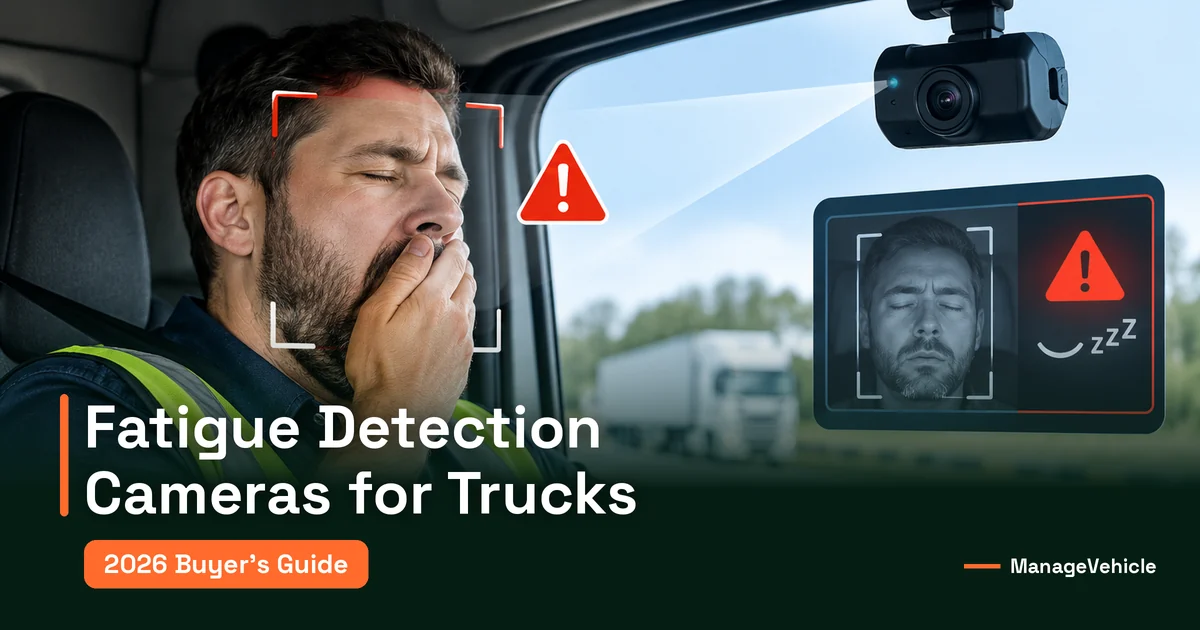
A fatigue detection camera is an in-cab camera that watches the driver’s face and alerts them, and usually your office, when it sees signs of drowsiness or distraction. For trucks, it’s one of the few tools that can catch a driver nodding off in the moment, rather than after the fact.
There are plenty of systems on the market, and they’re not all equal. This guide covers what a fatigue detection camera actually detects, where Australian rules stand in 2026, what to look for when you’re choosing one, the privacy steps you can’t skip, and what should happen when an alert goes off.
What is a fatigue detection camera?
A fatigue detection camera is a small driver-facing camera, usually mounted on the dash or A-pillar, paired with software that analyses the driver’s face in real time. In Australia, the NHVR groups these systems under the name Fatigue and Distraction Detection Technology, or FDDT.
Most systems use an infrared camera, so they keep working at night and in changing light. When the software spots a sign of fatigue or distraction, it sounds an alert in the cab. Many also send the event and a short video clip to the office, so someone can check in with the driver. For more on what happens inside the camera, see how fatigue cameras work.
What does a fatigue detection camera detect?
Most systems watch for two types of events:
|
Fatigue signs |
Distraction signs |
|
Eyes closing for too long, or closing more often |
Looking away from the road for too long |
|
Slow blinking |
Using a mobile phone |
|
Yawning |
Head turned down, for example to the lap or a screen |
|
Head nodding or drooping |
Smoking or eating, on some systems |
Operators who use these systems generally find they get far more distraction alerts than fatigue alerts. Plan for that when you set up who responds and how.
Are fatigue detection cameras mandatory in Australia?
No, not under the Heavy Vehicle National Law. The NHVR doesn’t require fatigue cameras in heavy vehicles. But two things have made them harder to ignore.
- The 2026 Master Code. The NHVR’s 2026 Master Code of Practice lists “install Fatigue and Distraction Detection Technologies (FDDT) into vehicles” as a control for managing fatigue (control 13.21). The code isn’t mandatory, but courts can look to it when deciding what “reasonably practicable” steps an operator should have taken under Chain of Responsibility.
- Client requirements. Some mining, energy and large freight customers write fatigue cameras into their contractor and site access rules. If you work for those clients, check their current vehicle specification.
The NHVR has also published FDDT good practice guidance for operators, with templates for policies and alert procedures.
How to choose a fatigue detection camera for trucks
These are the things worth comparing, and the questions to ask any supplier before you sign.
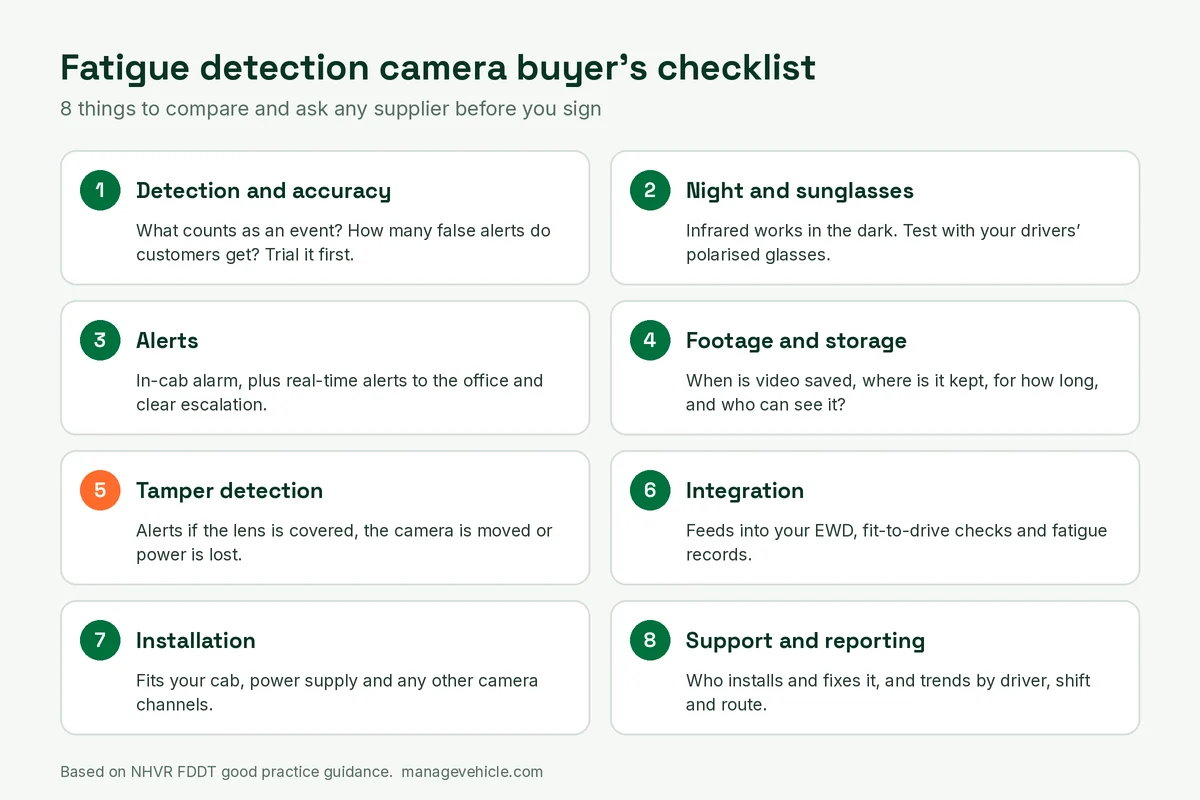
1. Detection and accuracy
There’s no national accuracy standard for fatigue cameras, so you have to ask. How does the system decide an event is fatigue? What sensitivity settings can you change? How many false alerts do current customers get? The best test is a trial in a few of your own trucks, on your own routes, before you roll it out.
2. Night driving and sunglasses
Ask whether the camera uses infrared, and how it handles sunglasses. Infrared works in the dark and through many sunglasses, but some lenses block it. If your drivers wear polarised glasses, test with those.
3. Alerts in the cab and at the office
An in-cab alarm is the minimum. Better systems also notify your office or a monitoring team in real time, so someone can call the driver. Check how alerts escalate, for example, if a driver has two fatigue events in an hour.
4. Footage and storage
Find out when video is saved. Some systems keep a short clip around each event, while others record continuously. Ask where the footage is stored, how long it’s kept, and who can see it. That matters for privacy as much as for incident reviews.
5. Tamper detection
A fatigue detection camera only works if it can see the driver. Ask whether the system alerts you when the lens is covered, the camera is knocked out of position or the unit loses power. This isn’t hypothetical. In one NHVR case study from WA, a camera-equipped truck logged 465 camera misalignments in six weeks before it rolled and caught fire, and one person died.
6. Integration with your fatigue system
A camera on its own gives you alerts. A camera connected to your work diary, fit-to-drive checks and fatigue records gives you the full picture. You can see whether an alert came at the end of a long shift, and you can record what you did about it. Ask whether the camera feeds into the same platform as your EWD and fatigue management.
7. Installation and fit
Check that the unit suits your vehicles: mounting position, power supply, and whether it can sit alongside forward-facing or side cameras. Some systems combine a fatigue camera with several other channels, so one unit covers the road, the driver and the sides of the truck.
8. Support and reporting
Ask who installs it, who fixes it and how quickly. Then look at the reports. You want to see trends by driver, by shift and by route, not just a list of alerts.
Privacy and driver buy-in
A camera pointed at a driver’s face for a whole shift is a big change. Getting it wrong can lose you good drivers, and in some states it can break surveillance laws.
- Follow your state’s workplace surveillance rules. In NSW, for example, the Workplace Surveillance Act requires employers to give workers at least 14 days’ written notice before camera surveillance starts. Other states and the ACT have their own rules, so check before you install.
- Write it down. The NHVR’s good practice guidance includes templates for a driver FDDT monitoring policy and a data, privacy and confidentiality policy. Use them.
- Explain it to drivers first. Tell them what the camera detects, when it records, who sees the footage, and what happens after an alert. Operators who roll out in stages, starting with a few trucks, generally get less pushback.
- Use alerts for coaching, not punishment. If every alert leads to a warning, drivers will find ways to block the camera.
What should happen when an alert goes off?
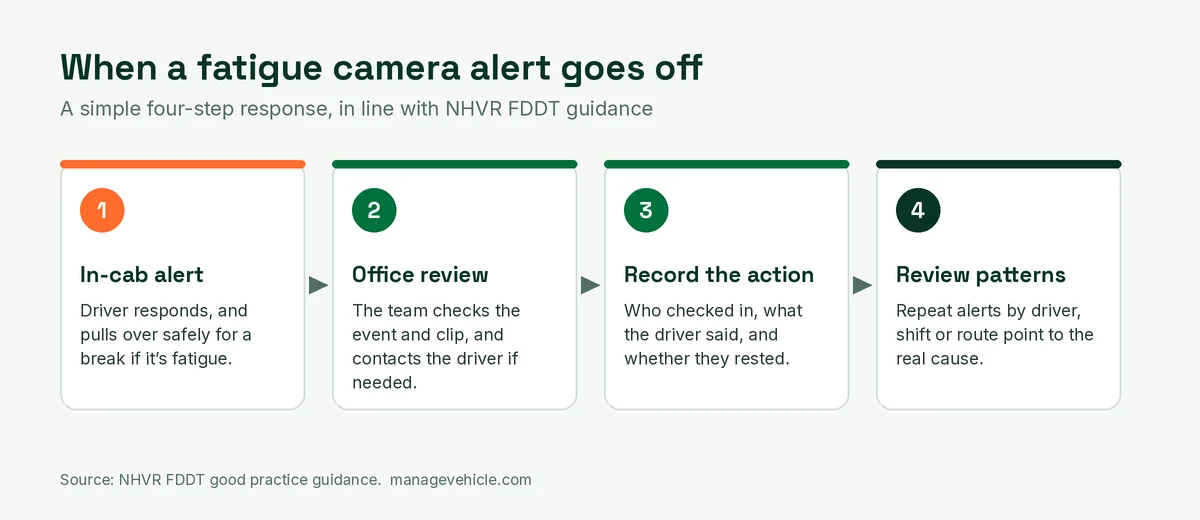
The NHVR’s guidance is clear that the camera is only half the system. The other half is how you respond. A simple process looks like this:
- The driver gets an in-cab alert and should respond, for example, by pulling over safely for a break if it’s a fatigue alert.
- The office or monitoring team reviews the event, usually with the video clip, and contacts the driver if needed.
- The action is recorded: who checked in, what the driver said, and whether they rested or the job changed.
- Patterns get reviewed. Repeated alerts for one driver, shift, or route usually point to a scheduling or health issue, not just a tired moment.
Fatigue detection cameras with Manage Vehicle
Manage Vehicle’s fatigue and distraction monitoring camera system connects straight into our fatigue management software. When a camera detects fatigue or distraction, your team gets the alert with footage to review and can contact the driver straight away. Every follow-up is logged against the event, so you build a history per driver and can show the steps you took.
Because it sits in the same platform as MV Driver, our NHVR-approved EWD, and driver fit-to-drive checks, you can see each alert alongside the driver’s hours. The system also works with our smart dashcams, so road-facing and driver-facing footage sit together.
Book a demo to see it set up for your fleet.
Frequently asked questions
Do fatigue cameras record the driver all the time?
It depends on the system. Most analyse the driver’s face continuously but only save a short clip when they detect an event. Some also record continuously to local storage. Ask your supplier exactly what’s recorded, where it’s kept and for how long, and tell your drivers.
How accurate are fatigue cameras?
There’s no Australian accuracy standard, and results vary between systems, settings and conditions like sunglasses or camera position. The best way to judge accuracy is a trial in your own trucks, tracking how many alerts turn out to be real.
Can drivers turn them off?
They shouldn’t be able to. A good fatigue detection camera is hardwired and alerts you if it’s covered, moved or loses power. Your policy should also make clear that tampering with the camera is a serious breach.
Are fatigue detection cameras mandatory in Australia?
No. The HVNL doesn’t require them. But the NHVR’s 2026 Master Code lists them as a fatigue control, and some mining and freight clients require them, so they’re becoming standard for many heavy vehicle fleets.
What’s the difference between a fatigue camera and a dashcam?
A standard dashcam records the road for evidence after an incident. A fatigue detection camera faces the driver and alerts in real time when it sees signs of fatigue or distraction. Many fleets run both.