The National Driver Work Diary is the legal record of your work and rest hours, and filling it in properly is what keeps you on the right side of an inspection. Get it wrong and a roadside check can end with a fine, or with an officer telling you to stop work on the spot.
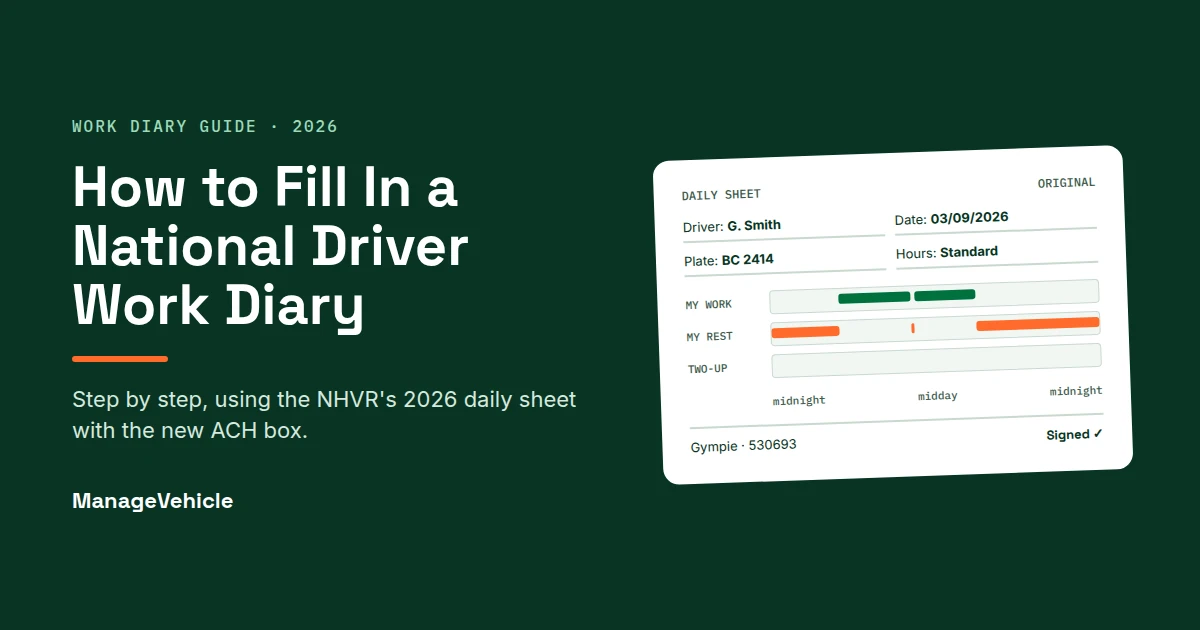
The good news is the daily sheet follows the same routine every day once you know it. This guide walks through it step by step, based on the NHVR’s current 2026 version of the diary, including the new ACH box added after the August 2026 HVNL changes. For the wider rules on logbooks, see our guide to the logbook for truck drivers.
Who needs to fill in a National Driver Work Diary?
You need one if you drive a fatigue-regulated heavy vehicle. That means:
- a vehicle with a GVM over 12 tonnes
- a combination where the GVMs add up to more than 12 tonnes
- a bus over 4.5 tonnes GVM that seats more than 12 adults, including the driver
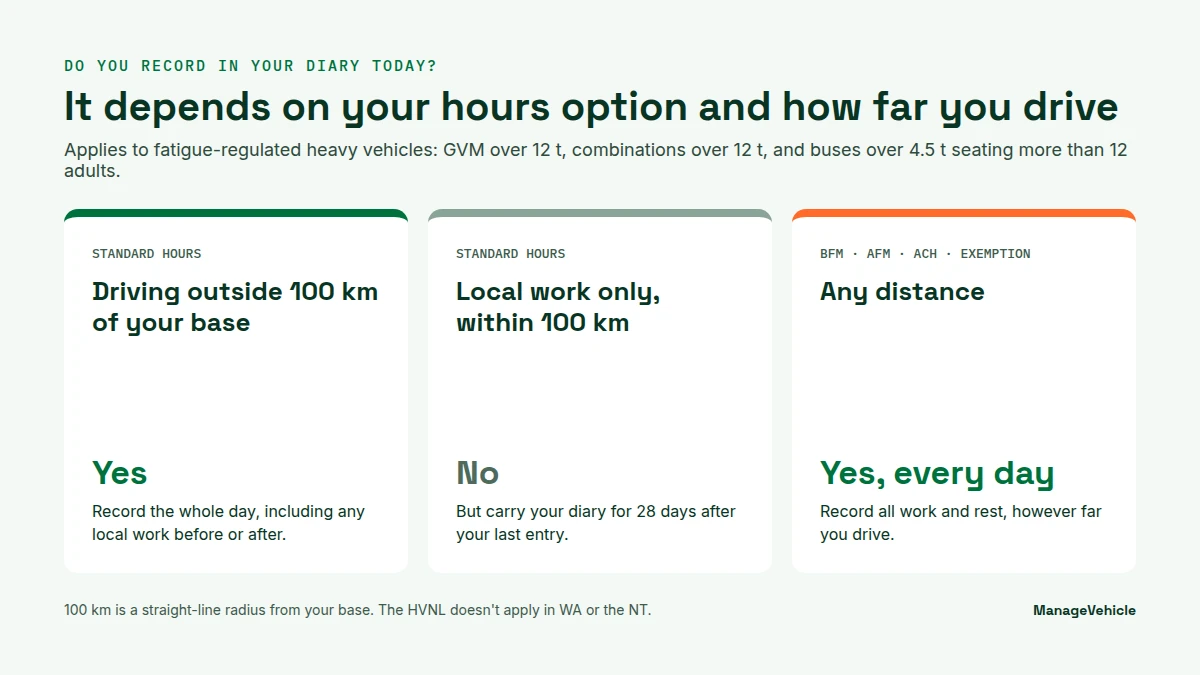
Whether you have to record in it on a given day depends on your hours option and how far you drive:
| Your situation | Do you record in the diary? |
| Standard Hours, driving outside 100 km of your base | Yes, for the whole day, including any local work before or after |
| Standard Hours, local work only (within 100 km of base) | No |
| BFM, AFM, ACH or exemption hours | Yes, every day, no matter how far you drive |
The 100 km is measured as a straight-line radius from your base, not by road. If you only ever do local work under Standard Hours, you don’t need a diary at all. If you occasionally go further, you need one and must record every day you do.
Even on days you don’t write in it, you must carry your diary for 28 days after your last entry. So most drivers who do any long-distance work end up keeping it in the cab permanently. One more rule: you can only use one written diary at a time. Running two in parallel is an offence.
These rules come from the Heavy Vehicle National Law, which doesn’t apply in WA or the NT. If you spend more than 7 days in either, you have to follow their local record-keeping rules, though you can keep using your national driver work diary to do it.
Before you start: the base, record location and accreditation page
Before you use a new national driver work diary for the first time, fill in the “Base, record location and accreditation number” page near the back. It has three columns, each with a date next to it:
- Base. The garaged address of the vehicle, or the place you normally start your shift. It could be a depot, a freight yard, or your home if the truck is parked there overnight.
- Record location. Where your work diary records are kept. If you’re employed, your employer tells you this address. If it’s the same as your base, write the base address again.
- Accreditation number. Only if you work under BFM, AFM or ACH, using your operator’s number. Leave this column blank under Standard Hours.
Whenever any of these change, even if you’re just swapping between the same two depots, write the new details on the next line with the date. If you don’t record a base, an officer can treat the vehicle’s garage address as your base, which affects how your 100 km radius is worked out.
How to fill in your national driver work diary, step by step
Each page in the diary is a set of three: a white ORIGINAL, a pink DUPLICATE and a yellow DUPLICATE. Slide the cardboard divider behind the pink sheet, write only on the white one, and press hard enough that both copies come through clearly. Use a black or blue ballpoint pen, and fill in the sheets in order.
- Fill in your driver details as soon as you start work. Write your name, licence number, the vehicle’s number plate and the date. Then mark the time zone of the state or territory where your base is. The day of the week is optional.
- Tick your hours option. You must mark it if you’re on BFM, AFM, ACH or exemption hours. Under Standard Hours it’s optional, but ticking it costs you nothing and avoids questions. If you change hours options partway through the day, start a new daily sheet.
- Fill in the two-up section, if you’re driving two-up. Write the other driver’s name, licence number, where their licence was issued, their hours option and their work diary page number. Then you both sign each other’s sheets.
- Record every work and rest change as it happens. Each time you switch from work to rest or rest to work, draw the line on the grid (see the next section), write the place, and record the odometer reading. Do it just after you start work or just before you start a rest, not at the end of the shift.
- Note any vehicle change. If you swap trucks during the day, write the new number plate and the time in the comments line.
- Use the comments line for anything worth explaining. Roadworks, a breakdown, a full rest area or being stopped by an officer. It’s optional, but it can explain a gap in your day if your diary is checked later.
- Sign the sheet. You must sign before you finish work for the day, or when you first use the diary the next day. Adding up your total work and rest hours on the sheet is optional.
For place names, be specific. In a city, the suburb is enough (Bayswater, not Melbourne). In remote areas, describe where you are in relation to the nearest known place, for example “Calder Hwy, 10 km east of Charlton”. If you rest somewhere and the place and odometer don’t change, you only need to write them once for that rest, as long as the break starts and ends on the same sheet.
Recording work and rest on the 24-hour grid
The grid in the middle of the daily sheet runs from midnight to midnight and has three rows:
- MY WORK. Draw a straight horizontal line across the hours you’re working.
- MY REST. Draw a straight horizontal line across the hours you’re resting.
- TWO-UP. If you’re in a two-up arrangement, draw a line for the whole time it lasts, even while both of you are resting.
At every change between work and rest, draw a short vertical line at the exact time. The shaded hours between 10pm and 8am show your night rest window.
Remember that work isn’t just driving. Loading and unloading, inspections, refuelling, cleaning the truck and even filling in your diary all count as work time.
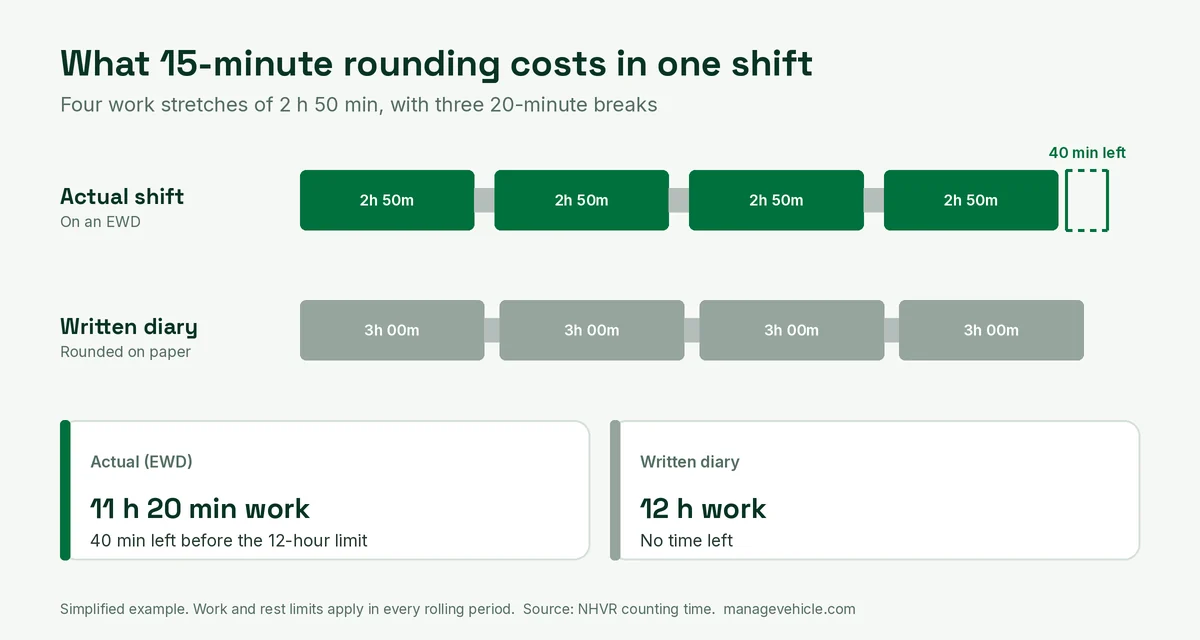
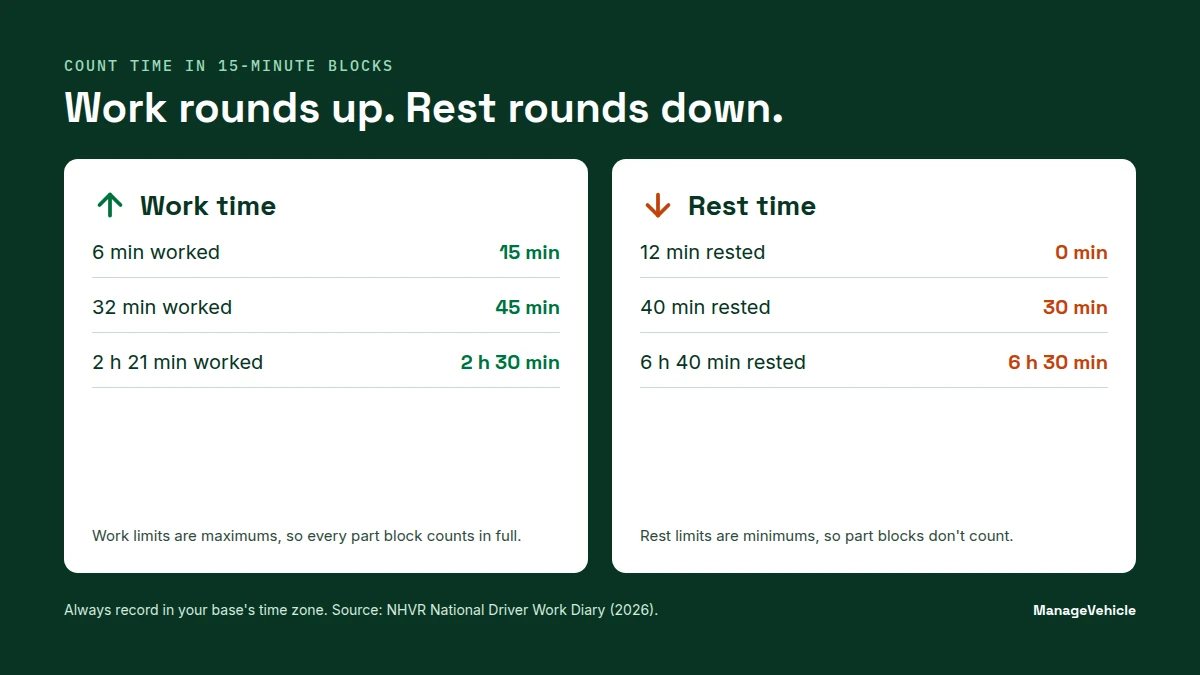
Count time in 15-minute blocks. The NHVR rounds work and rest in opposite directions, so you never end up with more rest or less work than you actually had:
| What happened | How it counts |
| 6 minutes of work | 15 minutes of work |
| 2 hours 21 minutes of work | 2 hours 30 minutes of work |
| 12 minutes of rest | No rest at all |
| 6 hours 40 minutes of rest | 6 hours 30 minutes of rest |
Always use your base’s time zone. If you cross into another state or time zone, keep recording in the time zone of your base. When daylight saving changes the clock, note it in the comments line.
Counting 24-hour periods. Under Standard Hours and ACH, you count each 24-hour period forward from the end of your last major rest break (7 hours or more for a Standard Hours solo driver), not from midnight. That’s why the totals you add up on the sheet often won’t match your 24-hour limits. For the full limits on each hours option, see our guide to work and rest hours.
What changed in the work diary in 2026
The amended HVNL started on 1 August 2026, and the NHVR updated the written work diary to match. The main changes on the daily sheet are:
- A new ACH box. Alternative Compliance Hours (ACH) is the new accredited hours option under Heavy Vehicle. Accreditation. Drivers working under ACH tick this box and record their operator’s accreditation number on the base and accreditation page.
- Totals are now optional. You no longer have to add up your total work and rest hours on each sheet.
- Ticking “Standard” is optional. If you’re on Standard Hours, marking the box is no longer required.
If you’re still using an older diary and you’ve moved to ACH, the NHVR’s guidance is to strike out “AFM” in the hours options and write “ACH” next to it.
The change also affects BFM and AFM operators. Once an operator’s BFM or AFM accreditation expires, their drivers go back to Standard Hours unless the operator has been approved under the new scheme. If that happens mid-week, the rules for switching options apply, which can mean a 48-hour reset rest break. Check with your operator before your hours option changes.
Common mistakes and how to fix them
Officers aren’t out to catch spelling mistakes in your national driver work diary. The NHVR accepts minor errors, like a misspelt town or a missing digit in one odometer reading, as long as the entry can still be understood and isn’t misleading. What gets drivers into trouble is records that can’t be relied on. Enforcement is tightening too: during the NHVR’s Operation Ambit II in March 2026, false or misleading records were up 42%.
| Mistake | What to do instead |
| Filling in the sheet at the end of the shift | Record each work and rest change as it happens |
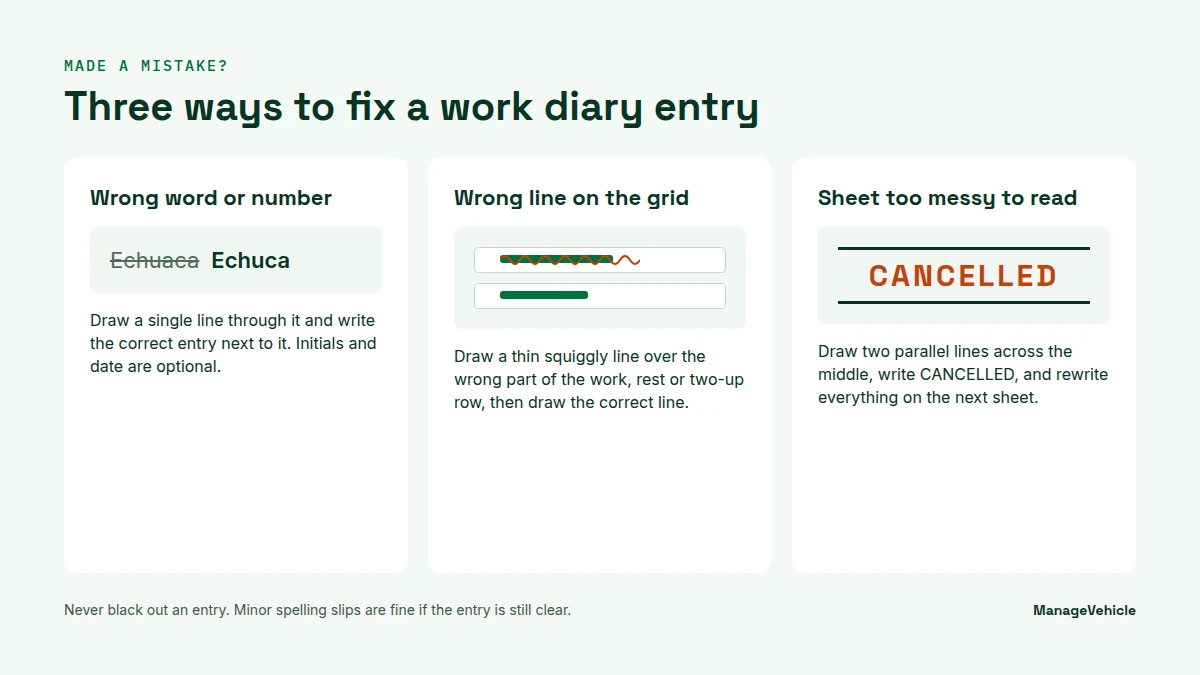
| Blacking out or scribbling over an error | Draw a single line through it (or a thin squiggly line on the grid) and write the correct entry. Initials and date are optional |
| A sheet so messy it’s hard to read | Cancel it: two parallel lines across the middle and CANCELLED in large letters, then rewrite everything on the next sheet |
| Recording time in the local time zone | Always use your base’s time zone |
| Forgetting to sign | Sign before finishing for the day, or first thing the next day |
| Writing on the pink or yellow copies | Write only on the white ORIGINAL |
| Leaving the diary at home on a local-work day | Carry it for 28 days after your last entry |
If an officer can’t rely on your diary, or you can’t produce it without a good reason, they can direct you to stop work immediately for a set period, such as 24 hours. That’s often a bigger cost than the fine itself. For what each breach can cost, see fatigue breaches and penalties, and for a real example, read how one driver was fined for a logbook error.
After the shift: what happens to the copies. The white original stays in the book. Give the yellow copy to your record keeper within 21 days. The pink copy stays in the diary unless an officer takes it. Record keepers (your employer, or you if you’re self-employed) must keep the daily sheets for three years.
If your diary is lost or stolen, tell the NHVR within two business days. Until you get a new one, use a supplementary record, which you can download from the NHVR website, for up to seven business days.
Paper diary or electronic work diary?
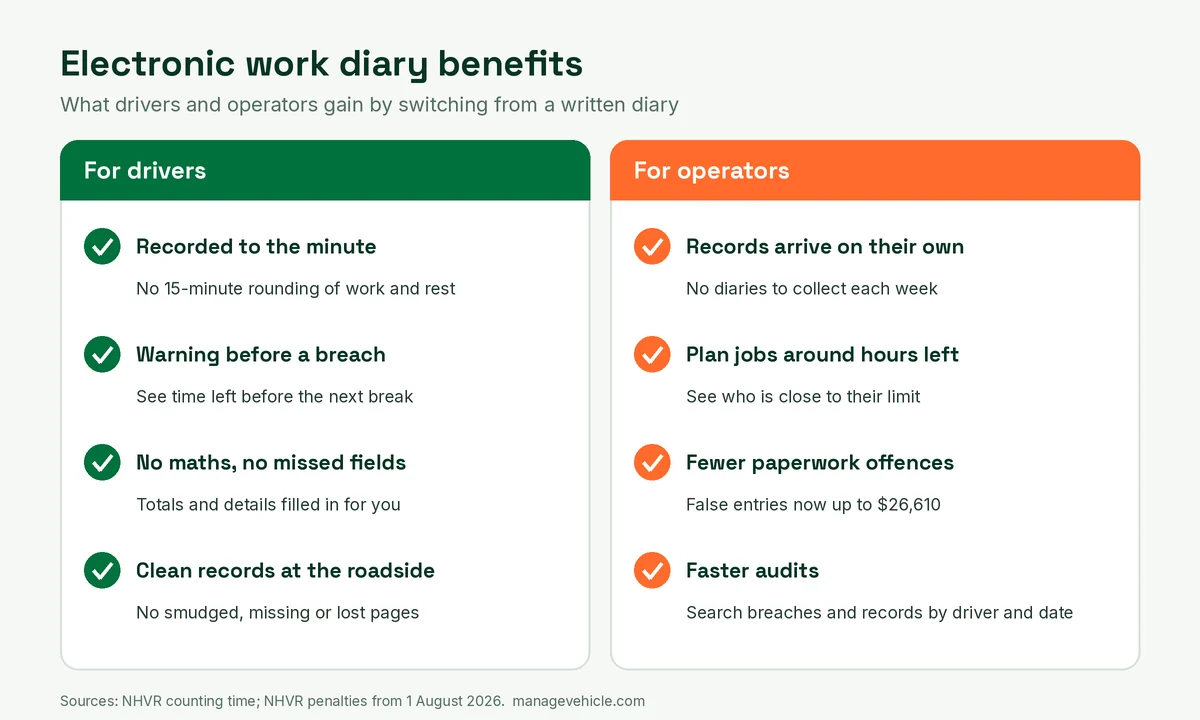
You don’t have to use an electronic work diary (EWD). The written national driver work diary is still fully valid, including under ACH. But a lot of the mistakes above simply can’t happen on an approved EWD: the time is recorded automatically, there’s no rounding to work out, and there are no copies to hand in within 21 days.
Manage Vehicle’s electronic work diary, MV Driver, is approved by the NHVR. It records work and rest as you go and sends the records to your record keeper electronically, so there’s no pile of yellow copies to hand in. If you’re weighing it up, our comparison of the electronic work diary vs paper logbook covers the pros and cons, and the EWD setup guide shows what switching a fleet over involves.
FAQs
Do I need a work diary for local work?
Not if you only drive within 100 km of your base under Standard Hours. You need one on any day you go further, or every day if you’re on BFM, AFM or ACH.
What pen should I use?
A black or blue ballpoint, pressed firmly so the pink and yellow copies are readable.
How do I fix a mistake in my national driver work diary?
Draw a single line through the wrong entry (or a thin squiggly line on the work and rest grid) and write the correct one. Don’t black it out. If the sheet becomes hard to read, cancel it and start again on the next sheet.
Is time spent with an inspector work or rest?
It depends on whether you’re answering questions or attending to the vehicle. If you’re unsure, the NHVR suggests counting it as work. You can also ask the officer to note the stop in your diary if it lasts more than 5 minutes.
Can I keep using my old diary after the 2026 changes?
The NHVR has given guidance for older diaries, such as striking out “AFM” and writing “ACH” if you’ve moved to ACH. When you buy a new one, you’ll get the updated version.
Where can I get help filling it in?
Ask your employer or an experienced driver, contact the NHVR on 13 NHVR (13 64 87), or do the nationally recognised course “Complete a work diary in the road transport industry” (TLIE3028) through a registered training organisation.