Vehicle Tracking vs Fleet Management Software: What’s the Difference?

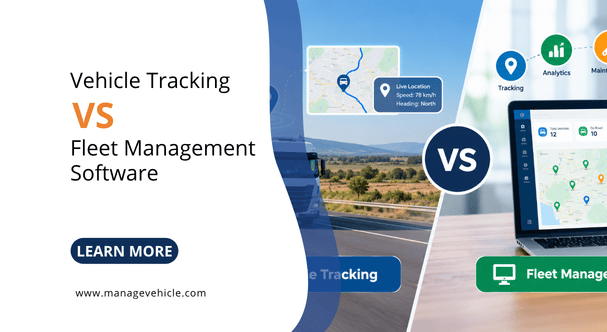
Vehicle tracking vs fleet management software is one of those comparisons that sounds like splitting hairs until you actually need to buy something. Right now they get used interchangeably in a lot of marketing copy, and that’s honestly a bit misleading.

If you’re trying to work out which one your business actually needs, the short version is this: vehicle tracking tells you where a vehicle is. Fleet management software tells you where it is, whether it’s due for a service, whether the driver’s fatigue hours check out, and whether you’ve got the paperwork to prove all of that to an auditor if it ever comes to that.

What Vehicle Tracking Actually Is

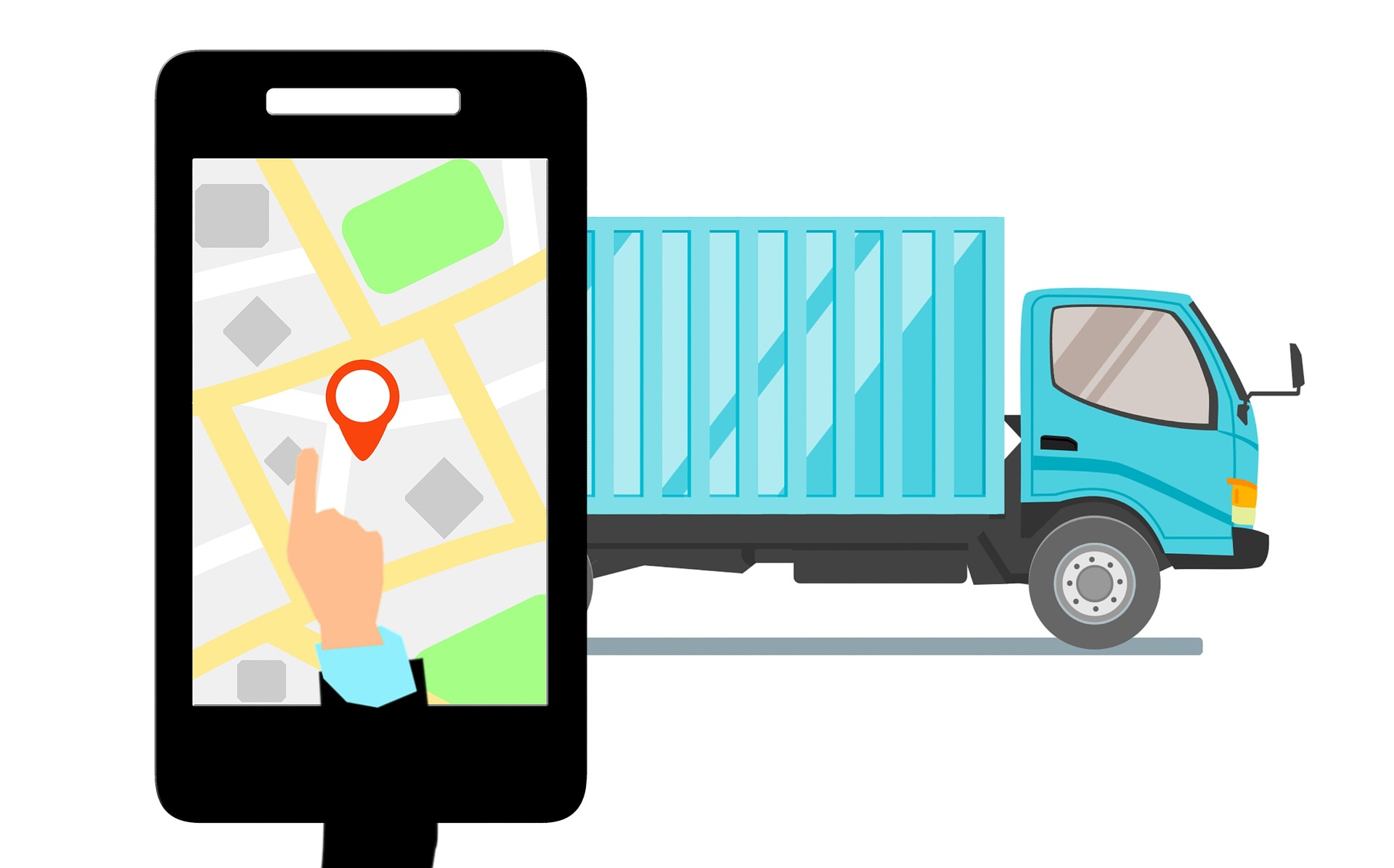
Vehicle tracking answers one question. Where is this vehicle, right now or at some point in the past? A GPS tracker logs location, and most units these days also grab speed and basic route history. You get a live map, a trail of everywhere the vehicle’s been, and usually an alert if it wanders outside an area you’ve set.

That’s genuinely handy on its own. It’s good for proof of delivery, checking a route was actually followed, recovering a stolen vehicle, or just knowing where things are without ringing every driver. But it’s a fairly narrow slice of what running a fleet involves, especially once heavy vehicles and compliance requirements come into it.

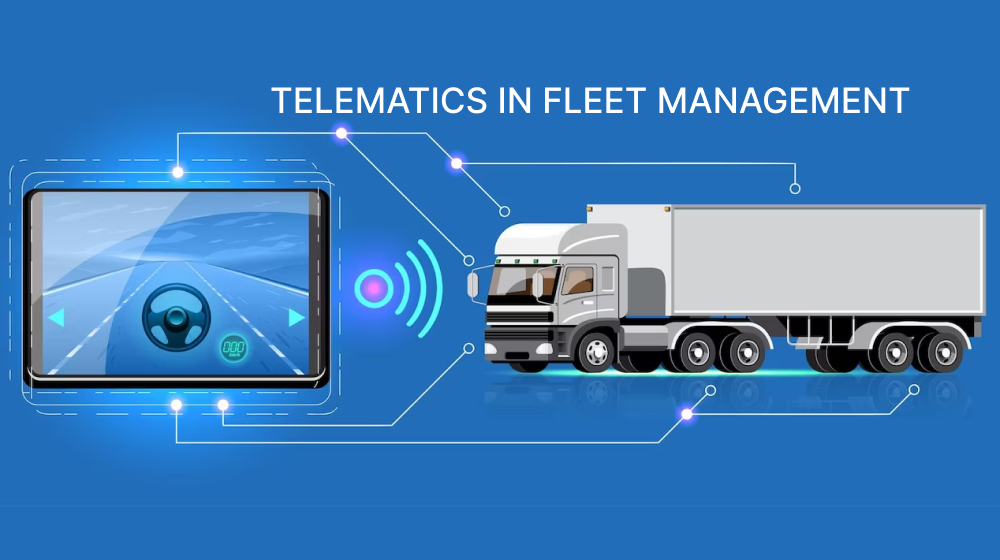
Some people call this telematics, and the terms do overlap a lot in everyday use. Strictly speaking, telematics covers a bit more ground again, since it usually pulls in engine diagnostics and driver behaviour data alongside the location piece. Either way, it’s still one layer below the full fleet management picture.

What Fleet Management Software Actually Is

Fleet management software is the fuller operational platform. Vehicle tracking sits inside it as a base layer, and everything else gets built on top: maintenance scheduling tied to odometer or engine-hour readings, fuel and expense tracking, driver behaviour scoring, document storage, and for Australian heavy vehicle operators specifically, compliance tools like Electronic Work Diaries, fatigue records, and Chain of Responsibility evidence.

You notice the difference the moment something actually goes wrong. A vehicle tracker will tell you a truck was speeding. Fleet management software tells you the truck was speeding, flags whether that driver’s done it before, checks it against their work diary for a possible fatigue link, and keeps the whole record somewhere an NHVR auditor can actually use it.

Some platforms package the driver-behaviour side of this into what’s called an in-vehicle monitoring system, or IVMS. It’s not a separate category so much as a specific way of describing that layer within fleet management software.

Vehicle Tracking vs Fleet Management Software: Side-by-Side

Vehicle Tracking Fleet Management Software
Live location and route history Yes Yes
Geofencing and movement alerts Usually Yes
Driver behaviour scoring Rarely Yes
Maintenance scheduling No Yes
Fuel and expense tracking No Yes
Electronic Work Diary/fatigue records No Often built in
Chain of Responsibility (CoR) evidence No Yes
Document and compliance reporting No Yes
Fine for a single ute or small light fleet Often, yes A bit much, but it scales
Suits heavy vehicles under the HVNL Not on its own Built for this


vehicle tracking nested diagram

Why This Actually Matters in Australia

The vehicle tracking vs fleet management software question gets a lot more serious once heavy vehicles and HVNL compliance are involved.

For any fleet running vehicles over 4.5 tonnes GVM, this isn’t just a feature comparison. It’s a compliance question. Under the Heavy Vehicle National Law, Chain of Responsibility parties have to manage safety “so far as is reasonably practicable,” and since the 2026 reforms, that gets assessed using the PSOE method: whether your systems are Present, Suitable, Operating, and Effective.

A standalone tracker can show where a truck was. That’s useful evidence something happened. What it generally can’t show is fatigue compliance, maintenance history, or a documented safety management system, which is exactly what gets examined in an audit. If your fleet includes any heavy vehicles, tracking alone won’t get you through a PSOE-based HVA audit. You need the wider platform.

For light vehicle fleets with no HVNL exposure, that calculation looks different. A good tracker might genuinely cover everything you need, at least until the fleet grows or takes on heavier vehicles.

Which One Do You Actually Need?

Three questions worth asking yourself.

decision framework

Do you run anything over 4.5 tonnes GVM? If yes, fleet management software isn’t really optional. The compliance side alone rules out standalone tracking.

Is the fleet growing? Two vehicles might be fine on tracking alone. Fifteen vehicles with a mix of light and heavy assets need the operational layer that fleet management software adds, since manual tracking in a spreadsheet stops being workable pretty quickly.

Do you ever need to prove something to someone? Insurers, auditors, councils, courts. They increasingly want documented systems, not just raw location pings. If you’d ever need to show what you knew and what you did about it, that’s a fleet management function, not a tracking one.

The Bottom Line

Vehicle tracking isn’t really competing with fleet management software. It’s a feature that’s already inside it. The real question isn’t tracking versus software, it’s whether you only need location data, or whether you need the compliance, maintenance, and reporting layer built around it too. For any fleet with heavy vehicles or real compliance exposure, that question tends to answer itself.

If you’ve landed on fleet management software as the answer, our guide to choosing GPS fleet tracking software in Australia goes through what’s actually worth looking for before you sign anything.

FAQ

Is vehicle tracking the same as fleet management software?

No. Vehicle tracking is one feature (knowing where a vehicle is). Fleet management software is the broader platform, and it includes tracking plus maintenance, compliance, fatigue management, and reporting tools.

Can I use just a vehicle tracker for my heavy vehicle fleet?

Not really, on its own. Heavy vehicle operators under the HVNL need documented compliance evidence (fatigue records, maintenance history, CoR trails) that standalone trackers don’t provide. A basic tracker can support that evidence, but it can’t replace the broader system an audit actually looks for.

When is standalone vehicle tracking enough?

For small fleets of light vehicles with no HVNL exposure, a decent tracker can genuinely do the job, particularly if all you need is location and basic route history.

Does fleet management software cost more than vehicle tracking alone?

Usually, yes, since it covers more ground. But for a fleet with compliance obligations, the real comparison isn’t tracking versus software. It’s the cost of the platform against the cost of failing an audit or a CoR investigation without one.

Do all fleet management platforms include vehicle tracking?

Yes. Vehicle tracking (GPS location, route history) is a baseline feature of pretty much every fleet management platform. It doesn’t work the other way around. Most standalone GPS trackers don’t include the wider compliance and maintenance tools fleet management software has.

What Is an In-Vehicle Monitoring System (IVMS)?

An In-Vehicle Monitoring System (IVMS) is a hardware and software platform installed in a vehicle to track its location, speed, and driver behaviour in real time. IVMS goes beyond basic GPS tracking by monitoring harsh braking, acceleration, cornering, seatbelt use, idling, geofence violations, and safety events. In Australia, IVMS is mandatory for site access on virtually every tier-one mining and energy operation. For heavy vehicle operators on public roads, IVMS data provides the auditable evidence that the HVNL’s Chain of Responsibility (CoR) provisions and the 2026 Safety Management System (SMS) requirements increasingly demand.

The simplest way to understand what IVMS does: GPS tracking tells you where a vehicle is. IVMS tells you where it is, how it got there, who was driving, and whether they did it safely.

That distinction matters. A basic GPS tracker drops a pin on a map. An IVMS platform records that the driver exceeded the site speed limit by 12 km/h in Zone C at 2:47 pm, braked harshly three times on the haul road, and triggered a geofence alert when the vehicle entered a blast exclusion area. That data sits in a timestamped log that can be produced for an auditor, a WHS investigator, or a court.

For operators running fleets across transport, construction, mining, or waste management, the practical question is not whether IVMS exists. It is whether your current tracking setup captures enough data to satisfy the compliance frameworks that now govern how Australian fleets operate.

How an In-Vehicle Monitoring System (IVMS) Works

An IVMS installation has two components: hardware in the vehicle and a software platform that receives, processes, and displays the data.

How an in-vehicle monitoring system works - data flow from in-vehicle unit to fleet dashboard

Hardware. The in-vehicle unit (IVU) is a ruggedised device wired into the vehicle’s electrical system. It contains a GPS receiver for positioning, an accelerometer for detecting harsh driving events, a cellular modem for transmitting data, and inputs for connecting additional sensors. Depending on the configuration, those additional sensors can include seatbelt switches, door sensors, engine diagnostics via the ECM (Engine Control Module) or OBD port, temperature probes, on-board mass sensors, and connections to driver identification systems such as iButton or NFC fobs.

When the ignition is on, the IVU records position, speed, heading, and sensor data at defined intervals. The Safer Together IVMS Specification used across Australia’s coal seam gas industry requires data storage at minimum every 200 seconds or at every vehicle event, whichever is shorter. Tier-one mining operators typically require second-by-second or near-real-time data transmission.

In areas without cellular coverage (common across the Pilbara, Goldfields, remote NT, and inland Queensland), the IVU stores data locally and syncs when connectivity returns. For operations that need continuous real-time visibility in remote areas, an Iridium satellite modem can be connected to the IVU so data transmits regardless of mobile coverage.

Software. The fleet management platform receives the data stream and presents it as live maps, trip replays, driver scorecards, exception reports, geofence alerts, and compliance dashboards. This is where IVMS becomes operationally useful. Raw GPS coordinates are meaningless. A dashboard that highlights the drivers with the most speed events this week, the vehicles with overdue pre-start inspections, and the route that consistently generates harsh braking alerts is where safety decisions happen.

IVMS vs GPS Tracking: What Is the Difference?

This question comes up constantly, and the honest answer is that the line is blurry. “GPS tracking” and “IVMS” and “telematics” are often used interchangeably, especially in the mining and resources sector where “IVMS” is the default term. In practice, industry practitioners across mining, oil, and gas treat IVMS as essentially interchangeable with telematics – the term is simply the default label for vehicle monitoring in the resources sector.

In-vehicle monitoring system IVMS vs GPS tracking comparison showing what each system captures

The functional differences matter more than the labels.

A standalone GPS tracker provides real-time vehicle location, trip history, basic speed data, and geofencing with entry and exit alerts. It answers the “where” question. It is enough for operators whose primary need is vehicle visibility and route management.

An IVMS platform provides everything GPS tracking does, plus driver behaviour monitoring (harsh braking, acceleration, cornering, speeding by zone), seatbelt compliance monitoring, driver identification, geofence-specific speed rules (different speed limits for different zones on the same site), event-based alerts with in-cab warnings, integration with fatigue and distraction monitoring systems (DFMS/DFDM), and configurable exception reporting that generates the compliance evidence auditors and investigators require.

The National Road Safety Partnership Program (NRSPP) published a discussion paper on IVMS that identifies the critical implementation factor: what you do with the data determines whether you meet your safety objectives. Collecting driver behaviour data and never reviewing it is worse than not collecting it at all, because you have created a record showing you were aware of the risk and took no action.

Insider note: We see this exact mistake in transport fleets, not just mining. An operator installs telematics to get the “we have a system” box ticked, runs it for 18 months, and never sets up a single alert rule or generates a driver behaviour report. Then a speed-related incident occurs on a public road. During the CoR investigation, the NHVR asks for the telematics data. The data shows 340 unactioned speed events across the fleet over the previous six months. That data just became prosecution evidence, not a compliance asset. Install the system, configure the alerts, and act on the exceptions. That is what IVMS is for.

Where IVMS Is Mandatory in Australia

There is no single national law that requires IVMS in every Australian vehicle. The obligation comes from three different sources, and which one applies depends on where and how the vehicle is used.

Mining and energy sites. IVMS is a near-universal access requirement at tier-one mining operations. BHP, Rio Tinto, Fortescue (FMG), Glencore, Santos, and BMA each publish vehicle specification documents that mandate IVMS with GPS tracking and driver behaviour logging for all contractor and company vehicles entering their sites. In 2025, BMA tightened requirements further, mandating that all light vehicles be fitted with IVMS, a handbrake alarm, and a VHF radio programmed to site specifications before entry.

The Safer Together industry body, whose members include Santos, QGC, Arrow Energy, and Origin Energy, has published a Common IVMS Specification that standardises IVMS settings across the Australian energy production industry. It covers speed management, seatbelt monitoring, fatigue management, harsh driving events, and reporting formats. Before this specification existed, contractors working for multiple operators in the same week faced different IVMS rules at every gate. The specification was developed specifically to fix that problem.

If your vehicle does not have a commissioned and approved IVMS unit when it arrives at the gate, it does not enter the site. The enforcement mechanism is that simple.

Heavy vehicle operators under the HVNL. The HVNL does not mandate IVMS by name. What it does mandate, since 1 August 2026, is a documented Safety Management System that demonstrably manages speed, fatigue, mass, maintenance, and CoR risks, assessed against the PSOE standard (Present, Suitable, Operating, Effective). The NHVR’s own regulatory advice confirms that compliance with the HVNL Primary Duty requires doing what is “reasonably practicable” to ensure safety. For a fleet running 20 or more heavy vehicles, an auditor assessing whether your speed management system is “Operating” and “Effective” will expect to see data. IVMS produces that data.

The 2026 Master Code of Practice, released by the NHVR in January 2026, identifies over 500 recommended controls across 45 transport activities. While the Master Code is not legally mandatory, courts may use it as a benchmark for what constitutes reasonably practicable steps. Multiple controls in the Master Code reference real-time vehicle monitoring, speed management systems, and driver behaviour data, which is IVMS by function if not by name.

Corporate CoR penalties for the most serious breaches now reach $4,230,550 (as of 1 August 2026, post-CPI indexation). The due diligence duty under the HVNL applies personally to executive officers. An executive who cannot demonstrate their organisation took active steps to manage speed and fatigue risks faces personal fines up to $436,850 and up to five years’ imprisonment for a Category 1 breach, independently of the company penalty.

Workplace Health and Safety legislation. Under every state and territory WHS Act, a Person Conducting a Business or Undertaking (PCBU) has a primary duty of care to ensure, so far as reasonably practicable, that the health and safety of workers is not put at risk. For any business that operates vehicles as part of its work, managing foreseeable driving risks is part of that duty. The NHVR’s regulatory advice on WHS and CoR confirms that both duties must be complied with, and both emphasise proactive risk prevention. IVMS provides the documented evidence trail that your driving risk controls are in place and operating.

What Data Does an IVMS Capture?

The specific data points depend on your hardware configuration and the compliance standard you need to meet. A typical IVMS installation for an Australian transport or mining fleet captures the following:

IVMS data points captured including vehicle data driver behaviour and safety compliance

Vehicle data: Real-time GPS position, speed, heading, trip start and end times, odometer or hour meter readings, ignition status, idle time and duration, engine diagnostics (fault codes, fuel consumption, coolant temperature via ECM/OBD), and geofence entry and exit events with timestamps.

Driver behaviour data: Speeding events (above posted limit, above site-specific zone limit, or above a defined threshold), harsh braking events (measured by G-force from the accelerometer), harsh acceleration events, harsh cornering events, seatbelt status (buckled or unbuckled while vehicle is in motion), and unauthorised vehicle use (ignition on outside of defined operating hours or without a valid driver ID).

Safety and compliance data: Duress/panic button activations, geofence violations (vehicle enters a restricted zone, blast area, or exclusion area), driver identification records (which driver was operating which vehicle at what time), fatigue and distraction alerts (if integrated with a DFMS/DFDM camera system), and journey management plan compliance (vehicle deviated from approved route or failed to reach a checkpoint within the expected time).

Insider note: The data point that catches operators off guard most often is idle time. IVMS records every minute the engine runs without movement. When we onboard a fleet of 15 to 30 vehicles, the idle time report almost always reveals 20 to 40 minutes of unnecessary idling per vehicle per day. At current diesel prices, that adds up to thousands of dollars per year in wasted fuel across even a modest fleet. It is also a compliance issue: excessive idling in a loading area or depot can indicate scheduling pressure, which is a CoR red flag for fatigue and speed management.

IVMS for Heavy Vehicle CoR Compliance

The strongest compliance case for IVMS in Australian transport fleets is its role in meeting Chain of Responsibility obligations. CoR does not just apply to the driver. It extends to every party in the supply chain that exercises control or influence over how a heavy vehicle is used on a road: the operator, the scheduler, the consignor, the consignee, and the loader.

chain of Responsibility penalty scale 2026 showing corporate and individual maximums by category

The HVNL’s primary duty requires each CoR party to ensure, so far as is reasonably practicable, that their conduct does not directly or indirectly cause or encourage a driver to contravene the law. “Reasonably practicable” is assessed against what the party knew, or should have known, and what was available to them.

IVMS directly supports three of the five CoR risk areas.

Speed management. IVMS records every speed event, timestamped and location-tagged. If a scheduler sets a delivery window that requires exceeding the speed limit, the IVMS data will show either that the driver exceeded the limit (evidence of the breach) or that deliveries consistently arrived late because the schedule was unrealistic (evidence the scheduler should review their planning). Either way, the data forces accountability.

Fatigue management. IVMS tracks driving hours, rest breaks, and vehicle movement patterns. When integrated with an Electronic Work Diary (EWD) or a DFMS camera system, it creates a complete picture of when a driver was working, how long they had been driving, and whether fatigue indicators were detected. The expanded “unfit to drive” duty under the amended HVNL, which since 1 August 2026 covers fatigue, illness, medication, and mental health for all heavy vehicles over 4.5 tonnes GVM (previously fatigue-only and only for vehicles over 12 tonnes), makes this data even more operationally relevant. The penalty for a single unfit-to-drive offence is $26,610.

Vehicle maintenance. IVMS platforms that pull engine diagnostics via ECM or OBD can flag fault codes, overheating, and abnormal operating conditions in real time. Linking that data to your maintenance scheduling system means defects are captured before a vehicle goes out with a known issue. Under CoR, an operator who dispatches a vehicle with a recorded unresolved fault is directly exposed.

Insider note: The CoR angle most operators miss is the scheduling evidence. We have worked with fleets where the IVMS trip data showed that drivers were consistently departing the depot 30 to 45 minutes late due to loading delays, then driving above the speed limit to make the delivery window. The speed events were a symptom. The root cause was a scheduling and loading problem that created pressure on the driver. IVMS data identified the pattern. Without it, the operator would have kept addressing individual speed events and never fixed the structural issue.

IVMS and the 2026 PSOE Audit Standard

Since 1 August 2026, operators with Heavy Vehicle Accreditation (HVA) are audited against the PSOE standard: Present, Suitable, Operating, Effective.

PSOE audit framework showing how IVMS maps to Present Suitable Operating Effective levels

IVMS maps directly to each level.

Present: The IVMS hardware is installed and the software platform is configured. Policies reference the system and define how data is used. This is the easiest level to satisfy and the one most operators clear without trouble.

Suitable: The IVMS configuration matches the operation’s risk profile. A long-haul B-double fleet needs different alert thresholds, geofence structures, and reporting dashboards than a metropolitan rigid fleet running 50 km urban routes. A one-size-fits-all setup with factory-default settings will not clear “Suitable” for a fleet with specific fatigue, speed, or mass management risks.

Operating: This is where most systems fail. “Operating” means the IVMS data is being used in daily operations. Drivers are receiving in-cab alerts. Managers are reviewing exception reports. Speed events generate follow-up actions that are recorded. The system is not installed and ignored. Auditors look for evidence of active use: alert acknowledgement records, corrective action logs, driver coaching sessions triggered by IVMS data, and management review minutes that reference fleet performance trends from the platform.

Effective: The IVMS is producing measurable safety outcomes. Incident and near-miss rates are trending down. Speed event frequency is declining. Corrective actions are being closed out and verified. Management reviews show that decisions are being made based on IVMS data and those decisions are producing results. This is the level that separates compliance from genuine safety management.

A paper-based speed management policy with no data behind it clears “Present” at best. IVMS data that is collected but never reviewed clears “Present” and “Suitable” but fails “Operating.” A fully integrated IVMS platform with active alerts, documented follow-up actions, and quarterly management reviews of fleet safety trends is the system that clears all four levels.

How to Choose an IVMS for Your Fleet

The choice depends on where your vehicles operate, which compliance standards you need to meet, and how many vehicles you are running.

Cellular vs satellite connectivity. If your fleet operates exclusively in metropolitan and regional areas with reliable mobile coverage, cellular-only hardware is sufficient and cheaper. If any of your vehicles operate in remote areas, on mine sites outside mobile coverage, or across inland routes where dead zones are common, you need hardware with local data storage that syncs on reconnection, and ideally an Iridium satellite option for continuous real-time visibility.

Site-specific compliance. If your vehicles access mining or energy sites, confirm which IVMS specifications your clients require. BHP, Rio Tinto, FMG, Santos, and Safer Together members each have distinct requirements for data format, reporting cadence, speed zone configurations, and approved hardware vendors. Some sites have preferred supplier lists. Installing a system that does not output data in the format the site operator expects means you will need to reconfigure or replace it before you get through the gate.

Integration with existing fleet systems. An IVMS that operates as a standalone platform creates a data silo. The real value comes when IVMS data connects to your maintenance scheduling, driver documentation, fatigue management, and compliance reporting. Speed events should trigger a workflow. Fault codes should generate a maintenance task. Fatigue alerts should feed into your SMS documentation. If your IVMS platform cannot integrate with your broader fleet management system, you are building the disconnected compliance environment that the 2026 PSOE standard was designed to eliminate.

Fleet size matters. For a five-truck operation, a basic GPS tracking setup with speed alerts and trip history may be sufficient for the first 12 months. For 15 or more vehicles, the volume of data and the compliance obligations make a full IVMS platform with automated reporting and exception management the practical minimum. The cost of a typical IVMS installation ranges from $20 to $50 per vehicle per month for the software platform, plus $200 to $500 for the hardware unit per vehicle depending on the feature set. That cost is offset quickly against fuel savings from idle time reduction, insurance reductions from documented safety controls, and the avoidance of a single CoR penalty that starts at $705,820 for a Category 3 corporate breach (as of August 2026).

How Manage Vehicle’s IVMS and Telematics Platform Works

Manage Vehicle’s GPS tracking and telematics solution provides the core IVMS functionality that Australian transport, construction, and mining operators need: real-time vehicle positioning, driver behaviour monitoring, speed zone management, harsh event detection, geofencing, and configurable alerts.

The platform connects IVMS data directly to compliance management, so speed events feed into your CoR evidence trail. Maintenance alerts from engine diagnostics link to your vehicle servicing schedule. Fatigue data from smart dashcams with AI-powered driver monitoring integrates with work diary records. The result is one connected system that produces the PSOE audit evidence across all five SMS components, not separate platforms that an auditor has to reconcile.

For operators in construction and mining, the platform supports offline data storage with automatic sync for vehicles operating outside cellular coverage, site-configurable pre-start inspections, and the compliance reporting structure that mine site operators and WHS inspectors expect.

Frequently Asked Questions (FAQs)

Is IVMS mandatory in Australia?

There is no single national law requiring IVMS in every vehicle. IVMS is mandatory for site access at virtually all tier-one mining and energy operations in Australia, including BHP, Rio Tinto, Fortescue, Glencore, Santos, and Safer Together member companies. For heavy vehicle operators under the HVNL, IVMS is not explicitly mandated, but the data it produces is increasingly necessary to demonstrate compliance with CoR obligations and the 2026 SMS and PSOE audit requirements.

What is the difference between IVMS and GPS tracking?

GPS tracking monitors vehicle location, speed, and trip history. IVMS includes GPS tracking but adds driver behaviour monitoring (harsh braking, acceleration, cornering, speeding by zone), seatbelt compliance, driver identification, geofence-specific speed rules, event-based alerts, and integration with fatigue monitoring systems. In the mining and resources sector, “IVMS” is the standard term for what the broader fleet industry calls “telematics.”

What does IVMS stand for?

IVMS stands for In-Vehicle Monitoring System. Related acronyms used in the Australian mining sector include IVFMS (In-Vehicle Fatigue Management System), DFMS (Driver Fatigue Monitoring System), and DFDM (Driver Fatigue and Distraction Monitoring), which refer to AI-powered camera systems that detect fatigue and distraction events and are often deployed alongside or integrated with IVMS.

How much does IVMS cost per vehicle?

Typical costs for an Australian IVMS installation range from $200 to $500 per vehicle for the hardware unit (one-time), plus $20 to $50 per vehicle per month for the software platform and data connectivity. Costs vary depending on the feature set, satellite connectivity requirements, and whether fatigue camera integration is included. These figures should be weighed against the cost of a single CoR penalty (Category 3 corporate breach: $705,820 maximum, as of August 2026) and the fuel savings from reduced idle time.

Does IVMS work in remote areas without mobile coverage?

It depends on the hardware. IVMS units with local data storage will record and store data when out of cellular range, then sync automatically when coverage returns. For continuous real-time visibility in remote areas, an Iridium satellite modem can be added to the IVU. This is common in Pilbara mining operations, Goldfields sites, and remote NT and SA locations where cellular dead zones are the norm.

Can IVMS help with Chain of Responsibility compliance?

Yes. IVMS directly supports three of the five CoR risk areas: speed management (timestamped speed event records), fatigue management (driving hours, rest patterns, and integration with EWDs and fatigue camera systems), and vehicle maintenance (real-time engine diagnostics and fault code alerts). Under the HVNL, CoR parties must demonstrate they took “reasonably practicable” steps to ensure safety. IVMS data is the most practical form of that evidence.

What IVMS specifications do Australian mining companies require?

Each mining company publishes its own IVMS requirements. Common frameworks include the Safer Together Common IVMS Specification (used by Santos, QGC, Arrow Energy, Origin Energy), BHP’s vehicle safety standard, Rio Tinto’s contractor vehicle requirements, and Fortescue’s project-specific standards. Requirements typically cover GPS tracking interval, speed zone configuration, harsh event thresholds, seatbelt monitoring, data format, reporting cadence, and approved hardware. Always check the current revision of your client’s specification before mobilising a vehicle.
Beyond Tracking: 3 Advanced Features of Manage Vehicle You Might Be Missing

If you’re a truck driver or transport operator, you already know that vehicle tracking is like having a co-pilot that never sleeps.

It’s the backbone of modern fleet management, helping logistics businesses save time, cut costs, and keep everyone safe on the road. But what if I told you that your tracking system could do so much more?

While basic GPS tracking is great for knowing where your rig is, today’s advanced systems like Manage Vehicle offer features that go far beyond location updates.

These tools aren’t just about monitoring, they’re about empowering you to drive smarter, stay compliant, and protect your livelihood.

Let’s dive into three advanced features you might be missing out on, and why they’re game-changers for your daily operations.

1. Real Time Alerts to Keep Your Drivers Safe

Imagine having a guardian angel that whispers in your ear when risks pop up. That’s what real-time alerts feel like!

Manage Vehicle’s system monitors your vehicle’s movements and instantly notifies you of potential hazards, like excessive speeding, harsh braking, or idling.

These alerts aren’t just nagging reminders, they’re proactive tools to prevent accidents and reduce wear-and-tear on your rig.

Vehicle Tracking for Driver Safety
Manage Vehicle provides you with fleet technology trend reports with real-time alerts to protect your fleet from any danger.

For example, if a driver exceeds the speed limit, the system triggers an alert via text or email, allowing you to address the issue before it becomes a problem. This is not building the culture of safety by evading fines only.

Organizations like the National Heavy Vehicle Regulator (NHVR) emphasize the importance of real-time monitoring to reduce incidents on Aussie roads.

With features like geofencing and after-hours activity alerts, you can also prevent unauthorized vehicle use and theft, giving you peace of mind whether you’re on the road or off the clock.

2. HD Video Footage for Evidence

Wish you had someone to side with when it comes to a he-said, she-said fight? HD dash cameras with GPS positioning are can solve your time and energy.

Manage Vehicle integrates AI-powered cameras that record crystal-clear footage of the road and cabin, complete with timestamps and location data. This isn’t just for catching bad drivers, it’s your best defense against fraudulent claims and insurance disputes.

HD Video Footage for Evidence
Manage Vehicle shares solid evidences in HD video footage in case of any mishappenings on the road.

To explain, when an accident takes place, the system records the video and notifies immediately. This evidence will help in claiming the insurance and save your reputation.

Plus, with features like driver behavior tracking, you can review footage to coach your team on safer driving habits. As highlighted by Aussie road safety advocates, video telematics is a proven way to reduce accidents and promote accountability.

3. Seamless Integration with Compliance Tools

Let’s face it: compliance paperwork is a headache. But what if your tracking system could handle it for you?

Manage Vehicle seamlessly integrates with compliance tools like electronic logging devices (ELDs) and mass management systems, automating record-keeping and reducing manual errors. This means fewer hours spent on paperwork and more time on the road.

Vehicle Tracking for Seamless Integration
Manage Vehicle gives you seamless integration with compliance tools so that your transport or logistic business can run smoothly.

The system tracks critical data like driver hours, vehicle maintenance schedules, and axle weights, ensuring you meet NHVR standards effortlessly.

For example, it alerts you when registration is due or when a driver is nearing their shift limit, helping you avoid fines and stay within legal limits.

As one transport company named A2Z WORX noted, “Manage Vehicle has made a huge difference for us. The real-time tracking and driver safety features are spot on. We’ve had fewer incidents, and everything runs more smoothly. The support team is always there when we need them.”

Why Choose Manage Vehicle as Your Road Partner?

Running a fleet is not simply about moving between point A and point B, it is about running it safely, efficiently and compliantly. Manage Vehicle isn’t just another tracking system; it’s a partner that grows with your business. Here’s why it stands out:

  • Comprehensive Safety Tools: From real-time alerts to HD video, it prioritizes your safety on the road.
  • Regulatory Compliance: It simplifies compliance with NHVR and other regulatory bodies, so you’re always audit-ready.
  • User-Friendly Design: Designed for drivers, by drivers, the system is intuitive and easy to use, even for tech newcomers.

As endorsed by transport operators across Australia, Manage Vehicle helps you “boost safety through real-time alerts and optimize performance with data-driven insights”.

Whether you’re a solo owner-operator or part of a large fleet, this system adapts to your needs without locking you into long-term contracts.

Don’t Settle for Basic Vehicle Tracking

In today’s fast-paced transport industry, sticking to basic GPS tracking is like using a map when everyone else has a GPS, it works. But, you’re missing out on a world of efficiency and safety.

With Manage Vehicle, you’re not just tracking vehicles, you’re unlocking tools that protect your drivers, streamline compliance, and safeguard your business.

So, why wait? Embrace the future of fleet management and discover how these advanced features can transform your daily operations. Register a free quote now on your transport/logistic company and enjoy 30 days free trial.

Stay safe, stay compliant, and keep rolling strong!

The Future of Fleet Tracking: Manage Vehicle

While GPS provides valuable location data, Manage Vehicle creates an interconnected ecosystem of data points. We transform raw GPS coordinates into tangible results by integrating fleet diagnostics, driver behavior, real-time video analytics, and compliance tools into a single pane of glass.

Manage Vehicle is leading this charge, moving beyond simple tracking to deliver a holistic fleet management software that predicts problems, optimizes operations, and prevents costs.

At the heart of this is our integrated 4 channel smart dashcams with real time GPS, designed to actively prevent accidents, collisions, rollovers, and crashes before they happen.

“Manage Vehicle has made a huge difference for us. The real-time tracking and driver safety features are spot on. We’ve had fewer incidents, and everything runs smoothly. The support team is always there when we need them.” from A2Z WORX, our valued customer since 2021

Here’s How Manage Vehicle’s Fleet Tracking Ecosystem Works

Manage Vehicle’s suite of services is designed to be the central nervous system for your transport and logistics company. Here’s how each module delivers unparalleled value:

1. Smarter Transport Management:

Manage Vehicle Fleet Tracking for Smarter Transport Management
Manage Vehicle fleet tracking system helps you to plan or dispatch and allocate drivers for smarter transport management. | Image Source: Delivery Solutions

From plan to dispatch traditional GPS shows you where a driver is after they’ve gotten lost. Manage Vehicle’s cloud-based system ensures they never get lost in the first place.

  • Plan or Dispatch: Dynamically assign jobs based on real-time vehicle location, traffic conditions, and driver Hours of Service (HoS) compliance. Our system optimizes routes for fuel efficiency and timely deliveries.
  • Allocate Drivers: Match the right driver to the right job based on skill set, certification, and current availability. Ensure your most qualified personnel are handling your most valuable shipments.

2. Proactive Fleet Maintenance:

Manage Vehicle Solutions for Proactive Fleet Maintenance
Manage Vehicle assists you during vehicle inspection by storing your documents or permits into safe hands. | Image Source: Whip Around

Just predict, don’t react. A basic GPS unit can’t tell you a vehicle’s health. But, our dash camera sensors can.

  • Vehicle Inspection: Convert pre and post trip inspection to automated. Drivers can complete checks on their mobile app, flagging issues instantly for the maintenance team.
  • Fault Report: Real-time engine diagnostic data alerts you to fault codes the moment they appear, from engine malfunctions to low tire pressure.
  • Vehicle Repair: Automatically generate repair tickets and assign them to your preferred mechanics based on the fault reports. Track repair status and history for each vehicle to maintain pristine maintenance records and maximize asset lifespan.

3. Simplified Compliance Regulation:

Manage Vehicle Solutions Simplifies Compliance Regulation
Manage Vehicle’s cloud-driven system saves truck drivers from penalties during vehicle inspection and provides training and toolbox to meet compliance regulation. | Image Source: Fleetworthy Solutions

Stay audit-ready and avoid the massive costs of violations with tools built to follow Australian transport regulation.

  • Training & Toolbox: Provide and administer required modules of driver training and safety toolbox talks directly into the driver application. To check that the track is done to make sure you are consistently upto date.
  • Non Compliance Alerts: Receive instant alerts for potential compliance breaches, such as impending HoS violations, missed inspections, or expired driver certifications.
  • Incident Report: In the event of an incident, our system becomes your best ally. Automatically collate data, including triggered video footage from the 4 channel dashcam, GPS location, speed, and G-force impact data, to create a comprehensive, indisputable report for insurers and authorities.

Our 4 Channel Smart Dashcam with Integrated GPS for Fleet Tracking

This is where Manage Vehicle truly separates from the pack. Our cloud-integrated 4-channel smart dashcams is more than a recorder. It’s a proactive safety co-pilot integrated directly into our real-time GPS tracking system.

  • 360 Degree Awareness: Monitor the road ahead, the driver cabin, and both blind spots simultaneously.
  • Real Time Incident Prevention: Using advanced AI, the dashcam analyzes video in real-time to detect and warn against risky behaviors like distracted driving, fatigue, tailgating, and lane departure.
  • Crash Reconstruction: In the event of a collision, rollover, or crash, the system immediately saves footage from before, during, and after the event, providing irrefutable context that protects your drivers and your business from fraudulent claims.

Let’s take glimpse into this video…

By combining live video analytics with precise GPS and vehicle data, we don’t just track your fleet; we actively work to make it safer, smarter, and more efficient.

Don’t Just Track Your Fleet, Transform It!

The future of fleet management isn’t about choosing between GPS and IoT. The future is about integrated, intelligent solutions that leverage the best of both.

GPS provides the foundation of the location, whilst Manage Vehicle app provides the environment, the insight and the control that delivers ROI (return on investment) for your transport business.

Manage Vehicle is that future, today. We provide a unified platform that empowers transport and logistics companies to move beyond reactive tracking and into the realm of predictive, proactive management.

“MV’s real time tracking has helped us streamline our operations, and the team is always there to support us when we need it. Definitely recommend!” by Jaswant Tiwana from Tiwana Transport

Ready to stop just tracking and start transforming?

Give your fleet a real vehicle management solution. Also, get a free trial of the Manage Vehicle app today and get a quote for your transport-logistics business where there’s no obligation for you.

So, let’s find out what you can do to increase savings, safety, and less fuel consumption in your transport and logistic business.

Get Your Free Quote and Sign Up Now!

Impact of Australia’s 3G Network Shutdown on Vehicle Tracking

Australia is getting rid of old 3G networks to make way for faster ones like 4G and 5G for smooth vehicle tracking. This means that 3G is slowly disappearing. The change is happening because newer networks are better. This switch is having an impact on how we track fleets.

In this article, we’ll discuss the effects of the 3G network shutdown in Australia on vehicle tracking systems. We’ll explore the difficulties that fleet businesses and managers might encounter as they switch to newer technologies, like 4G and 5G, for GPS fleet monitoring.

Overview of 3G Network Shutdown in Australia

3G networks, which were a big deal in the early 2000s and made mobile services like smartphones and mobile internet possible, are getting old and costly to keep up.

Australia’s telecom regulators and companies, like Telstra, Optus, and TPG Telecom, have decided to shut down 3G services gradually.

They told people about it well in advance, and the shutdown will mostly happen by 2024. They’re also helping customers switch to newer networks like 4G and 5G by telling them what devices work and what plan changes they might need.

Challenges of 3G Shutdown on Vehicle Tracking

The shutdown of 3G networks is causing problems for businesses that use 3G-based vehicle tracking systems. These systems rely on 3G networks to talk, send data, and use GPS to figure out where fleets are.

They also use geofencing to set up virtual boundaries. But because 3G is going away, these devices won’t work properly, which can mess up how companies manage their fleets.

Fleet businesses that don’t deal with the 3G shutdown might have these issues with their vehicle tracking:

  1. Loss of Connectivity: The devices won’t be able to talk, so they won’t know where the vehicles are, and GPS won’t work.
  2. Old Equipment: The tracking devices will be outdated and might need to be replaced with newer ones.
  3. Limited Support and No Updates: Companies won’t get support or updates for their old 3G devices, which can cause problems with GPS and geofencing.
  4. And more issues could come up.

Switch to 4G & 5G after Australia’s 3G Net Work Shutdown

To make the 3G shutdown’s impact on vehicle tracking easier to handle, businesses should switch to newer networks like 4G and 5G. These networks are better than 3G and bring more benefits to geofencing and alerts, ensuring it keeps working well and improving over time.

Advantages of 4G and 5G Network for Vehicle Tracking

Using 4G and 5G for vehicle tracking comes with several advantages. These newer networks provide faster and more reliable connections, ensuring real-time tracking and data transmission.

They also offer lower latency, meaning there’s less delay in receiving information. With improved network capabilities, businesses can enhance the efficiency of their rout optimization solutions, leading to better overall fleet management.

Solutions for 3G Shutdown and Adopting 4G/5G in Vehicle Tracking

To overcome challenges linked to the 3G shutdown and shift to 4G and 5G for vehicle tracking, businesses can explore the following solutions:

Conduct a System Audit

Review the current real-time location tracking setup, pinpoint devices relying on 3G, and prioritize hardware upgrades or replacements.

Engage with Service Providers

Seek advice from telecom service providers and technology vendors specializing in vehicle tracking like Manage Vehicle. We can guide the transition, offer compatible solutions, and help integrate them seamlessly.

Plan for Network Coverage

Evaluate the coverage and reliability of 4G and 5G providers in the areas your vehicles operate. Choose providers with extensive coverage for consistent tracking.

Address Data Security

Implement strong data security measures, including encryption and secure communication protocols, to protect fleet and customer data. Regularly update software to address security vulnerabilities.

That’s How Manage Vehicle Supports You Through the 3G Shutdown

Upgraded Telematics

Switch to Manage Vehicle’s modern telematics solutions compatible with 4G and 5G. This upgrade ensures your connectivity stays smooth, and you can always access real-time data about your vehicles.

Easy Transition

Moving your fleet to new tech can be confusing, but our team is here to help. We guide you through hardware upgrades and software changes, making sure your operations stay on track with as little interruption as possible.

Better Operations

Our telematics systems do more than just track. They tell you about driver behavior, keep an eye on vehicle health, and suggest better routes. This helps you run your operations more smoothly, save money, and make things safer.

Top-notch Support

Customer support is a big deal for us at Manage Vehicle. Whenever you have questions or run into issues, our teams are ready to assist. From getting started to ongoing help, we make sure your experience is hassle-free.

Loads of Experience

With lots of years working in fleet management and telematics, Manage Vehicle knows its stuff. We share our knowledge to help you use the latest tech and stay competitive in your industry.

Choosing Manage Vehicle isn’t just about handling the 3G shutdown. It’s about making your fleet management more efficient, connected, and successful in the times to come.

Embracing the Future of Fleet Tracking Beyond 3G

The 3G shutdown in Australia is changing how we track vehicles. This affects fleet businesses using 3G for tracking, causing issues like losing connections and outdated equipment. Telecom companies like Telstra and Optus are gradually stopping 3G services by 2024.

The solution? Switch to better networks like 4G and 5G for improved tracking with faster and more reliable connections.

For businesses facing challenges, there are solutions. Check your current tracking setup, get advice from service providers, plan for good network coverage, and keep data secure.

Manage Vehicle is here to help with upgraded telematics for smooth connectivity, guiding through the transition, and offering insights for better operations.

So, choosing Manage Vehicle isn’t just about dealing with the 3G shutdown. It’s about making your vehicle management better, connected, and ready for what’s coming next.

GPS Fleet Tracking Software in Australia: Your Key to Real-Time Tracking

In the vast and diverse landscapes of Australia, efficient fleet management is essential. Whether you run a delivery service, construction company, or transportation business, ensuring your fleet operates optimally is paramount. One way to achieve this is through GPS fleet tracking software, and the best part is that you can find options that offer real-time tracking for free. In this article, we’ll dive into the world of GPS fleet tracking software in Australia, with a focus on real-time tracking solutions that won’t cost you a dime.

The Benefits of Real-Time Tracking

Real-time Insights for Enhanced Efficiency

Real-time tracking software provides you with up-to-the-second information about the location and status of your fleet vehicles. This means you can monitor your vehicles as they move across Australia, making it easier to plan routes, manage delivery times, and respond swiftly to unexpected situations.

Improved Fleet Safety

Safety is a top priority for any fleet operator. With real-time tracking, you can keep a close eye on driver behavior, ensuring they adhere to speed limits and drive safely. In the event of an emergency or accident, you can quickly dispatch assistance to the precise location, potentially saving lives and reducing the severity of incidents.

Enhanced Customer Service

Real-time tracking isn’t just about monitoring your fleet; it’s also about keeping your customers informed. With accurate delivery or arrival times, you can provide customers with real-time updates, enhancing their experience and trust in your service.

Cost Savings

Real-time tracking allows you to optimize routes and reduce idle time, resulting in significant fuel cost savings. By monitoring your vehicles’ performance and fuel consumption in real-time, you can make informed decisions to minimize expenses.

Maintenance Efficiency

Real-time tracking software often includes maintenance scheduling and alerts. This feature helps you stay on top of routine maintenance, reducing the risk of breakdowns and costly repairs. Efficient maintenance prolongs the lifespan of your fleet and minimizes downtime.

Theft Prevention

Real-time tracking provides an added layer of security. In the unfortunate event of vehicle theft, you can track and locate the stolen vehicle quickly, increasing the chances of recovery and reducing financial losses.

Environmental Impact

Efficient route planning through real-time tracking not only saves on fuel costs but also reduces your carbon footprint. By optimizing routes, you can decrease unnecessary mileage and emissions, contributing to a more environmentally friendly operation.

Data-Driven Decision Making

Real-time tracking generates a wealth of data that can be analyzed to make informed decisions. You can identify trends, areas for improvement, and opportunities for cost reduction through data-driven insights, ultimately enhancing your fleet’s performance and profitability.

Regulatory Compliance

Real-time tracking can assist in ensuring compliance with regulations, such as hours-of-service rules for drivers. It helps monitor and record driver hours accurately, reducing the risk of violations and associated penalties.

Free GPS Fleet Tracking Software in Australia

While you may come across many GPS fleet tracking software options available for free download in Australia, it’s important to be aware that these often come with limitations in terms of features and can be prone to errors, bugs, or even crashes.

While it’s true that usually, you have to pay for good things, like software, when searching for the best Free GPS Fleet Tracking Software in Australia, you might find several options that don’t cost anything. But there’s a catch – these free options often have limited features.

Instead of just going for free software, it might be a good idea to consider premium tracking software. Even though you’ll have to pay a bit, these premium options offer many more useful features. They can be budget-friendly, meaning they won’t cost you a lot, and they work well for fleets of all sizes.

One of the best fleet management software options out there is Manage Vehicle. It comes with lots of features that can make your fleet work better, like being safer and more efficient. So, when you’re thinking about running your fleet successfully in Australia, it’s smart to find the right balance between what you can afford and what features you need. Premium software, like Manage Vehicle, can help you do just that.

Choosing the Right Solution for Your Fleet

In your quest to optimise fleet management in Australia, it’s essential to choose the right solution. While free GPS fleet tracking software might initially catch your eye due to its cost-effectiveness, it’s crucial to consider the limitations these options often come with. These limitations can potentially impede your fleet’s performance and the overall efficiency of your operations.

Instead, investing in premium tracking software like Manage Vehicle offers a comprehensive and dependable solution. Striking the right balance between affordability and functionality ensures that your fleet operates at its peak, delivering enhanced safety, efficiency, and customer satisfaction. With the added benefit of real-time tracking and premium features, your fleet becomes well-equipped to navigate the diverse terrains of Australia, ensuring your business thrives even in today’s competitive environment.

Conclusion

When it comes to finding the best GPS tracking software, it’s important to make an informed choice. While free GPS fleet tracking software may seem like a budget-friendly option, it often comes with limitations that can hinder your fleet’s performance. Instead, considering premium tracking software like Manage Vehicle provides a more comprehensive and reliable solution. By striking the right balance between affordability and functionality, you can ensure your fleet operates at its best, delivering enhanced safety, efficiency, and customer satisfaction. With the added advantage of real-time tracking and premium features, your fleet is well-prepared to conquer the diverse terrains of Australia and thrive in today’s competitive business environment.

The Role of Telematics in Fleet Management

Quick answer: Fleet telematics combines GPS location data with vehicle diagnostics (engine data, fuel use, driver behaviour) transmitted in real time to a central platform. It’s broader than plain GPS tracking – telematics tells you not just where a vehicle is, but how it’s being driven, how efficiently it’s running, and increasingly, whether your fleet is compliance-audit-ready.

Telematics in fleet management combines GPS location data, vehicle diagnostics, and driver behaviour data into a single system fleet managers can act on in real time – turning a fleet from a set of vehicles you hope are doing the right thing into one you can actually see and manage.

How Fleet Telematics Actually Works

At its core, a telematics system pairs a vehicle-installed device with software that collects and processes the data it generates. The device combines GPS positioning with onboard diagnostics – engine data, speed, fuel consumption, harsh braking or acceleration – and transmits it over a cellular network to a central platform.

How does Fleet Telematics Works?

GPS positioning itself relies on signals from global navigation satellite systems (GNSS) – the US-operated GPS constellation is the most familiar, though modern receivers often draw on multiple systems for improved accuracy. Fleet managers view the resulting data as live maps, historical reports, and automated alerts, rather than having to physically check in with drivers or wait for a vehicle to return to base.

Types of Telematics Hardware

Not all telematics hardware works the same way, and the option that fits depends on fleet type:

  • OBD-port plug-in devices – connect directly to a vehicle’s onboard diagnostics port, generally the fastest and least invasive to install, common on lighter commercial vehicles.
  • Hardwired units – installed directly into the vehicle’s wiring, typical for heavy vehicles and trucks where a more permanent, tamper-resistant installation is preferred
  • Asset trackers – battery-powered, non-wired devices used for trailers, equipment, and other assets that don’t have their own ignition or engine to draw power from
  • Integrated in-cabin systems – combine GPS/telematics with driver-facing cameras and displays, increasingly common where fatigue and distraction monitoring is bundled with core tracking

The right hardware choice affects both installation cost and what data is actually available – a basic OBD plug-in typically can’t support the same depth of driver-facing monitoring an integrated in-cabin system can.

What Telematics Data Actually Includes

  • Location and route history – where a vehicle is now and where it’s been
  • Driver behaviour – speeding, harsh braking, idling, and other patterns that affect both safety and running costs
  • Vehicle health – engine diagnostics that can flag maintenance needs before they become breakdowns
  • Fuel consumption – actual usage patterns, not just fuel card totals

5 Ways Telematics Improves Fleet Management

Role of Telematics in Fleet Management

1. Better Route Efficiency

Telematics doesn’t just show drivers where to go – it calculates the most efficient path based on live traffic, distance, and delivery sequence, while tracking fuel usage, idling, and driver behaviour alongside route data for a fuller picture of where time and fuel are actually being spent.

2. Lower Operating Costs

Less time in traffic and fewer unnecessary kilometres translate directly into lower fuel spend – one of the largest line items in any fleet’s operating budget. Combined with reduced idling and optimised routing, telematics gives fleet managers a concrete lever to pull on cost.

3. Stronger Customer Relationships

Accurate, telematics-backed ETAs let transport businesses commit to delivery windows with real confidence rather than best-guess estimates – predictability that compounds into customer retention over time.

4. Insurance and Risk Benefits

Insurers increasingly factor telematics data into commercial vehicle premiums – fleets that can demonstrate consistent, monitored driving behaviour are often viewed as lower risk, with fewer opportunities for the kind of incidents that drive up claims history.

5. Better-Informed Budgeting

Telematics data compounds over time – daily, weekly, and monthly records let fleet managers build budgets based on actual historical consumption and cost patterns, rather than rough estimates.

Telematics and Compliance

Beyond operational efficiency, telematics data increasingly serves as compliance evidence under the HVNL. Digital records – location history, driving hours, vehicle inspection data – are far better positioned to demonstrate an “Operating and Effective” Safety Management System under the new PSOE audit standard than paper-based logs, since they produce a genuine, timestamped record rather than a static document.

Choosing a Telematics Provider

Beyond raw features, the practical decision usually comes down to a few factors: whether the platform supports Australian compliance requirements out of the box, whether hardware installation and support is genuinely local, and whether the data integrates with systems you already run – fuel cards, maintenance scheduling, accounting. For a full breakdown of what to evaluate, see our guide on choosing GPS fleet tracking software in Australia.

The Bottom Line

Telematics turns fleet management from a reactive, after-the-fact process into a live, data-driven one – with direct payoffs in cost, safety, customer experience, and now, compliance evidence. For a deeper look at how telematics specifically supports Chain of Responsibility obligations, see our guide on telematics as compliance evidence.


FAQ

What’s the difference between GPS tracking and telematics?

GPS tracking shows location only. Telematics combines GPS with vehicle diagnostics, driver behaviour, and fuel data – a much fuller picture than location alone. See our dedicated comparison for the full breakdown.

Does telematics help with NHVR compliance?

Yes. Telematics data – location, driving hours, engine data – increasingly serves as digital evidence supporting Chain of Responsibility obligations and the new PSOE audit standard, which favours timestamped digital records over paper logs.

How much does fleet telematics typically cost?

Costs vary by hardware, number of vehicles, and feature set – factor in installation, contract length, and per-vehicle scaling fees, not just the headline monthly price.

Do I need telematics if I already have a fuel card program?

Fuel cards show spend; telematics shows the why – actual consumption per vehicle, idling time, and route efficiency – which is what lets you actually act on fuel costs rather than just observe them.

Is telematics only useful for large fleets?

No – even small fleets benefit from route efficiency, theft/security visibility, and (increasingly) audit-ready compliance records, though the ROI scales with fleet size.

What type of telematics hardware do I need?

It depends on the asset – OBD plug-ins suit light commercial vehicles, hardwired units suit heavy vehicles needing tamper-resistant installation, and asset trackers suit trailers or equipment without their own power source.

How does GPS positioning actually work?

GPS receivers calculate location using signals from satellites in global navigation satellite system (GNSS) constellations, timing how long each signal takes to arrive to triangulate a precise position – the same underlying technology across consumer, survey-grade, and fleet telematics devices.

GPS Fleet Management Tracking Software

GPS fleet management combines the power of GPS tracking and telematics to boost fleets. Fleet managers can easily track vehicles’ locations and speeds using GPS. Telematics devices provide important information about engines and safety.

“A wealth of data is collected through GPS fleet management software.”

This software is highly beneficial. It contributes to better maintenance practices, enhanced safety measures, and improved fuel efficiency. With GPS fleet management, fleets have the opportunity to make substantial improvements.

Also;

By implementing GPS Fleet Management, businesses can achieve numerous advantages. They can enhance operational efficiency, decrease operational costs, which include fuel expenses and maintenance, enhance customer service by providing accurate delivery estimates, elevate driver safety, and optimise the overall performance of their fleet.

What Is GPS Fleet Management?

GPS Fleet Management, also known as Fleet Tracking or Vehicle Tracking Software. It is a technology-based system that uses GPS fleet tracking technology and telematics to track and manage a fleet of vehicles in real time. This system involves the use of GPS devices installed in vehicles, along with software and communication technologies, to monitor and control various aspects of a fleet’s operations. It offers numerous benefits to businesses and organisations that rely on a fleet of vehicles for their operations, such as transportation, logistics, delivery services, public services, and more.

To truly understand GPS fleet management, it’s essential to be familiar with its building blocks—GPS, telematics, GPS fleet tracking, and fleet management software.

What is GPS?

GPS, which stands for Global Positioning System, is a remarkable technology that helps us figure out where we are on Earth. Imagine having a magical map that can tell you exactly where you are, whether you’re on a road trip, hiking in the mountains, or even flying in an airplane. That magical map is what GPS provides.

What Is GPS Fleet Tracking?

GPS fleet tracking is a technology that uses GPS (Global Positioning System) to monitor and trace the movements and activities of vehicles within a fleet. It’s like having a watchful eye on all the vehicles, whether they’re delivery trucks, service vans, or any other vehicles used by a company or any industry.

GPS fleet tracking uses GPS receivers inside fleet vehicles to keep tabs on where they are, how fast they’re going, the routes they’re taking, and more. This data gets sent to the fleet manager. They can look at it to figure out how the drivers are doing, make sure they’re not driving dangerously, and make the vehicles work better.

What is Telematics in Fleet Management?

Fleet telematics is a technology that combines GPS (Global Positioning System) with communication technology to collect, transmit, and manage information from vehicles in a fleet. It’s like having a smart connection that gathers data from these vehicles and shares it with a central system for analysis and decision-making.

What Is Fleet Management Software?

vehicles-using-gps-fleet-management-software

Fleet management software is a specialised computer program designed to help businesses and organisations efficiently manage and oversee their fleet of vehicles. Fleet Management Software is like a digital control center that provides tools and features to track, analyse, and optimise various aspects of fleet operations. This software simplifies the complex task of managing multiple vehicles by providing a centralised platform for information and decision-making.

Fleet management software serves as a powerful tool for businesses to keep track of their vehicles, enhance efficiency, reduce operational costs, improve safety, and ultimately ensure the smooth operation of their fleet.

Advantages of GPS Fleet Management Software

GPS fleet management software offers a wide range of benefits to businesses and organisations that rely on vehicle fleets for their operations. Here are some key advantages:

Real-Time Tracking:

GPS fleet management software provides real-time visibility of vehicle locations, allowing fleet managers to monitor their entire fleet on a digital map. This helps improve coordination, track progress, and respond quickly to unexpected changes.

Route Optimisation:

The software suggests the most efficient routes for vehicles based on traffic conditions, road closures, and other factors. This reduces travel time, fuel consumption, and operational costs.

Reduced Fuel Costs:

By optimising routes and minimising unnecessary idling, GPS fleet management software helps reduce fuel consumption, leading to significant cost savings over time.

Improved Customer Service:

Accurate tracking and real-time updates enable accurate delivery estimates, enhancing customer satisfaction by providing transparency and reliability.

Enhanced Safety:

The software can monitor driver behavior, such as speeding, harsh braking, and sudden acceleration. This encourages safer driving habits, reduces accidents, and enhances driver and public safety.

Maintenance Management:

GPS fleet management software can track vehicle health, predict maintenance needs, and schedule maintenance tasks. This proactive approach reduces vehicle downtime and extends its lifespan.

Better Resource Allocation:

With insights into vehicle utilisation and availability, fleet managers can allocate resources more effectively, ensuring optimal use of the fleet.

Productivity Boost:

Streamlined operations, improved scheduling, and reduced paperwork lead to increased productivity for drivers and back-office teams.

Compliance Assistance:

The software can help manage compliance with regulations related to driver hours, rest periods, and vehicle maintenance. This is particularly important for industries with strict regulatory requirements.

Data-Driven Insights:

GPS fleet management software generates reports and analytics that provide valuable insights into fleet performance, driver behavior, and operational efficiency. This data informs strategic decisions for continuous improvement.

Geofencing:

The software allows the creation of geofences, triggering alerts when vehicles enter or exit specific areas. This helps monitor vehicle movements and enforce territorial restrictions.

Reduced Unauthorised Use:

With real-time tracking and alerts, the software helps prevent unauthorised vehicle use, deterring theft or misuse.

Customisable Alerts:

Fleet managers can set up customised alerts for various events, such as maintenance reminders, excessive idling, and entry into restricted zones.

Cost Control:

By optimising routes, reducing fuel consumption, and minimising vehicle wear and tear, GPS fleet management software contributes to overall cost control and better financial management.

In summary, GPS fleet management software transforms fleet operations by increasing efficiency, reducing costs, improving safety, and providing actionable insights that drive better decision-making.

Final Words on GPS Fleet Tracking Software:

In the world of managing vehicle fleets, GPS fleet tracking software is like a super tool that brings lots of good things. It has changed how businesses handle their vehicles, making things better in many ways. With this software, companies can know where their vehicles are all the time, which helps them make smart choices.

As technology keeps growing, GPS fleet tracking software will keep making fleets run smoother and better. It’s like having a smart partner for all the journeys ahead.

Looking for Top GPS Fleet Management Software? Contact Manage Vehicle!

What are the GPS Vehicle Tracking Laws in Australia?

GPS vehicle tracking refers to a system used to track and know a vehicle’s location using satellite tracking software. A navigation tracker gets data and communicates the vehicle’s location, speed, and direction.

With this, one can check vehicle movement, restrict speed, or find the vehicle’s current location.

Tracking device laws serve various purposes, including fleet management, vehicle security, and monitoring driver behaviour. It is important to note that there are rules regarding fleet tracking solutions in Australia.

What are the GPS Vehicle Tracking Laws in Western Australia?

If you are considering GPS vehicle tracking for your business, you must know the laws in your state or territory. In Western Australia, there are a few fundamental laws regarding fleet monitoring.

The Privacy Act 1988 establishes strict rules governing personal information collection, use, and disclosure, including information collected via GPS tracking devices.

If you plan to use GPS tracking for your business, you must ensure a clear and transparent privacy policy. This policy should explain to your employees and customers how your company will use navigation tracking and what information it will collect.

The Surveillance Devices Act 1998 prohibits using specific surveillance devices, including location tracking technology, without a warrant. The action means that if you want to use a geo-navigation system for your business, you will need to obtain a warrant from the police.

The Transport (Vehicle) Regulations 2014 also sets out some rules for using geofencing technology in vehicles. These regulations state that a person must not operate a car fitted with a GPS tracking device unless the device is:

  • turned off when the car is not being used for business purposes;
  • used following the driver’s privacy policy and
  • used under any other relevant laws.

Also Read: Fleet Management System in Australia: Revolutionizing Efficiency on the Road

What Are the GPS Vehicle Tracking Laws in New South Wales?

Businesses and individuals should be aware of several GPS fleet tracking laws in New South Wales. The rules intend to ensure the privacy of individuals and that companies use vehicle location data judiciously.

The first GPS fleet tracking law in NSW is the Privacy and Personal Information Protection Act 1998 (PPIP Act). This act establishes the rules for collecting, using, and disclosing personal information.

It also gives individuals the right to access their personal information and to correct it if it is inaccurate.

NSW’s second GPS vehicle tracking law is the Surveillance Devices Act 2007 (SDA). This act regulates the use of surveillance devices, including driver monitoring systems.

It prohibits using surveillance devices in certain circumstances, such as recording a private conversation without the consent of all parties.

The final fleet tracking statute enacted in NSW is the Workplace Surveillance Act 2005 (WSA), which regulates workplace surveillance devices, including real-time GPS tracking.

All parties must give consent before recording anything else in a private conversation.

Businesses and individuals should familiarise themselves with the relevant laws before using GPS tracking devices in New South Wales.

Final Thoughts on GPS Vehicle Tracking Software

Knowing the relevant laws is essential if you use GPS fleet tracking software for your business. By understanding the rules that apply to satellite-based tracking, you can ensure that you use the technology legally and responsibly.

Track your fleet with Manage Vehicle. We are a fleet management software company for large and small fleets that provides GPS tracking in Australia.

With Manage Vehicle, you can track vehicle location anytime and manage route planning instantly. Get a quote now!

8 Benefits of Investing in GPS Tracking for Fleet Management

GPS tracking for fleet management has become an essential tool for businesses that rely on a fleet of vehicles to get their work done.

How Does GPS Tracking Work?

There are a few different ways that GPS tracking can be used for fleet management. The most common way is through the use of a GPS tracking device, which is placed on each vehicle in the fleet. This device then transmits the vehicle’s location to a central server, which can be accessed by the fleet manager.

Another way to track fleet vehicles is through the use of GPS-enabled tracking software. This software is installed on the vehicles themselves, and transmits the location data to the fleet management software. This type of tracking is often used in conjunction with GPS devices, to provide a more complete picture of the fleet.

There are many benefits to using GPS tracking for fleet management, including:

1. Improved Safety for Your Drivers and Vehicles

GPS tracking can help you keep your drivers and vehicles safe by providing real-time visibility into their location and activity. This information can be used to monitor driver behaviour, identify risky driving patterns, and take corrective action to prevent accidents.

2. Reduced Fuel Costs

GPS tracking can help you reduce fuel costs by monitoring and optimising your fleet’s routes and schedules. By reducing the amount of time your vehicles spend idling or driving unnecessarily, you can save money on fuel expenses.

3. Increased Productivity

GPS tracking can help you increase productivity by reducing the amount of time your drivers spend on the road. This can free up time for your drivers to complete other tasks, such as making deliveries or completing service calls.

4. Better Customer Service

GPS tracking can help you provide better customer service by giving you the ability to track your fleet’s location in real-time. This information can be used to provide estimated arrival times to customers, route drivers around traffic congestion, and more.

5. Reduced Insurance Costs

GPS tracking can help you reduce insurance costs by providing data that can be used to improve safety and reduce accidents. This information can be used to improve your fleet’s safety rating, which can lead to lower insurance premiums.

6. Fewer Vehicle Maintenance Issues

GPS tracking can help you reduce vehicle maintenance costs by providing data that can be used to improve preventive maintenance. This information can be used to schedule routine maintenance, identify potential mechanical problems, and take corrective action to avoid more serious issues.

7. Less Paperwork and Administrative Hassle

GPS tracking can help you reduce the amount of paperwork and administrative hassle associated with managing a fleet of vehicles. This information can automate many of the tasks associated with fleet management, such as vehicle registration and insurance.

8. Reduced Theft 

GPS tracking can also help fleet managers to reduce the incidence of theft. By tracking the location of their vehicles, they can ensure that their vehicles are not left in high-crime areas. This can lead to fewer vehicles being stolen.

Conclusion

GPS tracking provides many benefits for fleet management, including improved safety, lower fuel costs, and increased efficiency. By tracking the location of vehicles, fleet managers can ensure that vehicles are being used safely and efficiently. GPS tracking can also help to lower fuel costs by allowing fleet managers to identify and correct inefficient driving patterns. Ultimately, GPS tracking can help to improve the overall efficiency of a fleet by providing managers with real-time data about the location and status of their vehicles.

Manage Vehicle has the best fleet GPS tracking systems that are perfect for large and small fleets in Melbourne, VIC. Get in touch with us.