$4.2 Million Investment Boosts Heavy Vehicle Safety Initiative

The Heavy Vehicle Safety Initiative (HVSI) is a cornerstone of Australia’s strategy to improve safety for everyone on the road. The Australian Government funds this grant program, and the National Heavy Vehicle Regulator (NHVR) administers it.

Heavy Vehicle Safety Initiative supports industry-led projects that deliver tangible safety improvements for the transport and logistics sector.

The Albanese Government and the NHVR have made a significant move for road safety. They have just announced a new allocation of funding. A total of $4.2 million will go to 12 new projects under Round 10 of the Heavy Vehicle Safety Initiative.

This latest investment continues the program’s strong track record. Since its inception in 2013, the program has now directed more than $45 million to 181 projects.

The Critical Need for the Heavy Vehicle Safety Initiative

The heavy vehicle industry is vital to the Australian economy. Road freight is expected to grow by 77% between 2020 and 2050. However, this increasing demand also brings unique safety challenges that require innovative solutions.

A sobering statistic underscores the urgency of this mission.

“In 2024–25, sadly we saw 190 lives lost in crashes involving heavy vehicles,” stated NHVR CEO, Nicole Rosie.

She emphasized that reducing fatalities and serious injuries is the NHVR’s number one priority. Furthermore, she stated that there is still plenty to be done.

Heavy Vehicle Safety Initiative Program under NHVR Australia
With 190 lives lost in heavy vehicle incidents last year, NHVR CEO Nicole Rosie announced the urgent mission behind this federal funding has never been clearer. | Image Source: Linkedin, nhvr

The HVSI program also represents a proactive approach to this challenge. As Assistant Minister for Regional Development, Senator Anthony Chisholm, explained,

“By investing in innovative projects that will deliver substantial road safety benefits, we’re furthering our commitment to reduce harm on Australian roads for truckies and all users”.

A Look at the Latest Heavy Vehicle Safety Initiative Funded Projects

The 12 projects funded in Round 10 focus on innovation, technology, and evidence-based material development. Moreover, they aim to address a range of safety issues, from fatigue management to intersection incidents.

Below is a summary of the diverse projects of Heavy Vehicle Safety Initiative that have received funding:

Project Applicant Description
Hold on Heavy SAGE Automation Develops AI to adjust traffic signal phases for approaching heavy vehicles, extending red or green lights to reduce intersection risks.
Interactive Livestock Loading Calculator Australian Livestock, Rural Transporters Association (ALRTA) A web-based tool for transport operators to determine optimal livestock loading patterns and generate compliance reports.
AI-based Fatigue Monitoring System Commonwealth Scientific and Industrial Research Organisation (CSIRO) Develops an AI solution using in-cab cameras to monitor driver fatigue indicators like eye activity and head movements in real-time.
Heads Up Safe Route Swinburne University of Technology Creates technology to identify overhead and at-height hazards in real-time, minimizing collision risks with low bridges or structures.
Compliance Co-pilot National Bulk Tanker Association Inc. (NBTA) An integrated app ensuring safe trailer connections and EBS compliance, providing real-time status checks via a traffic-light dashboard.
FLEETPREDICT: Wearable Fatigue Tech WHG Telematics Pty Ltd Conducts a real-world trial of wearable fatigue management solutions to develop industry guidance and educational materials.
Testing of Rigid Dollys on Roadtrains ARTSA-i Aims to quantify safety benefits of rigid dolly applications in road trains under controlled track conditions.
Preventing Bus Rollaways Bus and Coach Industrial Association Of New South Wales Develops a safety awareness campaign on park brake best practices to prevent bus rollaways.
HVRAP 3.0: Livestock Transport Livestock, Bulk and Rural Carriers Association Incorporated (LBRCA) Develops additional rollover awareness training content specific to livestock transportation.
Motum World Simulated Bus Driver Training Motum Simulation Expands simulation-based training capabilities specifically for the passenger bus driver training sector.
DRIVE S(AI)FE Opposite Integrates AI technology and behavioural science to create a holistic fatigue management intervention.
Safe Electric Trailers and Converter Dollies Tiger Spider Pty Ltd Defines electric trailer and dolly configurations and completes safety tests to establish minimum safety requirements.
Source: NHVR, Heavy Vehicle Safety Initiative (HVSI) program

How the Heavy Vehicle Safety Initiative is Driving Innovation?

While all funded projects show great promise, two in particular highlight the initiative’s push toward intelligent, practical technology.

The “Hold on Heavy” project tackles the high-risk environment of intersections. Moreover, using scalable AI and proven Intelligent Transport Systems (ITS), the technology dynamically detects approaching heavy vehicles.

It can then adjust traffic signal logic to extend a green light, giving a truck more time to pass safely.

If the extension reaches its limit while vehicles are still approaching, it can also flag an extension to the red phase for crossing traffic. This extension is calculated based on the vehicle’s mass and velocity.

Heavy Vehicle Safety Initiative Program in Australia
From intelligent traffic systems that “hold on heavy” to digital livestock calculators, see how new funding is fueling tangible safety solutions. | Image Source: hvia.asn.au

The Interactive Livestock Loading Calculator addresses a very different but equally critical challenge. This web-based tool is designed for use in the field, even in remote areas with limited connectivity.

Transporters can input trip details, vehicle specs, and livestock characteristics. The system then instantly generates accurate loading patterns, axle weight summaries, and compliance reports.

So, this takes the guesswork out of loading, promoting both safety and compliance.

A Sustained Commitment to Safer Roads

The Heavy Vehicle Safety Initiative demonstrates a long-term, sustained commitment to saving lives. The $45 million investment over 181 projects in the past nine years has had “transformative” impacts on the industry.

Heavy Vehicle Safety Initiative Australia
This isn’t a one-off effort. Discover how continuous funding for practical, value-for-money projects is delivering tangible safety improvements year after year. | Image Source: iRap

The program focuses on funding “implementable, value-for-money projects that deliver tangible improvements” to heavy vehicle safety. This ensures that government funding achieves real-world results.

Keep Your Fleet Safer with Manage Vehicle

The government’s investment in projects like AI fatigue monitoring and real-time hazard detection highlights a industry-wide shift towards proactive safety technology. You can bring this same proactive approach to your own fleet operations.

Manage Vehicle helps you enhance truck driver safety and streamline proactive fleet maintenance by providing real-time insights. Our cloud-integrated fleet compliance management system offers:

  • Live Fleet GPS Tracking for improved routing and operational oversight.
  • Real-time Driver Alerting to help combat driver fatigue and distraction on the road.
  • Comprehensive Maintenance Insights to keep your vehicles in optimal condition.

Embrace the future of heavy vehicle safety. Invest in technology that protects your drivers, your assets, and everyone on the road. Sign up today and get 20% off on your first deal with Manage Vehicle.
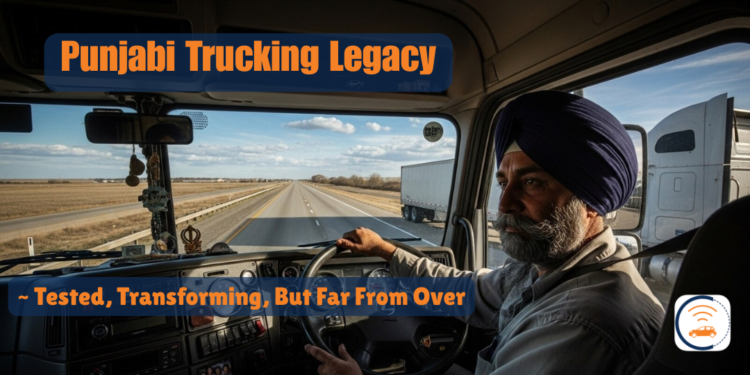
Punjabi Trucking Legacy: Collapse or Comeback?

The Punjabi trucking legacy on North America’s highways has long been more than a profession. It stands as a moving testament to resilience, faith, and the pursuit of opportunity.

Today, that legacy faces its most severe test as recent tragedies cast long shadows over an entire community.

The very industry they helped build now views them with suspicion, and the dreams woven into countless miles of asphalt suddenly feel fragile.

Yet, behind the headlines and harsh rhetoric lies a more complex story of community, contribution, and quiet perseverance that demands to be heard.

Punjabi Sikhs are a cornerstone of the trucking industry, making up roughly 20% of all U.S. truckers and a large portion in Australia. This success grew from a self-sustaining community that provided mentorship and built businesses.

The profession also uniquely accommodates their religious practices, like wearing turbans and keeping uncut hair.

Causes of the Crisis: Recent Tragedies and Their Implications on Punjabi Trucking Legacy

The Punjabi trucking community now finds itself at a crossroads following two devastating accidents that have triggered national scrutiny and heated immigration debates.

The California Case: Jashanpreet Singh, 21 Year Old Truck Driver

On Tuesday, 28th October, tragedy struck a California freeway when 21-year-old truck driver Jashanpreet Singh allegedly drove while intoxicated, resulting in a crash that killed three people.

Singh has been charged with three counts of gross vehicular manslaughter while intoxicated and one count of driving under the influence of a drug.

Punjabi Trucking Legacy, Is Its Fall Really True
Jashanpreet Singh, whose not-guilty plea sparked a national debate on trucking and immigration. | Image Source: ABC10

Despite pleading not guilty, the case has become a flashpoint in immigration debates. The Department of Homeland Security revealed Singh entered the U.S. illegally from India in 2022.

His requirement for a Punjabi interpreter during court proceedings raised questions about how he obtained a commercial driver’s license despite apparent English proficiency limitations.

The case has drawn national attention, with toxicology reports contradicting his family’s claims that he never uses drugs.

The Florida Tragedy: Truck Driver Harjinder Singh

Just months earlier, on August 12, another incident had already put the community under scrutiny.

Harjinder Singh, a 28-year-old India-born truck driver, allegedly made an illegal U-turn on a Florida Turnpike, blocking the roadway and causing a minivan collision that killed three people.

Punjabi Trucking Legacy, Collapse or Comeback
Harjinder Singh, the truck driver charged with vehicular homicide after a wrong U-turn on the Florida Turnpike. | Image Source: Times of India

The charges against him include three counts each of vehicular homicide and manslaughter.

Authorities stated that Singh entered the U.S. illegally from Mexico in 2018 and was processed for fast-track deportation. However, he was later released on a $5,000 bond after claiming a fear of returning to India.

His work authorization, denied during Trump’s first term, was granted under the Biden administration in 2021.

The case drew additional attention when Singh failed an English proficiency test after the accident. He answered only two of twelve questions and identified just one of four road signs.

AspectJashanpreet Singh (California)Harjinder Singh (Florida)
DateOctober 2025August 2025
ChargesGross vehicular manslaughter while intoxicated, DUIVehicular homicide, manslaughter
Immigration StatusEntered illegally in 2022Entered illegally in 2018
English ProficiencyRequired Punjabi interpreter in courtFailed post-accident English test
Policy ImpactTriggered MAGA backlash against immigrantsPrompted Trump administration to freeze trucker visas
Comparison of Two Recent Accident Cases. | Source: Times of India, News.com.au

Consequences: Punjabi Trucking Legacy Under Scrutiny

The aftermath of these tragedies has extended far beyond the courtroom. It has had real-world consequences for the Punjabi trucking community and sparked policy changes.

Harassment and Fear

In the wake of these incidents, Sikh truckers across the United States have reported increased harassment and discrimination.

The North American Punjabi Trucking Association has received numerous reports of Sikh drivers being targeted. In one instance, a Sikh man was ejected from an Oklahoma truck stop for trying to take a shower.

Punjabi Trucking Legacy Under Scrutiny
Increased scrutiny is now threatening thousands of Punjabi Sikh truck drivers, the very backbone of American commerce. | Image Source: LA Times

Sukhpreet Waraich, a trucker who owns an interstate freight carrier in Fontana, California, expressed the community’s anxiety:

“I’ve been talking to a lot of truck drivers, and they’ve been saying, ‘People look at us different now'”.

The situation has created such tension that some drivers are reconsidering their careers. Harsimran Singh, CEO of Gillson Trucking, reported that five of his Sikh drivers quit, telling him they no longer feel safe.

Policy Changes and Community Response

The political fallout has been swift and significant. Following the Florida crash, the Trump administration announced an immediate pause on all issuances of commercial truck driver work visas.

U.S. Secretary of Transportation Sean Duffy condemned what he called “despicable failures” in the system, vowing to “use every tool at our disposal to hold these states and bad actors accountable”.

Punjabi Trucking Legacy on Policy Changes and Community Response
U.S. Secretary of Transportation Sean Duffy, who announced a freeze on truck driver visas following the fatal accidents. | Image Source: Yahoo

In response, Sikh communities have proactively launched English language classes to address proficiency concerns.

Simultaneously, organizations like the Sikh Coalition have been reaching out to truckers to ensure they know their rights if stopped by authorities.

Beyond the Stereotypes: Success Stories and Diverse Narratives

While recent tragedies have dominated headlines, they represent only a small fraction of the Punjabi trucking experience.

Beyond the negative stereotypes lies a richer tapestry of stories that showcase the community’s resilience, diversity, and valuable contributions.

For every driver involved in an accident, there are thousands of Punjabi truckers who operate safely and professionally year after year. Sukhpreet Waraich, one of the many drivers concerned about increased scrutiny, proudly states,

“I’ve been driving since 2019. I haven’t got a single ticket”.

Many American-Punjabi truck drivers point out that they immigrated to the United States “the right way, legally.” They emphasize their commitment to safety and their respect for the country’s people and values.

As one Punjabi truckie eloquently expressed, “We’re judged not by our hearts or our work, but by the mistakes of a few. That hurts… because we’re part of the same road, the same dream”.

Sandeep Kaur: Breaking Barriers in Brisbane

In Australia, Sandeep Kaur represents the vibrant future of Punjabi trucking, shattering multiple stereotypes simultaneously as a female heavy vehicle operator.

Ms. Kaur hails from a small village, Goraya in Punjab and overcame significant personal challenges, including the early loss of her father and financial hardships. She later came to Australia as an international student from India in 2013.

Punjabi Trucking Legacy, Beyond the Stereotypes
In Australia’s male-dominated trucking industry, Sandeep Kaur stands out as one of the few women behind the wheel of a heavy vehicle. | Image Source: SBS Punjabi

Today, she navigates massive B-double trucks through interstate routes from Brisbane to Sydney, Melbourne, and Adelaide.

“This is not as difficult as I thought it to be. All you have to do is drive your load and finish the given task. You are your own boss. Your gender doesn’t matter here”. Ms. Kaur says in an interview with SBS Punjabi.

Ms. Kaur credits her mother as her inspiration and emphasizes mindset over external barriers,

“The first barrier is your own mind. Once you overcome that, everything else becomes so simple”.

Despite societal pressures that often discourage women from unconventional careers, Kaur remains focused on her goals. She aims to run her own fleet of heavy vehicles within ten years.

Satnam Singh: From Detention to Business Ownership

On Reddit, a user asked, “Why the Punjabi Sikh Community is so Active in Trucking as Compared to Other Professions?”

In response, American-Punjabi truck driver Satnam Singh offered a powerful testimony of transformation through the profession.

Punjabi Trucking Legacy
Journalist Shreen Khan joins Satnam Singh, a Punjabi Sikh trucker who crossed the U.S.-Mexico border, faced detention, and now owns a lucrative trucking company, to learn the story behind his remarkable journey. | Image Source: AJ+ on X.com

Satnam has been in the industry for 25 years. He shared his journey from crossing the U.S.-Mexico border and getting detained to now owning a successful trucking company that earns $200,000 annually.

Mr. Singh explained that trucking provides crucial opportunities for immigrants who may lack college degrees or strong English skills but possess a strong work ethic.

“Trucking is a hard job but we are willing to work hard,” Mr. Singh said.

He highlighted the freedom the profession offers, the ability to set one’s own schedule and determine one’s workload.

Satnam Singh’s story echoes the experiences of thousands who have found economic mobility through transportation.

Punjabi Trucking Legacy: Tested, Not Broken!

The Punjabi trucking legacy is not falling, it’s being tested. Like any community, it has its challenges and individuals who make tragic mistakes, but these exceptions do not define the whole.

The true Punjabi trucking legacy is built on countless safe journeys, immense economic contributions, and the religious freedom found on the open road.

It is a story of generational perseverance that has made these truckers indispensable to countries across the world.

Punjabi Trucking Legacy Tested, Not Broken
The enduring symbol of a community’s resilience: a Sikh trucker continues the long haul, upholding a legacy that persists despite its challenges. | Image Source: CTV News

The road ahead requires balance. This approach acknowledges where the community must improve while refusing to let isolated incidents erase decades of contribution.

The moral is not that the Punjabi trucking legacy is collapsing. Rather, it is evolving, facing modern challenges while maintaining its core values of hard work, faith, and family.

The trucking industry is adapting to new regulations and safety standards. The community’s resilience shows this isn’t an end, but another mile in the long journey of an extraordinary diaspora success story.

Drive Safer with Manage Vehicle Software

In light of recent tragedies, technology now offers powerful tools to prevent accidents before they happen.

Manage Vehicle’s fleet compliance management software provides drivers with essential safety features. It provides you with a digital logbook, a driver training toolbox, optimized routes, and real-time insights for proactive maintenance.

Drive Safer with Manage Vehicle Software
Navigate with confidence: Modern fleet management software provides real-time insights and tools to help ensure every journey is a safe one. | Image Source: The Bains Firm

Manage Vehicle ensure compliance with regulations, manage driver fatigue, and maintain vehicles in optimal condition. In doing so, they directly address several key factors that contribute to road incidents.

Whether you’re an owner-operator or part of a larger fleet, embracing such technology represents a positive step toward safer highways for everyone. Start Your Free Trial Today for 30 Days!