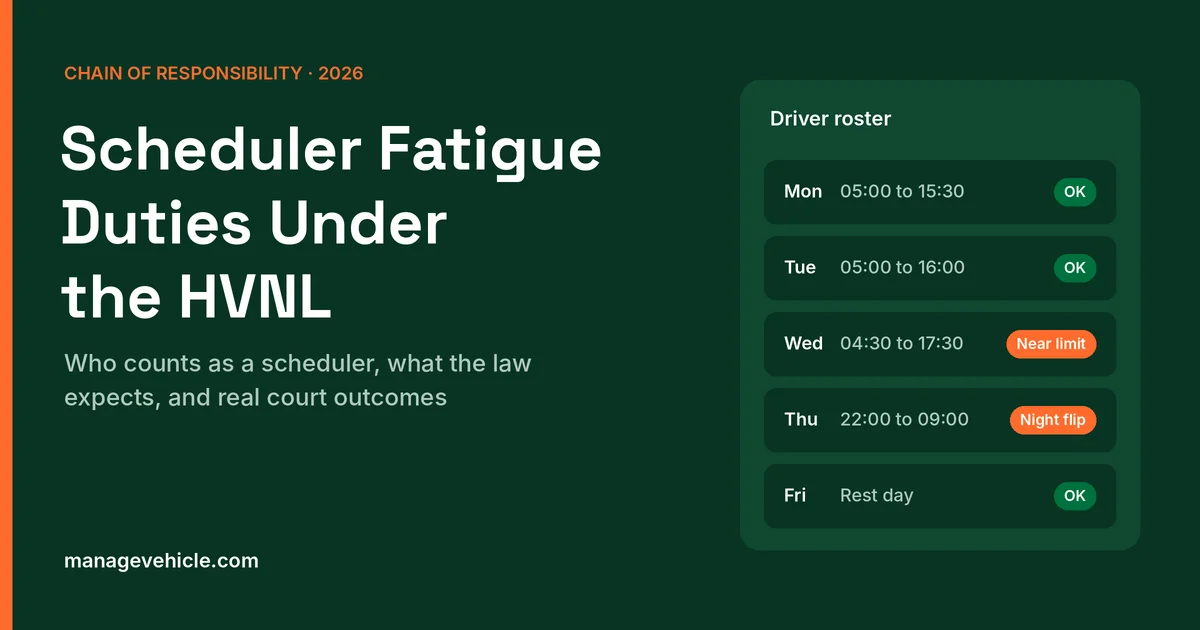
Scheduler fatigue duties under the HVNL come down to one idea: if you decide when trucks leave, where they go and how long drivers work, you share responsibility for whether those drivers end up too tired to drive safely. It doesn’t matter whether your title is scheduler, dispatcher, allocator, transport manager or owner. If you do the job, the duty is yours.
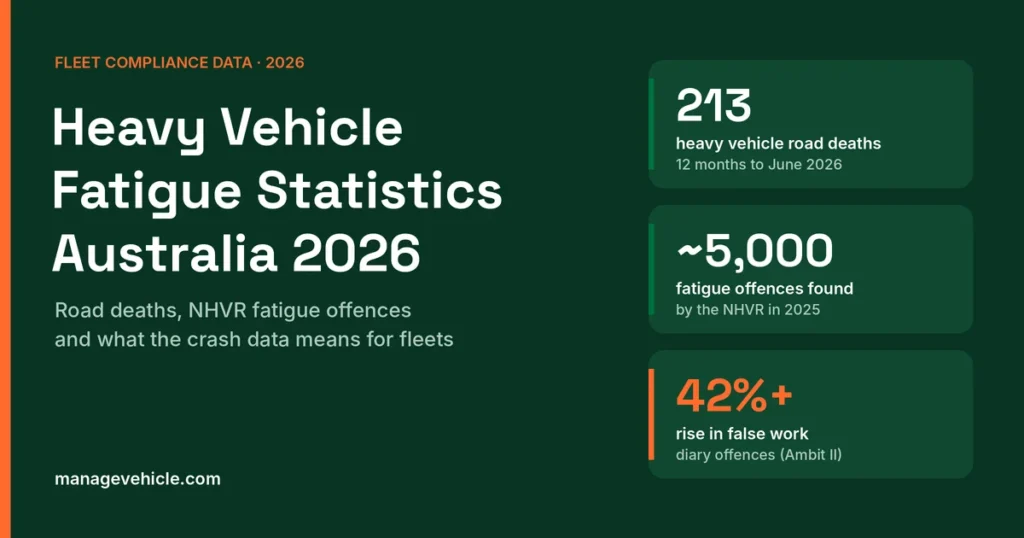
That duty has real teeth. Courts have fined individual schedulers personally, and the NHVR keeps finding fatigue breaches that trace back to how trips were planned, not just how drivers behaved. Our heavy vehicle fatigue statistics for 2026 show false work diary offences up by more than 42% in the latest national blitz, and an unrealistic schedule is exactly the kind of pressure that can push a driver to fudge their records.
This guide explains who counts as a scheduler, what the law expects from you, what went wrong in three real prosecutions, and a checklist you can use to build safer rosters.
The short answer: Under the Heavy Vehicle National Law, a scheduler must do everything reasonably practicable to make sure their schedules don’t cause or encourage a driver to drive while fatigued, breach work and rest hours, or speed. Since 1 August 2026, that also means not pushing a driver to drive when they’re unfit for any reason, including illness, injury or medication.
Who counts as a scheduler under the HVNL?
Under the HVNL, a scheduler is anyone who schedules the transport of goods or passengers by heavy vehicle, or schedules the work and rest times of a heavy vehicle driver. As Holding Redlich points out, the label is based on what you do, not your formal job title.
In practice, that usually covers:
- Dedicated schedulers and dispatchers who build daily runs and allocate drivers
- Transport and operations managers who set rosters, shift patterns or delivery windows
- Owners and directors of small fleets who do the scheduling themselves
- Customer service or sales staff, where the delivery times they set become the driver’s schedule
- Third parties such as freight brokers or prime contractors who set the timing for subcontracted loads
Many people hold more than one Chain of Responsibility role at once. A small-fleet owner can be the operator, the employer, the scheduler and an executive, all at the same time, and each role carries its own obligations. Our Chain of Responsibility guide for 2026 covers the other parties in the chain.
What scheduler fatigue duties actually require
The old HVNL had a list of scheduler-specific fatigue rules. Since the 2018 Chain of Responsibility reforms, those have been rolled into broader duties. Here’s how they apply to schedulers today.
1. The primary duty (section 26C)
Every party in the chain must ensure, so far as reasonably practicable, the safety of their transport activities. For a scheduler, that means using your control over trip times, routes and rosters to remove or reduce fatigue risk. “Reasonably practicable” isn’t a get-out clause. It means doing what a sensible person in your position could reasonably do, given the risk and the tools available. If you have GPS data showing a driver’s real hours and you don’t look at it, that will count against you.
2. No requests or contracts that encourage breaches (section 26E)
You must not ask, direct or require a driver, or another party in the chain, to do something you know or ought reasonably to know would cause the driver to drive while fatigued, break work and rest limits or speed. This covers the obvious (“just get it there tonight”) and the less obvious, like delivery windows that can only be met by skipping a rest break, or pay and incentives tied to finishing runs faster.
3. The expanded unfit-to-drive duty (from 1 August 2026)
The amended HVNL widened the driver’s duty in section 228. Drivers must not drive while impaired by fatigue or while unfit to drive for any reason, including illness, injury, medication, mental health, alcohol or drugs. It now applies to all heavy vehicles over 4.5 tonnes GVM, not just fatigue-regulated vehicles over 12 tonnes.
For schedulers, this matters because a driver who says they’re unfit has a clear legal footing to stop. As Kynection notes, if a driver reports being unfit and the scheduler sends them anyway, the business faces direct CoR exposure. Your process for handling those calls needs to be written down and followed.
4. Executive due diligence (section 26D)
If you’re a director or senior manager, you also have a personal duty to make sure the business has the systems, resources and monitoring to meet its safety duties. A scheduler working without fatigue checks, training or decent data is a gap an executive is expected to close.
What a breach can cost
Primary duty breaches are prosecuted by risk category. After the 1 July 2026 indexation, the maximum penalties are:
| Category | Corporation | Individual |
| Category 1 (reckless conduct, risk of death or serious injury) | $4,230,550 | $436,850 and up to 5 years in prison |
| Category 2 (risk of death or serious injury) | $2,120,880 | $212,090 |
| Category 3 (failure to comply) | $705,820 | $70,580 |
The driver also faces a maximum of $26,610 for breaching the fatigue or unfit-to-drive duty, as explained in our guide to fatigue duty penalties in 2026. You can read the legislation itself through the National Transport Commission.
What courts have found: three scheduling cases
The best way to see what scheduler fatigue duties mean in practice is to look at where businesses got it wrong.
Case 1: Schedulers fined personally (De Paoli Transport)
De Paoli Transport, a line-haul company running 32 fatigue-regulated heavy vehicles, was fined $180,000, and its two schedulers were fined $15,000 each, for breaching the primary duty. One of the schedulers was also the company’s sole director. According to the NHVR case learnings summarised by Holding Redlich, the business:
- scheduled trips using verbal directions, with no safe driving plans and no thought given to driver fatigue
- had fatigue cameras installed but didn’t monitor them
- had GPS that could show real driving hours and speeds, but didn’t use it to check compliance
- had poor processes for detecting work and rest breaches, and gave drivers no fatigue training
There was no crash. The charges came from the risk alone, which is the point: you don’t need an incident to be prosecuted.
Case 2: 251 breaches nobody noticed (Tasmanian logging operator)
The NHVR found a Tasmanian logging company had 251 fatigue-related breaches over 12 months that neither the company nor its director picked up. The court found the company had failed as an employer and the director had failed both as a scheduler and as an executive. The outcome, as reported by Holding Redlich, was fines of $80,000 for the company and $8,000 for the director, plus two supervisory intervention orders worth $100,000 to fix their fatigue management.
Case 3: Timesheets nobody checked (fatal collision)
After a fatal collision, an NHVR investigation into the operator found its drivers had committed 202 fatigue-related breaches over two months, and that driver timesheets weren’t being validated for accuracy and compliance. The company pleaded guilty to a Category 2 offence and its director to a Category 3 offence.
The common thread: in all three cases, the information needed to spot the problem existed, whether in GPS data, camera footage, work diaries or timesheets. Nobody in a scheduling or management role was looking at it.
A scheduler’s fatigue checklist
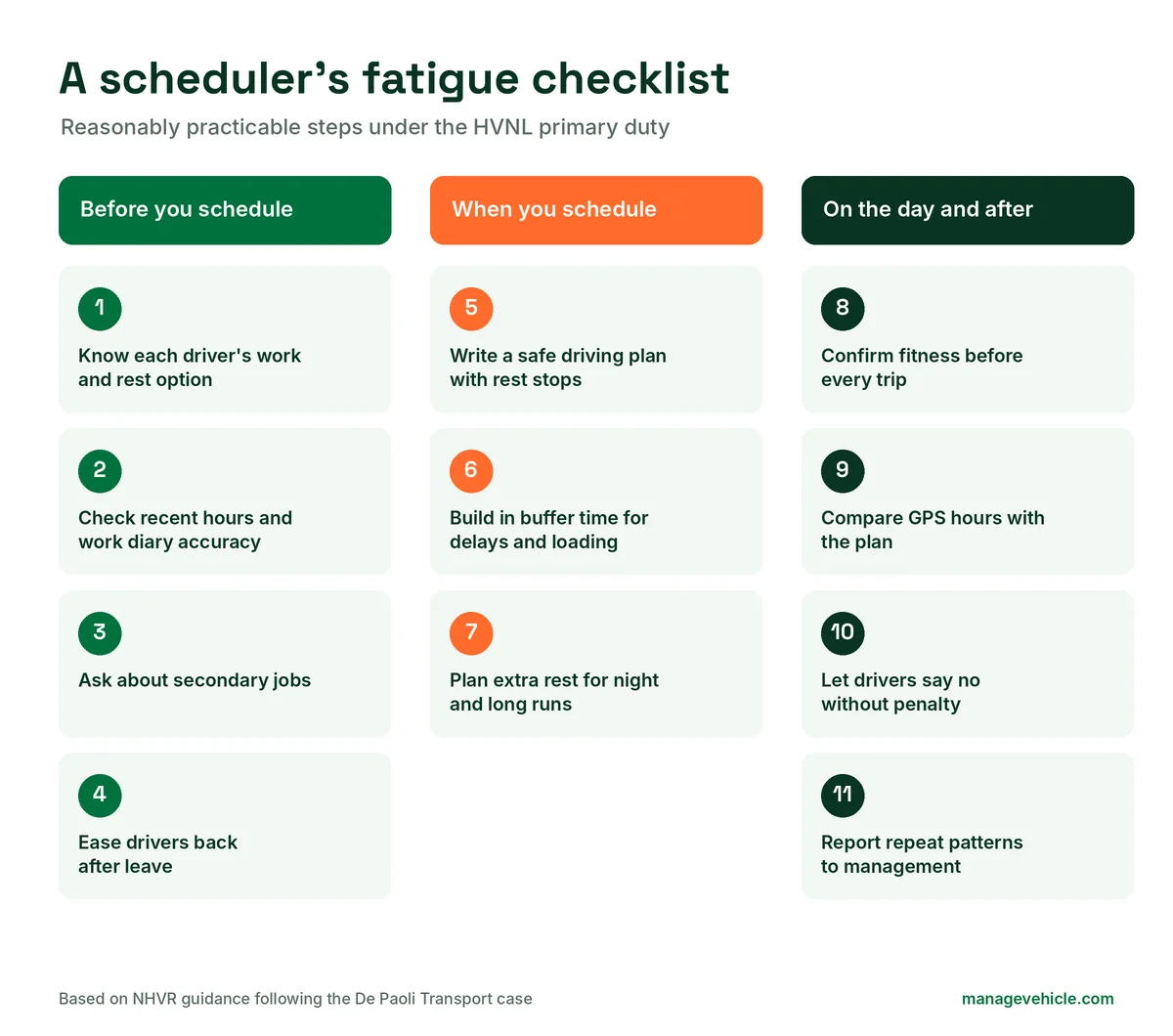
After the De Paoli case, the NHVR set out reasonably practicable measures for schedulers. Here they are, turned into a working checklist with a bit more detail on what each one looks like day to day.
Before you build the schedule
- Know each driver’s work and rest option. Standard hours, BFM, AFM or ACH all have different limits. If you’re unsure, our guide to heavy vehicle work and rest hours sets them out side by side.
- Check their recent hours, not just today’s. Confirm the driver’s work diary is filled in correctly and their totals add up before you allocate the next trip.
- Ask about secondary jobs. A driver working weekends somewhere else may start your shift already tired.
- Take care with returns from leave. Drivers coming back from holidays or sick leave often need an easier first few shifts, not a long overnight run.
When you build the schedule
- Prepare a safe driving plan. Write down the route, planned rest breaks and where the driver will take them. Verbal instructions don’t count for much if something goes wrong.
- Build in buffer time. Plan around realistic average speeds, roadworks, loading delays and traffic, so the driver isn’t forced to choose between the schedule and the rules.
- Avoid the high-risk windows where you can. Night driving and long runs after short sleep carry more risk. If the work has to happen then, plan extra rest. Our article on night driving fatigue rules covers the specifics.
On the day and after
- Confirm fitness before every trip. A quick check that the driver is rested, well and fit to drive, recorded somewhere you can find it later.
- Monitor actual hours with GPS. Compare planned trips with real driving time. If they don’t match, find out why.
- Make it easy to say no. Drivers must be able to tell you they’re tired or unfit without being punished. Act on what they tell you, and record it.
- Report patterns upwards. Repeated near-limit finishes, late deliveries or diary corrections are signals that the schedule itself needs fixing. Raise them with management.
These steps fit naturally into a written fatigue management plan, and a fatigue risk assessment will help you spot which routes and shifts need the most attention.
Common scheduling mistakes that create fatigue risk
Most scheduling problems aren’t deliberate. They creep in when the business gets busy. Watch for these:
- Planning to the legal limit. A schedule that works only if nothing goes wrong will regularly push drivers over. Work and rest limits are the ceiling, not the target.
- Treating the work diary as the driver’s problem. The driver fills it in, but you’re expected to check it. Unchecked diaries were a factor in two of the three cases above.
- Last-minute extra loads. “Can you squeeze in one more drop?” at the end of a long shift is exactly the kind of request section 26E is aimed at.
- Ignoring loading and queue delays. Two hours waiting at a distribution centre usually still counts as work time, unless the driver is genuinely resting away from the vehicle and its load. If your plan treats it as free time, the plan is wrong.
- Rewarding speed. Bonuses for early finishes or extra runs can quietly encourage drivers to skip breaks or cut corners.
- Rosters that flip between day and night. Rotating a driver from early starts to overnight runs within a few days makes it very hard for them to get proper sleep.
- No paper trail. If your decisions only exist in phone calls, you’ll have nothing to show the NHVR that you took reasonable steps.
How Manage Vehicle helps schedulers stay compliant
The cases above all came down to information that existed but wasn’t being used. Manage Vehicle puts that information in front of the person making the schedule:
- Job dispatch lets you assign trips with each driver’s available hours in view, so you’re not guessing who can safely take the next load.
- Electronic work diary records show work and rest in real time, with warnings as drivers approach their limits.
- Route and location history lets you compare planned trips with actual driving, which is exactly the check the court expected in the De Paoli case.
- Fatigue management tools keep fitness-to-drive checks, breaches and corrective actions on record, so you can show what reasonable steps you took.
If your schedulers are still working from whiteboards, spreadsheets and phone calls, book a demo and we’ll show you how it works with your fleet.
Frequently asked questions
What are a scheduler’s fatigue duties under the HVNL?
A scheduler must do everything reasonably practicable to make sure their schedules don’t cause or encourage a driver to drive while fatigued, breach work and rest hours or speed. This comes from the primary duty in section 26C and the prohibition on harmful requests and contracts in section 26E.
Can a scheduler be fined personally?
Yes. In the De Paoli Transport case, two schedulers were each fined $15,000 for breaching the primary duty, on top of a $180,000 fine for the company. The maximum penalty for an individual under a Category 1 breach is $436,850 and up to 5 years in prison.
Who counts as a scheduler?
Anyone who schedules the transport of goods or passengers by heavy vehicle, or schedules a driver’s work and rest times. It’s based on what you do, so dispatchers, transport managers and small-fleet owners can all be schedulers.
What changed for schedulers on 1 August 2026?
The driver’s duty widened from fatigue only to being unfit to drive for any reason, and it now covers all heavy vehicles over 4.5 tonnes. Schedulers need a clear process for handling drivers who report they’re unfit, and must not pressure them to drive.
Is a scheduler responsible if the driver lies in the work diary?
The driver is responsible for false entries. But courts expect schedulers and operators to check diaries against other data, like GPS records. If the evidence was there and nobody looked, the business can still be found to have failed its primary duty.