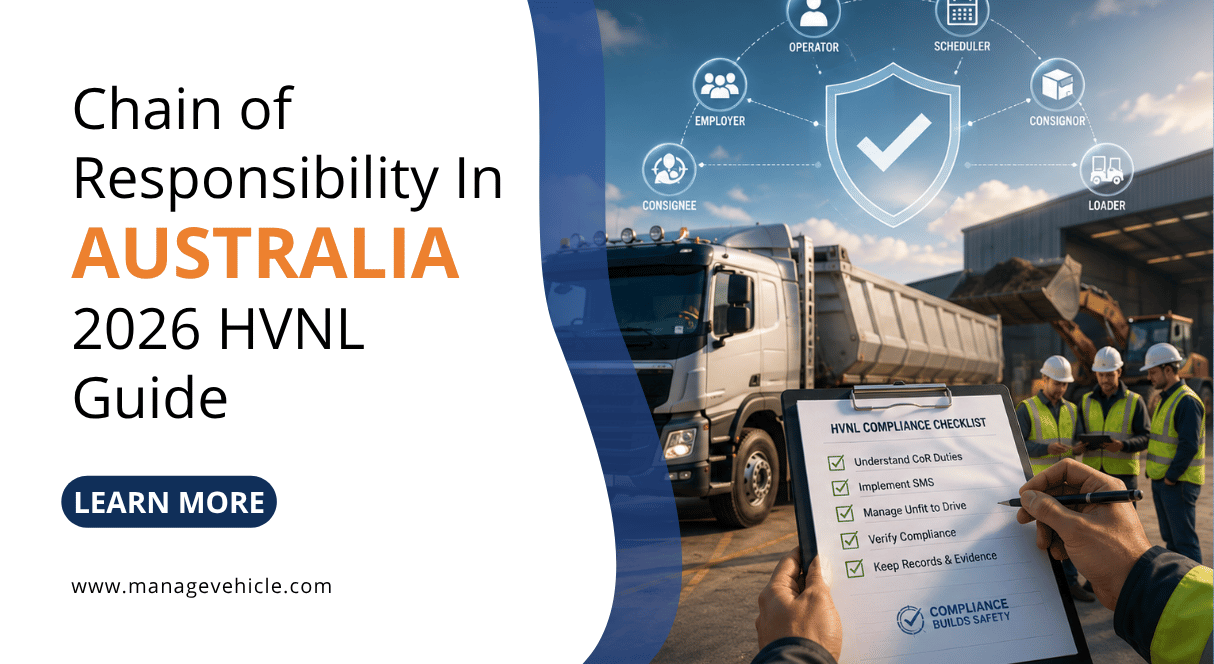
Every business in the chain of responsibility (CoR) needs to be able to show how it manages heavy vehicle safety risks. A written CoR policy is where that starts: who’s responsible for what, which risks you control and how, and how you check it’s working.
This page gives you two free tools, updated for the amended Heavy Vehicle National Law (HVNL) that started on 1 August 2026: a CoR policy template in Word that you can fill in, and a one-page CoR audit checklist to find the gaps.
What’s in the CoR policy template
| Section | What you fill in |
|---|---|
| 1–2. Purpose and scope | Who and what the policy covers |
| 3. Your roles in the chain | Which of the 10 CoR functions your business performs, and who’s accountable for each |
| 4. The primary duty | Your commitment to ensure, so far as is reasonably practicable, the safety of your transport activities |
| 5. Executive officers | How directors and senior managers meet their personal due diligence duty |
| 6. Managing your CoR risks | Your controls for speed, fatigue, fitness to drive, mass and loading, maintenance, and contractors |
| 7. Responsibilities | What executives, managers, schedulers, drivers, loaders and the workshop each must do |
| 8–10. Training, reporting and records | How people are trained, how concerns are reported, and which records you keep |
| 11–12. Review and approval | When the policy is reviewed, and executive sign-off |
How to write your CoR policy
- Work out your roles. Tick every CoR function your business performs. Most transport operators are also employers and schedulers, and many are loaders too. The duty attaches to what you do, not your job title or what a contract says.
- Name an owner for each. “Management” isn’t an owner. A name and position is.
- Describe your real controls. For each risk area, write what you actually do today, like “schedulers check drivers’ hours left before assigning a job”. Don’t copy controls you don’t use: an auditor or court will ask for the evidence.
- Fill the gaps. Where a risk has no control, decide what’s reasonably practicable for a business your size. The NHVR’s 2026 Master Code of Practice lists controls for 45 transport activities.
- Get it approved. An executive officer signs it, which is part of showing their due diligence.
- Use it, then review it. Train your people on it, and review it at least yearly and after any serious incident.
What changed for CoR in 2026
If your policy was written before August 2026, check three things:
- Fitness to drive. The “unfit to drive” duty now covers fatigue, illness, injury, mental health, medication, alcohol and drugs, for all heavy vehicles over 4.5 t GVM. A fit-to-drive check that only asks about fatigue no longer matches the law. The template’s risk table includes fitness to drive as its own area.
- Accreditation. NHVAS has been replaced by Heavy Vehicle Accreditation, which requires a safety management system. A CoR policy is a core part of it. See our guide to heavy vehicle accreditation and NHVAS.
- Penalties. Penalties for safety breaches went up. Our chain of responsibility guide has the current penalty table.
CoR audit checklist
A policy is only as good as what happens on the ground. The free audit checklist takes you through 26 questions in seven areas, from governance to records, and asks for the evidence behind every “yes”:
- Roles and governance: functions identified, owners named, policy signed, executives informed
- Risk management: a current risk register that reflects your real operation
- Speed and scheduling: schedules that can be met legally
- Fatigue and fitness to drive: hours checked before dispatch, work diaries reviewed, fit-to-drive checks
- Mass, dimension and loading: loads weighed and restrained
- Vehicle standards and maintenance: pre-starts, defects fixed, services on time
- Training, contractors and records: training records, subcontractor checks, records you can find
Every “no” is an action. Give each one an owner and a due date, and run the checklist again in three months.
Get the CoR policy template (Word)
The Word template has all 12 sections, ready to fill in, with tables for your CoR roles, risk controls and responsibilities. Tell us where to send it:
Frequently asked questions
The HVNL doesn't require a document called a CoR policy. It requires every party to do what's reasonably practicable to make their transport activities safe. A written policy, used in practice, is one of the clearest ways to show you've done that, and it's expected as part of a safety management system for Heavy Vehicle Accreditation.
Your CoR functions and who's accountable for each, your commitment to the primary duty, executive due diligence, your controls for speed, fatigue, fitness to drive, mass and loading, maintenance and contractors, responsibilities, training, reporting, records, review and sign-off.
An executive officer, such as a director or senior manager. Their personal due diligence duty under the HVNL includes making sure the business has suitable processes and resources.
At least every 12 months, and after any serious incident, a change in the law or a significant change to your operations.
A check of whether your CoR controls are in place and working, with evidence. Our free CoR audit checklist covers 26 questions across governance, risk, speed, fatigue, loading, maintenance and records.
Yes. The audit checklist PDF is a direct download. The Word policy template is free too. We just ask for your name and email so we can send it.
These templates are general information, not legal advice. Adapt them to your operation and get legal advice for your circumstances.


