A transport safety management system can look perfect in a binder and still fail on the road. Most operators find that out the hard way: after a crash, a roadside intercept or a tough audit.
The NHVR recently found the same thing at scale. Some of the operators it rated as highest risk had clean accreditation audit records. Their systems existed. They just weren’t doing their job. (We covered that story in NHVR Accreditation Audit: Why Clean Records Aren’t Enough Anymore.)
So how do you know if yours is actually working? Below are five warning signs, what each one usually means, and how to fix it.
Why your transport safety management system matters more in 2026
The amended HVNL that started on 1 August 2026 puts the SMS at the centre of accreditation. Under the new Heavy Vehicle Accreditation (HVA) scheme, operators are audited against a whole-of-business SMS rather than separate Mass, Fatigue and Maintenance modules, and that SMS has to suit the size, complexity and risk of the operation.
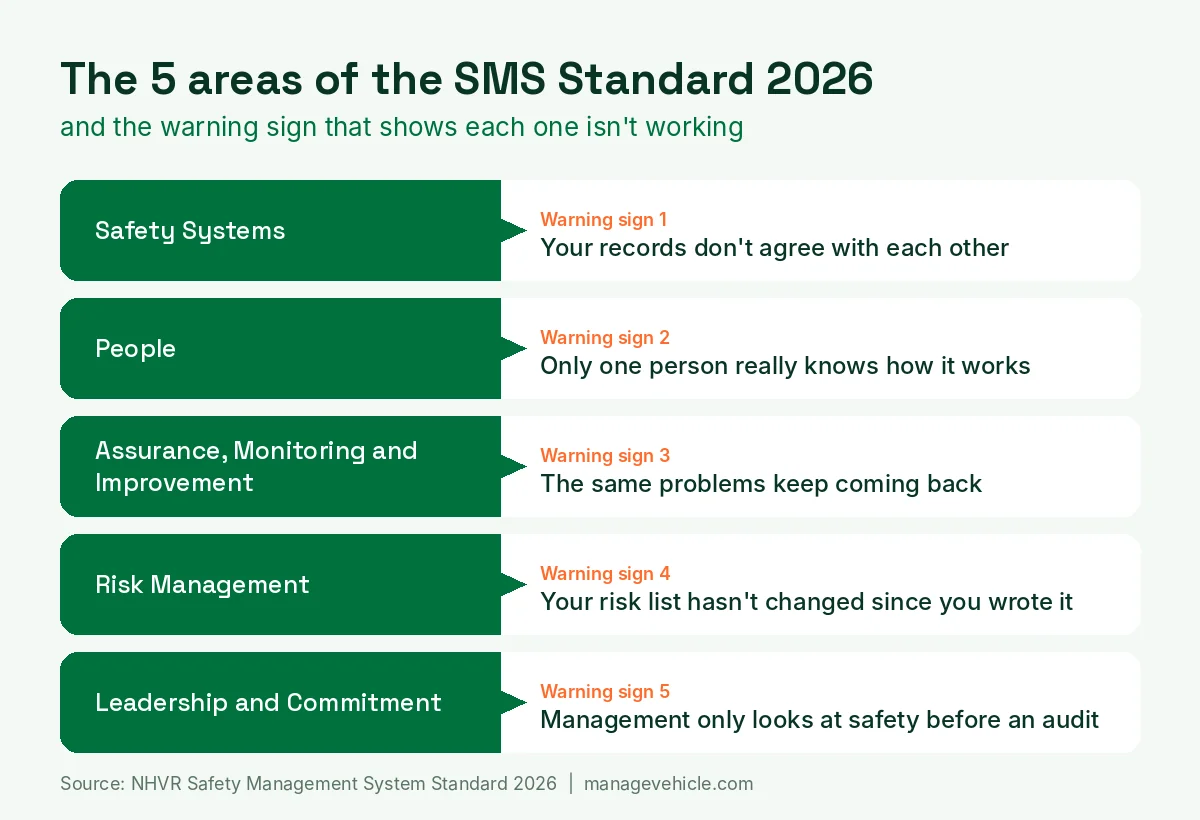
The NHVR’s Safety Management System Standard 2026 groups the requirements into five areas: Leadership and Commitment, Risk Management, People, Assurance, Monitoring and Improvement, and Safety Systems. Accredited operators also have to run internal audits and complete at least one SMS self-assessment every year.
NHVR CEO Nicole Rosie has described the reforms as a move away from purely compliance-driven regulation toward risk-based safety management. In plain terms: having the right documents is the starting point, not the finish line.
Even if you’re not accredited, a working SMS is one of the clearest ways to show you’ve taken reasonably practicable steps under Chain of Responsibility. Each of the five signs below lines up with one of those five areas.
The 5 warning signs
1. Your records don’t agree with each other
SMS area: Safety Systems
Work diaries say one thing, GPS trip history says another, and job sheets say something else again. A driver logs a 30-minute break at 2pm, but the truck was moving at 2:10.
Small mismatches happen. Regular ones mean nobody is checking, and that’s the first thing a serious auditor or investigator will spot. It’s also the kind of gap the NHVR’s own roadside and camera data can pick up without ever visiting your yard.
Fix it: Once a month, pick a random week and compare diaries, GPS data and job records for a few drivers. Write down every mismatch and what you did about it. If you’re unsure what the rules require in the first place, start with our guide to heavy vehicle work and rest hours.
2. Only one person really knows how it works
SMS area: People
Ask a driver, a scheduler and a yard supervisor how a defect gets reported, or what happens when a driver is too tired to continue. If you get three different answers, or everyone says “ask Sharon,” your system lives in one person’s head.
That breaks the moment that person is sick, on leave or gone. It also means procedures aren’t being followed consistently, which is exactly what “operating” means in an audit.
Fix it: Pick your five most important procedures and check that each person who uses them can explain them in their own words. Keep training short and practical, and do a quick refresher whenever someone slips up rather than waiting for the annual induction.
3. The same problems keep coming back
SMS area: Assurance, Monitoring and Improvement
The same driver keeps tripping speed alerts. The same truck keeps coming back with the same brake defect. The same route keeps running late. Each time it’s logged, and each time nothing changes.
An SMS that records problems but never fixes the cause is a filing system, not a safety system. Repeat issues are also strong evidence against you if something goes wrong, because they show you knew about the risk.
Fix it: Every month, look for anything that has happened more than twice. For each one, record the cause and the change you made: coaching, a different schedule, a part replaced earlier, a new check. Then watch whether it happens again.
4. Your risk list hasn’t changed since you wrote it
SMS area: Risk Management
You’ve taken on a new customer, a new route, night work or a different vehicle type, but your risk register still describes the business as it was two years ago.
Risks change with the work. If your register doesn’t, you’re managing yesterday’s operation. The NHVR’s 2026 Master Code is a useful benchmark here, with hazards and controls listed by transport activity.
Fix it: Make “does this change our risks?” a standard question whenever you add a customer, route, vehicle or shift pattern. Review the whole register at least once a year, ideally alongside your annual self-assessment.
5. Management only looks at it before an audit
SMS area: Leadership and Commitment
The owner or managers see safety reports once a year, usually the week before the auditor arrives. The rest of the time, safety is “the compliance person’s job.”
Under Chain of Responsibility, executives have their own duty to exercise due diligence. That’s hard to show if they never look at the data. It also sends a clear message to staff about what really matters, and they pick up on it fast.
Fix it: Put a short safety review on the regular management meeting agenda: fatigue breaches, open defects, incidents and repeat issues. Fifteen minutes a month, minuted, is worth more than a polished policy statement nobody reads.
A 10-minute health check for your transport safety management system
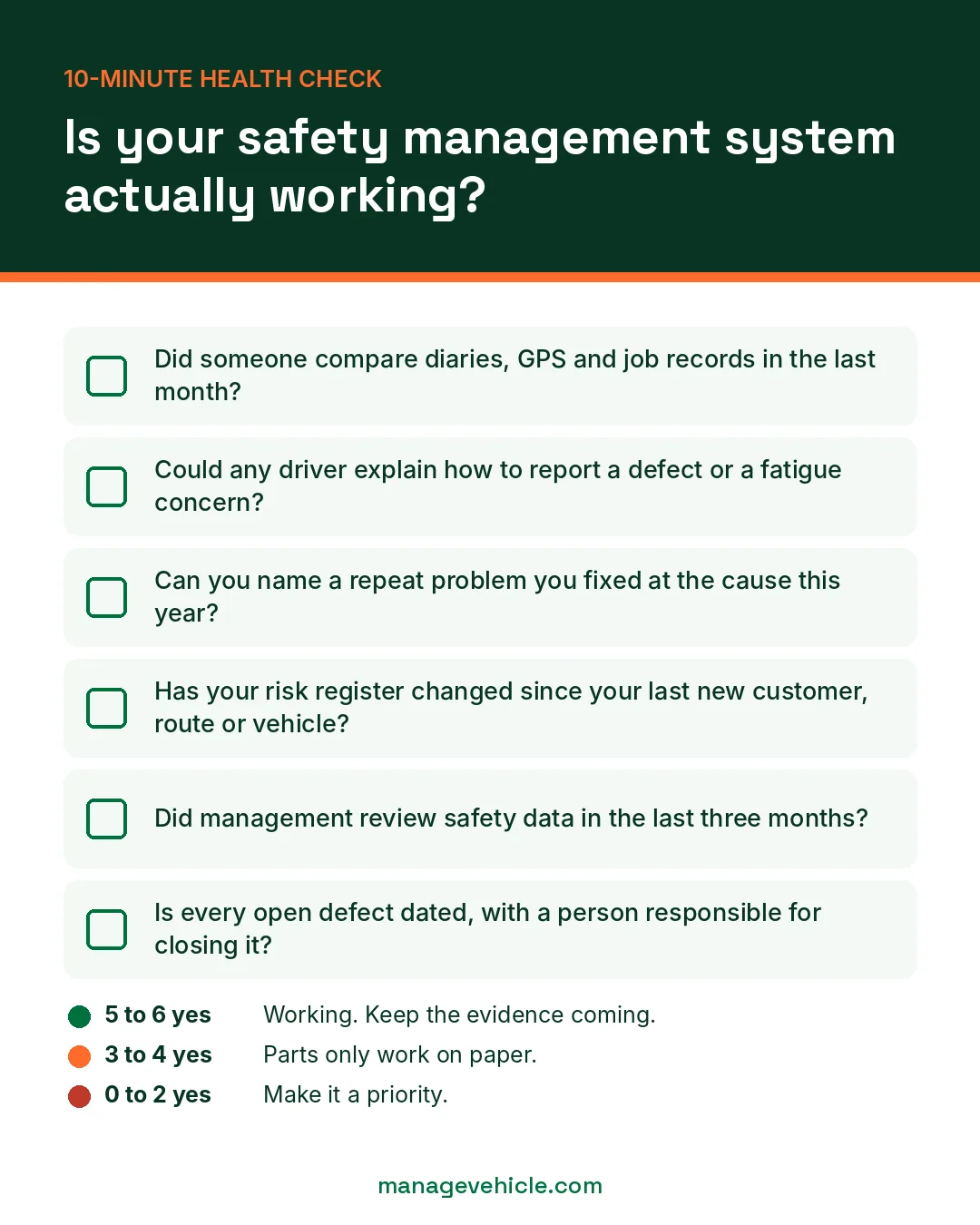
Answer these honestly. Each “no” points to one of the signs above.
| Question | Yes / No | Links to |
| Did someone compare diaries, GPS and job records in the last month? | Sign 1 | |
| Could any driver explain how to report a defect or a fatigue concern? | Sign 2 | |
| Can you name a repeat problem you fixed at the cause this year? | Sign 3 | |
| Has your risk register changed since your last new customer, route or vehicle? | Sign 4 | |
| Did management review safety data in the last three months? | Sign 5 | |
| Is every open defect dated, with a person responsible for closing it? | Signs 1 and 3 |
Five or six “yes” answers: your system is probably doing its job. Keep recording the evidence.
Three or four: the foundations are there, but parts of it only work on paper. Start with the sign that worries you most.
Two or fewer: treat it as a priority. A system that exists only on paper gives you little protection if something goes wrong, and audit findings can now end up as evidence in court.
Where fleet software helps (and where it doesn’t)
Software can’t give you leadership commitment or a good safety culture. Those come from people. What it can do is take the manual effort out of signs 1 and 3, which are usually the hardest to keep on top of.
- Records in one place. When electronic work diary entries and GPS history sit side by side, mismatches show up as they happen instead of months later. Manage Vehicle’s MV Driver electronic work diary is NHVR approved.
- Defects you can follow. Pre-start checks that log faults with a date and a status make it easy to see what’s still open and how long repairs take. Our piece on preventative vs reactive fleet maintenance covers why that matters for cost too.
- Alerts with a trail. You set a speed threshold in the portal. When a driver goes over it, they get an in-cab alarm and you get a safety event alert. Over time, that history shows who keeps triggering it and whether coaching worked.
- Reports ready for management. A monthly summary of breaches, defects and incidents makes sign 5 much easier to fix. See our guide to NHVR fleet reporting for which reports to run, and documents management and reporting for how it works in Manage Vehicle.
The aim isn’t more data. It’s a transport safety management system that produces its own evidence every day, so proving it works is the easy part.
FAQ
What is a transport safety management system? It’s the set of policies, processes and records a transport business uses to identify and control safety risks. Under the HVNL, it covers areas like fatigue, maintenance, mass, speed and scheduling, and it should suit the size and risk of your operation.
Is an SMS mandatory for heavy vehicle operators? Accredited operators under the HVA scheme must have an SMS that meets the Safety Management System Standard 2026. For everyone else, it isn’t mandatory as such, but it’s one of the clearest ways to show you’ve met your safety duties under Chain of Responsibility.
What are the five areas of the SMS Standard 2026? Leadership and Commitment, Risk Management, People, Assurance, Monitoring and Improvement, and Safety Systems.
How often should I review my SMS? HVA-accredited operators must complete at least one self-assessment a year. In practice, a short monthly review of key data and a full annual review works well for most operators.
What’s the biggest sign an SMS isn’t working? When your everyday records don’t match what your documents say. That gap is what auditors and investigators look for first.