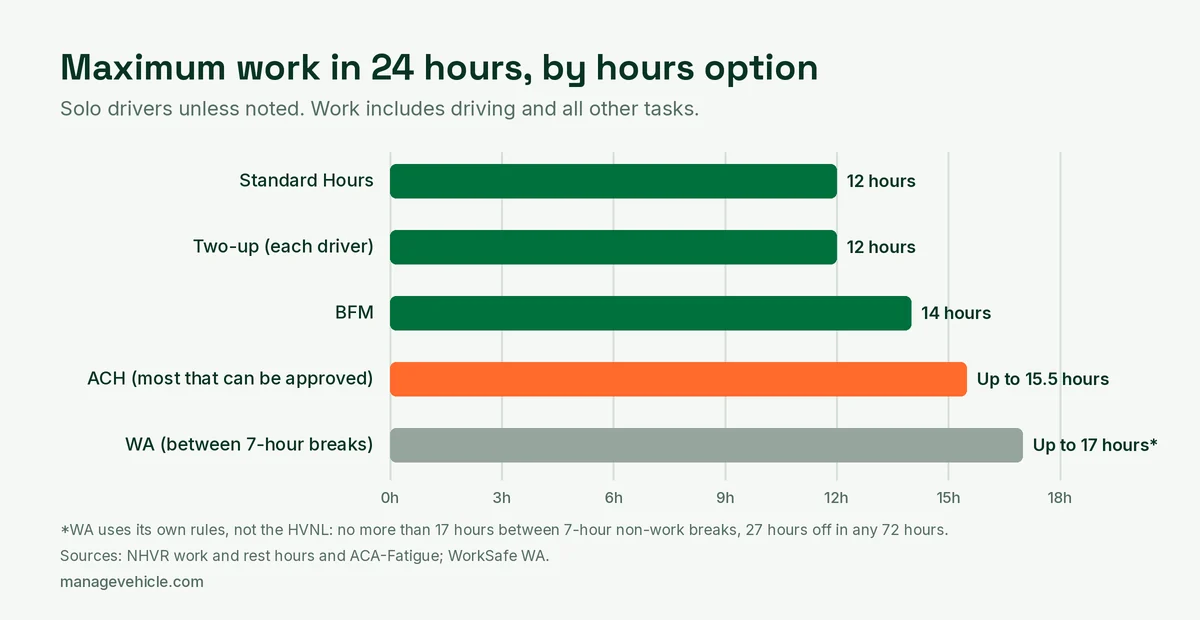
How long can truck drivers drive in Australia? Under Standard Hours, a solo driver can work up to 12 hours in any 24-hour period, with at least 7 continuous hours of rest. Drivers with BFM accreditation can work up to 14 hours.
Those limits cover all work, not just driving. Loading, unloading, checks, refuelling and paperwork all count. You also need short breaks during the day, and there are weekly and fortnightly caps. Here’s the quick version of each, with links to the full tables if you need them.
How long can a truck driver drive in one day?
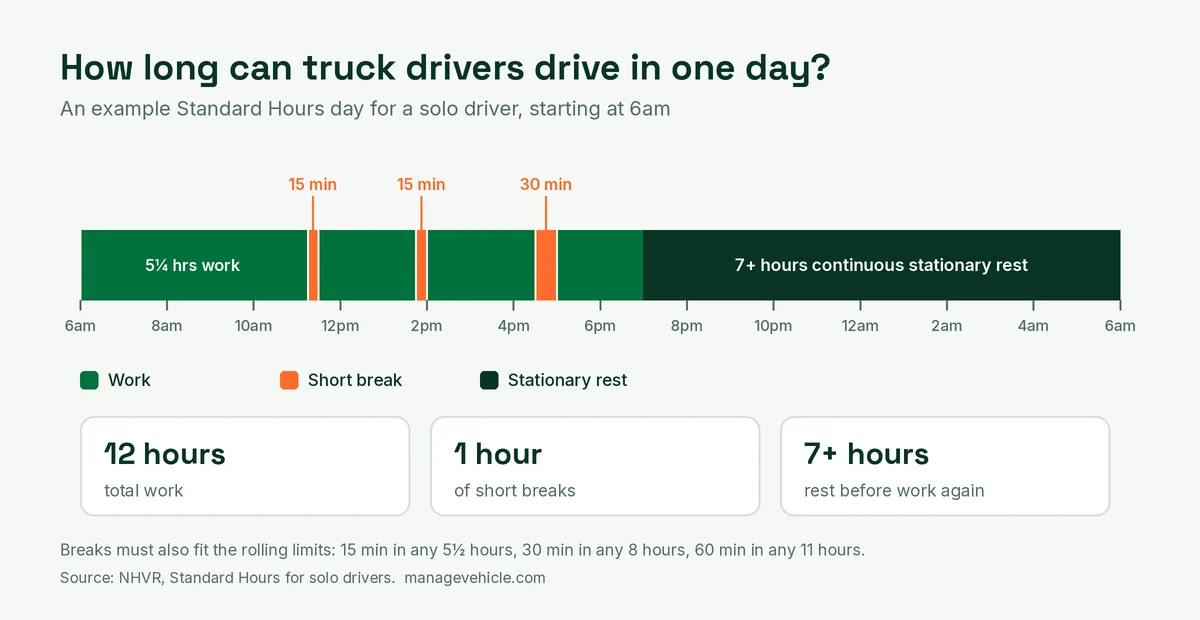
Under Standard Hours, a solo driver of a fatigue-regulated heavy vehicle can work up to 12 hours in any 24 hours. That applies to trucks over 12 t GVM or GCM. Within those 12 hours, you need regular breaks:
|
In any period of |
Max work |
Min rest |
|
5½ hours |
5¼ hours |
15 continuous minutes |
|
8 hours |
7½ hours |
30 minutes, in blocks of at least 15 minutes |
|
11 hours |
10 hours |
60 minutes, in blocks of at least 15 minutes |
|
24 hours |
12 hours |
7 continuous hours of stationary rest |
So if you’re asking how long truckers can drive a day, the answer is 12 hours of total work under Standard Hours. In plain terms: take a 15-minute break before you hit 5¼ hours of work, and keep breaking up the day so you’ve had a full hour of rest by the 11-hour mark. Then stop for at least 7 hours straight, out of the truck or in a parked sleeper berth.
How long can truck drivers drive in a week?
Under Standard Hours, a solo driver can work up to:
- 72 hours in any 7 days, with at least 24 continuous hours of stationary rest in that time
- 144 hours in any 14 days, with 2 night rest breaks plus 2 more taken on consecutive days
A night rest break is 7 continuous hours of stationary rest taken between 10pm and 8am, or a 24-hour continuous break.
Can drivers work longer under BFM or ACH?
Yes, but only with accreditation.
- BFM (Basic Fatigue Management) allows up to 14 hours of work in any 24 hours, with the same 7 continuous hours of rest. The short breaks are spaced a little further apart, starting with 15 minutes in any 6¼ hours. Long and night work is capped at 36 hours in any 7 days. No new BFM accreditations have been granted since 1 August 2026, but existing ones stay valid until they expire.
- ACH (Alternative Compliance Hours) replaced BFM and AFM for new applicants on 1 August 2026. The hours are set on each operator’s accreditation, but a solo driver can never be approved for more than 15.5 hours of work or less than 7 continuous hours of rest in 24 hours.
For every table in full, including the 7-day and 14-day limits under each option, see our guide to heavy vehicle work and rest hours.
How long can truck drivers drive two-up?
Two drivers sharing a truck can each work up to 12 hours in any 24 hours under Standard Hours. Each needs 5 continuous hours of rest in that time, which can be taken in an approved sleeper berth while the truck keeps moving. The trade-off is lower caps: 60 hours in 7 days and 120 hours in 14 days.
Are the limits the same in WA and the NT?
No. The Heavy Vehicle National Law doesn’t apply in Western Australia or the Northern Territory.
WA has its own fatigue rules for commercial vehicle drivers, run by WorkSafe WA. They’re built differently from the national rules. So how long can truck drivers drive in WA? A solo driver can work no more than 17 hours between 7-hour non-work breaks, must have 27 hours off in any 72 hours, and can work no more than 168 hours in any 14 days. Drivers also need a 20-minute break from driving for every 5 hours of work.
The NT doesn’t regulate driving hours under its transport laws, according to the NHVR. Workplace safety duties still apply, though, and once you cross into an HVNL state, the national rules apply to you.
What about the 11-hour and 14-hour rules?
If you’ve seen an “11-hour driving limit”, a “14-hour window” or a “34-hour restart”, those are from the United States. They’re part of the US hours of service rules for interstate truckers there, and they don’t apply in Australia.
The Australian rules work differently in two ways. They limit total work time, not just time behind the wheel. They’re also counted over rolling periods, such as “any 24 hours”, rather than from the start of a shift. Getting this mixed up is an easy way to end up in breach.
What happens if truck drivers drive too long?
Going over your hours is a fatigue breach. Breaches are ranked from minor to critical, depending on how far over you went, and the penalties rise with each category. Since 1 August 2026, the maximum penalty for breaching the fatigue duty is $26,610. Our guide to fatigue breaches explains the categories and fines.
You also need to show you stayed within your hours. If you drive more than 100 km from base, or work BFM or ACH hours, you’ll need a work diary, either paper or electronic.
Keep every driver inside their hours
Tracking breaks by hand is where most mistakes happen. Manage Vehicle’s fatigue management software tracks each driver’s work and rest time against their hours option and warns them before a break is due. Pair it with MV Driver, our NHVR-approved electronic work diary, and your records are done as you drive.
Frequently asked questions
How long can a truck driver drive in one day? Under Standard Hours, up to 12 hours of work in any 24 hours, with at least 7 continuous hours of stationary rest. With BFM accreditation, up to 14 hours. Work includes driving and all other tasks like loading and paperwork.
How long is the required break? Under Standard Hours, at least 15 continuous minutes in any 5½ hours, 30 minutes in any 8 hours and 60 minutes in any 11 hours. Then 7 continuous hours of stationary rest in any 24 hours.
Are the limits the same in WA? No. WA has its own fatigue rules. Solo drivers can work up to 17 hours between 7-hour breaks, need 27 hours off in any 72 hours, and can work no more than 168 hours in 14 days.
Does loading and unloading count as driving time? Yes, in the sense that the limits are on work time, not driving time. Loading, unloading, checks, refuelling and paperwork all count towards your 12 hours.
Do the US 11-hour and 14-hour rules apply in Australia? No. Those are US federal rules. Australia uses work and rest hours under the Heavy Vehicle National Law, plus separate rules in WA.