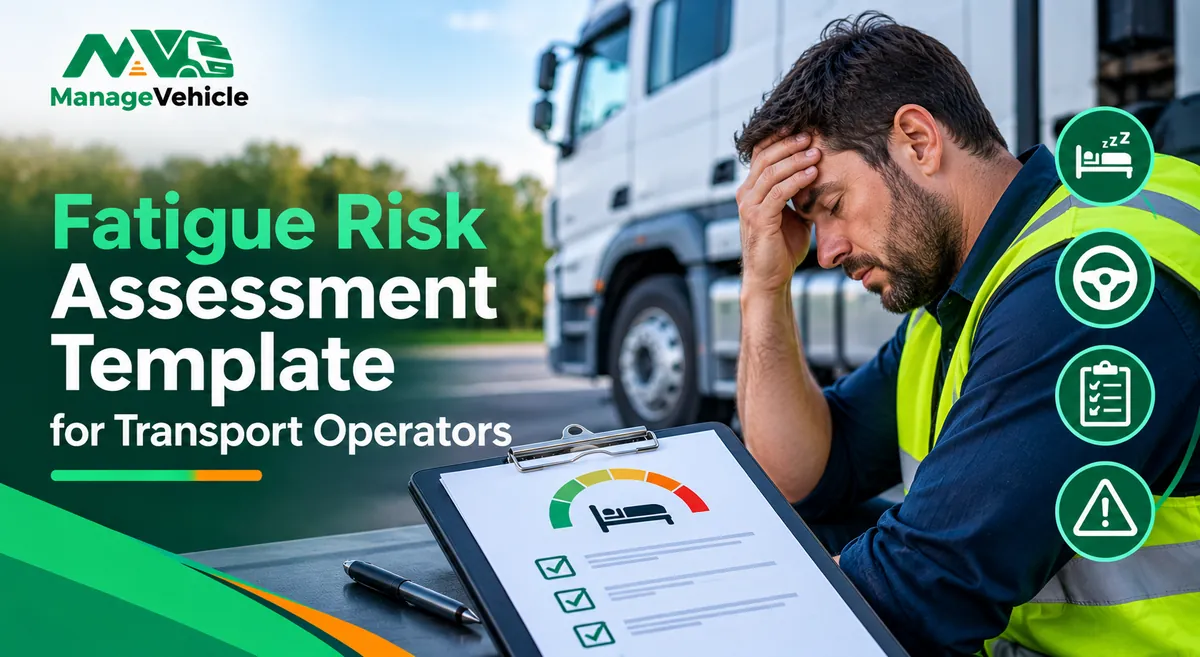
A fatigue risk assessment template gives you a simple, repeatable way to find what’s making your drivers tired, decide how serious it is, and write down what you’re doing about it. If you run heavy vehicles in Australia, that written record matters. Staying inside the work and rest hours isn’t enough on its own to show you’re managing fatigue properly.
This guide explains what a fatigue risk assessment should cover, walks through the four steps, and gives you a template you can copy into a spreadsheet today, plus a filled-in example to show how it works in practice.
Why operators need a fatigue risk assessment
Under section 26C of the Heavy Vehicle National Law, every party in the chain of responsibility has a primary duty to ensure, so far as is reasonably practicable, the safety of its transport activities. Fatigue is one of the biggest risks that duty covers.
The NHVR is clear that ticking the hours box isn’t the whole job. Its fitness to drive guidance on fatigue says any assessment of a driver’s fitness should consider outside factors that affect fatigue risk, not just compliance with regulated work and rest hours. A driver can be perfectly legal on paper and still be dangerously tired.
Filling in a fatigue risk assessment template is how you show you’ve thought about those factors. It matters for three reasons:
- It’s evidence. If something goes wrong, a dated, filled-in assessment shows what you knew and what you did about it. That’s what investigators look for when they test whether you did what was reasonably practicable.
- Executives are on the hook too. Directors and managers have a personal due diligence duty to make sure the business meets its primary duty.
- Accreditation expects it. Under the new Heavy Vehicle Accreditation scheme, operators need a safety management system that identifies, assesses and controls risks. A fatigue risk register is a core part of that.
Safe Work Australia’s model Code of Practice: Managing the risk of fatigue at work, published in late 2025, applies the same thinking to all workplaces, including your depot, warehouse and office staff.
The four steps of a fatigue risk assessment
The NHVR describes the same four-step process for every chain of responsibility risk, and a fatigue risk assessment template simply gives each step a column:
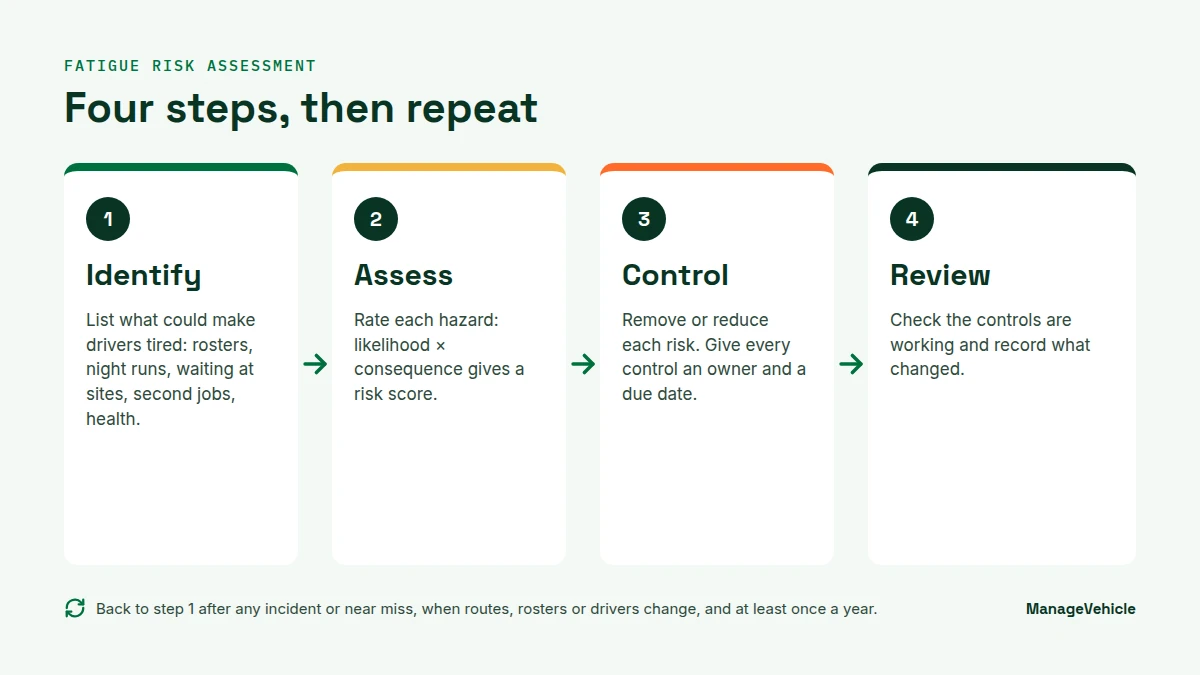
- Identify the hazards. What in your operation could make a driver tired? Think beyond the driving: rosters, waiting times at sites, second jobs, health and sleep.
- Assess the risk. For each hazard, how likely is it to lead to a fatigued driver, and how bad would the result be? That gives you a risk rating.
- Control the risk. Decide what you’ll do to remove or reduce it, who’s responsible, and by when.
- Review it. Check the controls are working, either on a set schedule or after any incident or near miss.
The review step is the one most operators skip. An assessment written once and filed away won’t count for much if your routes, rosters or drivers have changed since.
Fatigue hazards to look for
Start your list with the hazards the NHVR itself names. Group them so nothing gets missed:
| Area | Hazards to check |
|---|---|
| Scheduling and rostering | Long work hours, inconsistent rosters, night work, tight delivery windows, early starts after late finishes |
| The trip itself | Driving between midnight and 6am, repetitive routes, long high-speed stretches with little driver input, few safe rest stops |
| Non-driving work | Loading and unloading, waiting at sites, paperwork. It all adds to fatigue |
| Health | Sleep disorders like sleep apnoea, illnesses such as diabetes, medications that cause drowsiness |
| Life outside work | Second jobs (especially daytime work before a night shift), family demands, poor diet, too much caffeine, alcohol and drugs |
| Rest conditions | Cramped or noisy sleeper cabs, poor climate control, no out-of-vehicle accommodation on long trips |
| Workplace culture | A “push through” attitude, or drivers worried about consequences if they stop to rest |
The last one is easy to overlook, but it matters. If drivers think they’ll be judged for pulling over, every other control you put in place is weaker.
Talk to your drivers when you build this list. They know which runs, sites and customers cause the most fatigue, and involving them makes it far more likely they’ll speak up later.
The fatigue risk assessment template
| Column | What to write |
| Hazard | What could cause fatigue, in plain words (“overnight Melbourne to Sydney run”) |
| Who’s at risk | Which drivers, routes or shifts |
| Existing controls | What you already do about it |
| Likelihood (1 to 5) | How likely it is to lead to a fatigued driver, with current controls |
| Consequence (1 to 5) | How bad the worst realistic outcome would be |
| Risk score | Likelihood × consequence |
| Extra controls needed | What else you’ll do to bring the score down |
| Owner | The person responsible for each extra control |
| Due date | When the control will be in place |
| Score after controls | The new rating once the controls are working |
| Review date | When you’ll check it again |
Scoring the risk. Use a 5 × 5 matrix. Multiply likelihood by consequence:
| Likelihood ↓ / Consequence → | 1 Minor |
| 5 Almost certain | 5 Medium |
| 4 Likely | 4 Low |
| 3 Possible | 3 Low |
| 2 Unlikely | 2 Low |
| 1 Rare | 1 Low |
| Likelihood ↓ / Consequence → | 1 Minor |
| 5 Almost certain | 5 Medium |
| 4 Likely | 4 Low |
| 3 Possible | 3 Low |
| 2 Unlikely | 2 Low |
| 1 Rare | 1 Low |
Then act on the rating:
| Rating | Score | What to do |
| Extreme | 20 to 25 | Stop the activity until controls are in place |
| High | 10 to 16 | Add controls urgently, with senior sign-off |
| Medium | 5 to 9 | Add controls within a set timeframe |
| Low | 1 to 4 | Manage with existing procedures and monitor |
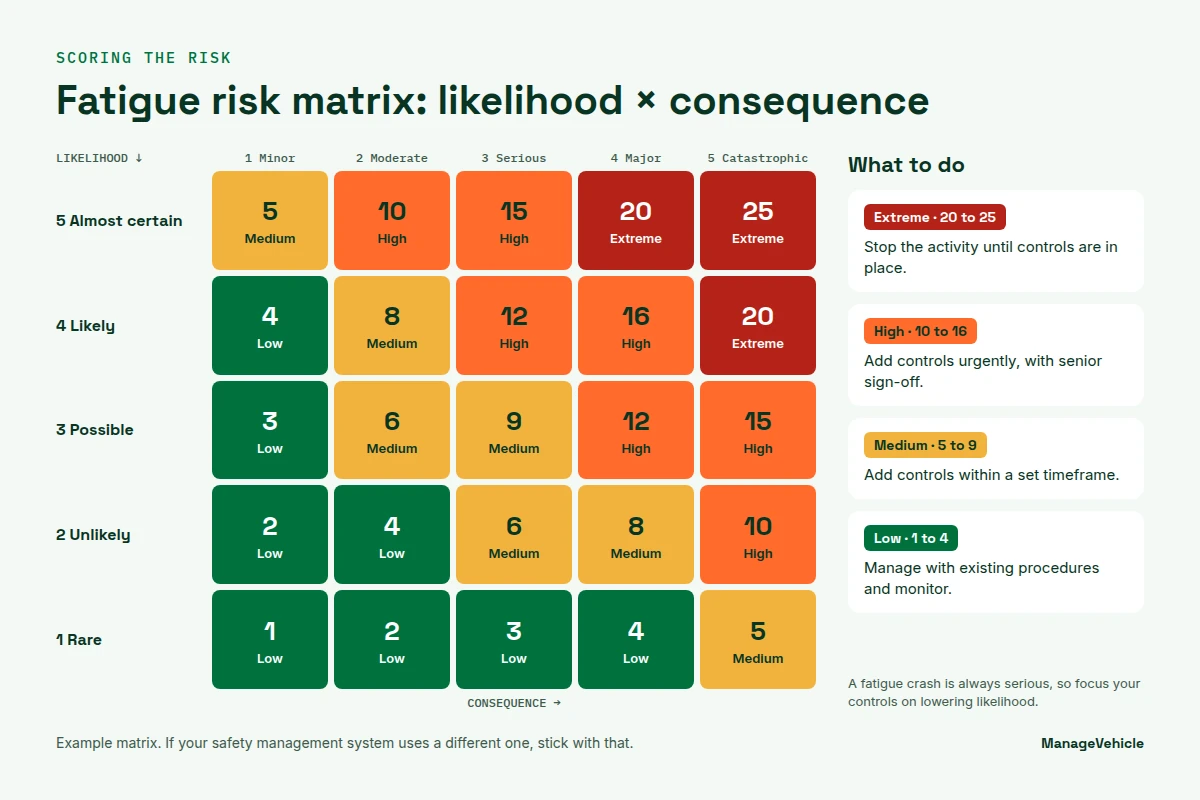
This is a common example. If your safety management system already uses a different matrix, use that one so your records stay consistent. For heavy vehicle fatigue, a crash is always a realistic worst case, so most fatigue hazards will score 4 or 5 on consequence. That’s why likelihood is where your controls do most of the work.
Worked example: a filled-in fatigue risk assessment template
Here’s how a mid-sized operator running interstate linehaul and local deliveries might fill it in. Scores are likelihood × consequence.
| Hazard | Score before | Extra controls | Owner | Score after |
| Overnight Melbourne to Sydney linehaul on rotating rosters | 4 × 5 = 20 Extreme | Fixed night rosters instead of rotating; planned rest stop at a named heavy vehicle rest area; welfare call around 2am; fatigue detection cameras in linehaul units | Operations manager | 2 × 5 = 10 High |
| Drivers waiting 2 to 4 hours at a distribution centre, cutting into rest | 3 × 4 = 12 High | Booked unloading slots agreed with the customer; waiting time counted as work when scheduling; clause added to the customer contract | Customer account manager | 2 × 4 = 8 Medium |
| Drivers working a second job during the day before night shifts | 3 × 5 = 15 High | Disclosure clause in employment contracts; regular fatigue conversations at toolbox talks; rosters adjusted for disclosed second jobs | HR and depot supervisor | 2 × 5 = 10 High |
| Possible undiagnosed sleep disorders | 2 × 5 = 10 High | Fatigue-focused medical checks when hiring; drivers encouraged to self-report sleep problems without penalty | HR | 1 × 5 = 5 Medium |
| Early starts after late finishes in the local delivery roster | 3 × 4 = 12 High | Roster rule of at least 12 hours between shifts; scheduler checks the roster against drivers’ hours before publishing | Scheduler | 2 × 4 = 8 Medium |
A few things to notice:
- Consequence barely moves. A fatigue-related crash in a heavy vehicle is always serious, so the controls work by making fatigue less likely, not less harmful.
- Some risks stay High after controls. That’s honest, and it’s fine. It tells you those rows need closer monitoring and more frequent review.
- Every control has an owner. A control nobody is responsible for usually doesn’t happen.
- Customers are part of it. Waiting times at sites are a chain of responsibility issue, and the fix often sits in the contract, not just in your depot.
Choosing controls that actually work
Not all controls are equal. Work through the hierarchy of controls from the top, and only drop down a level when the one above isn’t practical:
| Level | What it means for fatigue | Examples |
| Eliminate | Remove the hazard completely | Move a run out of the midnight to 6am window; stop scheduling back-to-back late and early shifts |
| Substitute | Swap it for something less risky | Two-up or relay driving on long routes; out-of-vehicle accommodation instead of sleeping in the cab |
| Engineer | Use equipment or technology | Fatigue detection cameras; better sleeper cabs with climate control and a decent mattress; an electronic work diary that flags hours before a breach |
| Administer | Rules, training and checks | Fatigue policy; journey planning with set rest stops; welfare calls on night runs; driver training; medical checks |
Most operators lean on the bottom row because it’s the easiest to write down. Policies and training do matter, but they rely on people getting it right every time. Rostering and route changes higher up the list usually do more. Running nights? Our guide to night driving fatigue rules covers the extra limits that apply.
One control costs nothing and works at every level: make it genuinely safe for drivers to say they’re tired. The NHVR suggests options like letting drivers call in fatigued rather than sick, and encouraging them to report fatigue events and near misses.
Reviewing your assessment and keeping records
Your fatigue risk assessment template is a living document. Review it:
- After any fatigue-related incident or near miss. This is the NHVR’s own trigger, and it’s the one investigators will check.
- When something changes. New routes, new customers, a roster change, new drivers, or a move to a different hours option.
- When your data shows a pattern. Repeated fatigue camera alerts on one route, or drivers regularly running close to their hours limits, are signs a control isn’t working.
- On a set schedule. At least once a year is a sensible minimum, even if nothing obvious has changed.
Keep every version with its date rather than overwriting the old one. Being able to show how your controls improved over time is strong evidence that you’re taking the primary duty seriously.
Risk assessment or fatigue management plan? They work together. The risk assessment is your register of specific fatigue risks and controls. The plan is the bigger document that sets out your policy, responsibilities and procedures. If you don’t have a plan yet, start with our fatigue management plan template and attach this assessment to it.
Where software helps
A spreadsheet is a fine place to start your fatigue risk assessment template. The hard part is the review step: knowing when a risk is creeping back up before something happens.
That’s where live data helps. Manage Vehicle’s fatigue management software brings drivers’ work and rest records, EWD data and alerts into one place, so you can spot patterns, like one route that keeps pushing drivers close to their work and rest hours, and feed them back into your assessment. It also keeps the records an auditor or investigator would ask for.
FAQs
Is a fatigue risk assessment a legal requirement?
The HVNL doesn’t prescribe a specific form, but every chain of responsibility party must manage fatigue risk so far as is reasonably practicable. A written assessment is the clearest way to show you’ve done that. Accredited operators also need to identify and control risks as part of their safety management system.
Who should do the assessment?
Someone who knows the operation well, usually an operations or compliance manager, working with drivers and schedulers. Executives should review and sign it off, since they have a personal due diligence duty.
Does the assessment cover drivers working under Standard Hours?
Yes. Staying within the hours doesn’t remove your duty to manage fatigue. The assessment applies whichever hours option your drivers use.
How often should I update my fatigue risk assessment template?
After any fatigue-related incident or near miss, whenever routes, rosters or drivers change, and on a set schedule. Once a year is a sensible minimum.
What’s the difference between this and a fatigue management plan?
The risk assessment lists specific fatigue risks and the controls for each. The fatigue management plan is the wider document covering policy, roles and procedures. Most operators attach the assessment to the plan.
Does it cover depot and office staff?
Work health and safety law covers fatigue for all workers, and Safe Work Australia’s model Code of Practice gives guidance for them. You can use the same template for warehouse, yard and office roles.